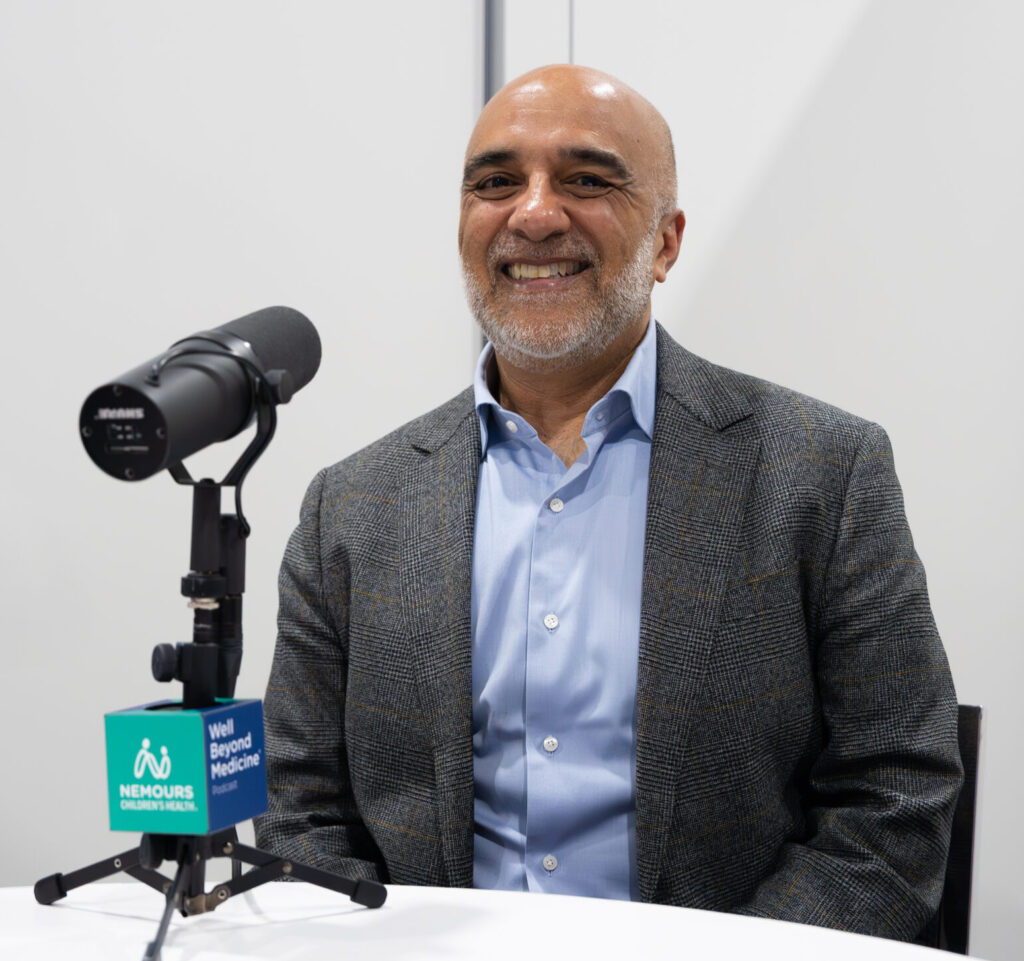
AI in health care isn’t a distant future — it’s happening right now. Micky Tripathi, PhD, MPP, Chief Artificial Intelligence Implementation Officer, Mayo Clinic, joined us at HLTH 2025 to share what this transformation looks like on the ground: dozens of AI tools already in daily use, breakthrough models detecting disease earlier than ever, and emerging foundations for precision medicine and digital twins. He also explains the challenges ahead — data quality, workflow integration and privacy gaps — alongside the extraordinary opportunities AI offers to improve patient care, research and education.
Featuring:
Micky Tripathi, PhD, MPP, Chief Artificial Intelligence Implementation Officer, Mayo Clinic
Host/Producer: Carol Vassar
TRANSCRIPT
Announcer:
Welcome to Well Beyond Medicine, the world’s top-ranked children’s health podcast, produced by Nemours Children’s Health. Subscribe on any platform at nemourswellbeyond.org or find us on YouTube.
Carol Vassar, podcast host/producer:
Each week, we’ll be joined by innovators and experts from around the world, exploring anything and everything related to the 85% of child health impact that occur outside the doctor’s office. I’m your host, and now that you’re here, let’s go.
MUSIC:
Let’s go, oh, oh. Well Beyond Medicine.
Carol Vassar, podcast host/producer:
We are at Health in Las Vegas, and I’m very pleased to welcome back to the podcast one of our most popular guests, Micky Tripathi, who is now the Chief Artificial Intelligence Implementation Officer at Mayo Clinic. Welcome back to the podcast, sir.
Micky Tripathi, PhD, MPP, Mayo Clinic:
Thanks. Really delighted to be here.
Carol Vassar, podcast host/producer:
We talked last year at Health. You were in a completely different position, and now you’re at Mayo Clinic. You’ve joined at a very pivotal time when it comes to healthcare innovation. What drew you to this role at Mayo Clinic, and what’s the larger vision for Mayo Clinic across the entirety of its enterprise for raising the game and really leading the way when it comes to technology, specifically in an AI world?
Micky Tripathi, PhD, MPP, Mayo Clinic:
Wow. Yeah. Big questions right off the top.
Carol Vassar, podcast host/producer:
I go for it.
Micky Tripathi, PhD, MPP, Mayo Clinic:
So I think the first part is having spent four years in the federal government as the assistant secretary for technology policy and chief AI officer, you’re kind of at the 100,000-foot level, trying to do everything you can to influence an ecosystem. And then even before that, I’ve been in health IT for a number of years and was always about the technology and trying to get people to adopt the technology. But for me, the appeal of being able to say, “All right, I’ve done a lot of that now.” Coming out of that experience with the federal government, I really want to now at this point in my career, be really involved in seeing these technologies get implemented in the front lines. And there’s no other organization that is so focused on the patient experience and the patient being first than Mayo Clinic.
I mean, and I had a little experience with Mayo Clinic about four years ago, helping with when they were launching the Mayo Clinic platform. So I got a little bit of taste for that. So as I was thinking about what I wanted to do next and really my focus being, I really want to be in AI because that’s sort of the next point on the trajectory that I’ve been on for a while, and the opportunity to be able to work in an organization that has the vision, the innovative sort of engine and the resources to really put these things as quickly as we can into the hands of the front-facing healthcare professionals to really see a difference in patient outcomes. It was almost natural for me to really want to be at Mayo Clinic.
Carol Vassar, podcast host/producer:
And you’ve been there less than a year. What have you-
Micky Tripathi, PhD, MPP, Mayo Clinic:
Oh yeah. Well, less than a year. May 12th I started.
Carol Vassar, podcast host/producer:
Oh my goodness, not very long at all.
Micky Tripathi, PhD, MPP, Mayo Clinic:
Yeah, I think it’s about five years when I think about it. No, it’s been a fantastic experience.
Carol Vassar, podcast host/producer:
It feels like five years since from May to now, but in a good way. What have you seen at Mayo that you like? How have the positions really been receiving what you’re putting out there in terms of technology?
Micky Tripathi, PhD, MPP, Mayo Clinic:
Yeah. So one of the things about the first part of your question, what am I seeing that I’m liked? I will say that I’ve been surprised, actually, when coming in at how much innovation is going on. And I think it’s true in the private sector at large, and maybe that speaks to the public sector, how shielded you are from what is really happening in the private sector because of the way we construct these barriers for… You don’t want to get overly influenced by vendors and all of that.
Carol Vassar, podcast host/producer:
Correct. Yeah.
Micky Tripathi, PhD, MPP, Mayo Clinic:
Some of that’s got a real firm basis, but also these technologies are moving so fast. And so I was surprised in coming to Mayo. I mean, I knew they were doing a ton, and obviously, in the conversations I’d had to come to Mayo, I learned more of that. But getting there and getting here where I am, I didn’t appreciate, for example, we have 97 AI solutions that are now in production, like being used on a day-to-day basis. Most of them are predictive AI, but a few of them are generative AI solutions. And all of them have human oversight, meaning human in the loop. So a lot of protections around them, but 97 in the practice that are being used, 270 plus that are in the pipeline for implementation along the way. And those are just the internally developed ones. So, ones that are Mayo innovators are developing ourselves. That doesn’t even even count everything that’s coming in through the Epic pipeline, where Epic is growing their AI applications.
And we’ve been, I think, one of the lead adopters of solutions coming out of Epic. And then we’re using Abridge and Ambience and all of these other third-party solutions. And we have the Mayo Clinic platform, which is bringing more in. So I didn’t appreciate how many of these solutions were coming through, and also how deep they were. So we also are building our own multimodal foundation models, for example, just within Mayo. This is not relying on… I mean, we have partners obviously, but we’re developing, we have a multimodal model for encoding of genetic information to start to predict disease, for example, using genetic information. We have another foundation model that we’ve developed and are starting to commercialize for digital pathology.
So we’ve taken like 16 million slides, glass slides, digitized them, now turned that into a foundation model to be able to use that kind of, sort of the slides, the pathology slides to be able to get an earlier prediction of when someone might have cancer, for example. Because you take the technology… One of the benefits of Mayo having a longitudinal patient record is that we’re able to look at those slides and look at patients who’ve got cancer, and then you’re able to go back and say, “Well, let me look at their pathology slides from before they had cancer.” We hadn’t diagnosed them with cancer. And now let’s digitize all of that and start looking at the progression and then throw the AI at it and say, “Is the AI able to detect early signs of cancer that the human eye wasn’t able to see?” And we’re starting to say, yes, actually. In certain cases, we are.
So that’s the second category. And then we have a third set of foundation models that we’re now starting to roll out in the radiology department that starts to look at radiology images and starts to see things that weren’t obvious, like early signs of pancreatic cancer, for example, as well as helping a radiologist with reviewing a chest x-ray, for example. You might think it’s a very simple thing, but the early indications from this model are that it can save a radiologist something like 30 to 45 seconds per x-ray. And even at that, you might think, well, 30 to 45 seconds, what’s that? We have radiologists who come in the morning; they have 125 chest X-rays to go through. So you save them 30 to 45 seconds on each one, you’ve eliminated a lot of cognitive load. Just imagine if you had a little bit more time to do something like that, and it gives just more time overall. So anyway, a lot more is happening than I anticipated.
Carol Vassar, podcast host/producer:
Lots of big ideas that are happening. Mayo seems to be leading the way. How are you working with… Are you? Some of this might be proprietary to Mayo, but are you working with other healthcare systems as they implement similar models?
Micky Tripathi, PhD, MPP, Mayo Clinic:
Yeah. I mean, we do sort of in a collaborative manner, I think there are a couple of places. So we’re a part of a lot of different coalitions like the Coalition for Health AI, Health AI Partnership, a number of those that are thinking with other provider organizations, as well as with technology vendors. How do we think about just ways of standardizing approaches for validating these kinds of models, for example? Because each of us has to figure this out. So are there common rules that we can just sort of… Well, not common rules, but let’s say common frameworks that we can adopt that allow us to at least not each of us have to solve that problem on our own, for example. So that’s kind of one area I think we’re sharing. And then just as a part of the course of clinical collaborations all over the place, we sort of are always sharing information in that way. We also have the Mayo Clinic platform, which is, John Halamka runs it.
It was created four years ago, specifically with an eye toward sharing a platform capability with vendors and other provider organizations to create essentially a multi-sided market kind of platform, I’ll put market in quotes, multi-sided platform. So we have provider organizations like Mercy Health, like a number of Israeli hospitals, for example, some hospitals from Singapore, Brazil, and then Mayo data is in this platform of de-identified data, highly protected, so it’s data behind the glass, like they’re not able to take it away, but then we can all collaborate using that shared data repository to build models and to validate models and do a variety of things and also bring in startup vendors who can use that shared data to develop solutions and then make it available to everyone there. So the Mayo Clinic platform is specifically designed to help with collaboration with other provider organizations.
Carol Vassar, podcast host/producer:
So places like Mercy are actually working in the platform with that data, and that data is protected.
Micky Tripathi, PhD, MPP, Mayo Clinic:
Yes. Absolutely, yes. I mean, so they have shared their data, and then it gets combined with Mayo data with others, again, de-identified, highly protected, but then it gives everyone to benefit from the diversity of the patient populations that we have, right? I mean, Mayo is a fantastic place, but we’ve got unique aspects to our patient population and we’d like to be able to have much more diversity from a race, ethnicity, language perspective, for example, from a acuity of care perspective, from the whole care spectrum. And that gives us the opportunity to be able to do that. And it offers the opportunity for the Mercys of the world to be able to benefit from that diversity of patient experience as well.
Carol Vassar, podcast host/producer:
If I’m remembering my Mayo history correctly, some of the pillars of Mayo Clinic are patients first, safety first.
Micky Tripathi, PhD, MPP, Mayo Clinic:
Patient always comes first is the-
Carol Vassar, podcast host/producer:
Most-
Micky Tripathi, PhD, MPP, Mayo Clinic:
… first principle.
Carol Vassar, podcast host/producer:
Is the first principle.
Micky Tripathi, PhD, MPP, Mayo Clinic:
There’s a bunch of principles that follows from that, but that is-
Carol Vassar, podcast host/producer:
Almost co-equal is safety, though, isn’t it?
Micky Tripathi, PhD, MPP, Mayo Clinic:
Oh yeah, absolutely. I mean, you can’t think about the patient coming first without thinking about safety, right?
Carol Vassar, podcast host/producer:
Exactly. Scientific rigor. Talk about your AI governance process. How do you make sure that what you’re creating, the many products that either you’ve implemented or are in the pipeline, are as good as they can be without being biased, without privacy concerns, that kind of thing?
Micky Tripathi, PhD, MPP, Mayo Clinic:
Sure. Yeah. Yeah. So I’ll note that my job title is Chief AI Implementation Officer, and it’s got that implementation in there for a reason, because my whole focus is on that governance, I’ll put it in quotes. It’s really about the implementation side. I mean, we don’t think of it as governance per se. We think about it as how do you accelerate the opportunity for patients to benefit from these really critical technologies? So my role, as I was describing, we have 270 plus internally developed solutions that are growing, and that huge uptick in those has been over the last year or two. And what we’ve found is that our processes, our implementation processes, haven’t kept pace with that growth, that huge surge. And that surge is at a couple of components. One is just the sheer volume of them, that there’s like more of them now, all of a sudden coming through our IRB, coming through our risk, coming through our privacy folks, coming through our technology assurance folks.
All those, every organization has them, but all those different bodies are now getting this huge deluge of these more and more solutions that are also more complex because they’ve got just these different characteristics that are unique to AI that don’t naturally fit in one or the other. So you have different bodies saying, “Well, is that a privacy issue?” No, I think it’s a security issue. And then it’s like, oh, well, now it fell in the middle. Is that IRB or not IRB? It doesn’t look like IRB, but it feels like IRB. And so then they get caught because people are trying to figure them out. So it slows down the implementation. And then the last point, though, is that with these solutions, we have real-time urgency on these.
Previously, solutions came up at a slower pace, so you weren’t so critically concerned about, all right, how do I get these out the gate, get them into the hands of providers, because they weren’t improvements, but incremental improvements. And the cadence of those just was like, it was a steady stream, almost a steady trickle in some ways. But with these solutions, they’re coming so fast, and we think some of them are so powerful for patients that we ourselves feel tremendous urgency to get them out. So that’s the other thin,g is that we’re pressing on these bodies to say, “Yes, I know you have more of them. You need to work faster. These need to get out,” but you also need to keep in mind patient safety, all of that.
So what am I doing? I’m streamlining all of those processes to say, how do we have an explicit AI focus as it relates to these? How do we integrate all of those things all with an eye towards saying we need to be thinking about not only misuse, because misuse is really important, just things you had mentioned, right? Which is bias and privacy issues and security issues, and a whole range of hallucinations, all of that.
But I would argue that we also need to be thinking about misuse, which is to say, what’s the opportunity cost of a certain solution not getting into the hands of that frontline provider so that they can actually benefit the patient? For example, we have one solution that is looking at genetic information and seeing if there are things that we can do to help a patient’s therapeutic journey. So one of the things we’re looking at, and there’s just early indications of this, so I don’t want to oversell it, but we’re starting to look at it, is that for rheumatoid arthritis, kind of the gold standard treatment right now is a drug called methotrexate, which is an immunological drug that it’s actually the gold standard treatment.
So it’s given to almost every rheumatoid arthritis patient, but it turns out that 30 to 50% of patients with rheumatoid arthritis don’t actually respond to methotrexate. But the problem is we don’t know which 30 to 50%, and it works really well on those who respond, but it also takes a long time. It takes a little bit of time for it to show that it’s not working, and the side effects can actually be bad. And so what’s happened is, we have patients who we’ve looked at that it’s like, wow, when they were first diagnosed, now here it is seven, eight years, and now it’s clear that they’re not responding to that and we’d like to solicit them to another treatment, but meanwhile, the disease has progressed in ways that are irreversible.
But if you had this tool, and then we have early indications that using certain genetic information, we might be able to predict at a much higher rate. Right now, we have zero information on it, but if we can predict at some meaningful rate which patients actually might be predisposed to respond to methotrexate, imagine the quality of life improvement for those patients who it’s like, “Oh, it looks like you’re not going to respond well. Let’s get you on a different therapy before this disease progresses with these irreversible things.”
And that’s one of the questions that I think that we as an industry have to start asking is, well, in that situation, how good is good enough? If you asked any of those patients and said, “This solution’s only 50% good or something.” I mean, I know myself, I would probably say, “Use it,” because right now, it’s 0%. You have nothing. You’re like coin flipping because you have no idea. I would much rather have a little bit of information and have you, the doctor who I trust, inform with that than have no information. So I’m not saying that that’s what we’re doing with it, but it just starts to raise those questions about how do we think about the opportunity costs and have that factor into the question of what’s the right thing to do here in these situations?
Carol Vassar, podcast host/producer:
I’m hearing echoes of personalized medicine in what you’re saying.
Micky Tripathi, PhD, MPP, Mayo Clinic:
Absolutely.
Carol Vassar, podcast host/producer:
Talk about that.
Micky Tripathi, PhD, MPP, Mayo Clinic:
This, to me, is the precision in precision medicine, right? So if you can sort of say, “I’m able to look at your genetic profile and I’m able to combine that with other types of information, your blood sample, your imaging, your medical record, all of that. I’m able to start building,” and you can start sort of, and this seems like rocket science, but you start to say, “Well, I can start to build the connections between that combination of information, which is specific to you and increasingly would love to be able to bring in environmental factors as well.” And then say, “How does that help me with the prediction of disease?” And then you can start to say, “Well, how does that actually translate into organ systems interacting with each other?”
Because if I know there’s a genetic connection with the way a particular organ behaves, then I’m able to say, “Well, how does that then start to translate into organs working with each other? How does that then help me build a digital twin of you?” And then I’m able to say, “Well, now you’ve got this complex condition. How about if we start to use this digital twin to test different disease progression scenarios and different treatment scenarios?” And then your provider’s able to come to you and say, “Look, here is a complete list of here are the different scenarios. You have a 50% chance of being on that course, and if we use this drug, we have a 90% chance of being able to attack it, but it’s got these side effects versus a 10%.” And you can imagine that you’re able to start doing that in a way that is unique to you.
It’s going to be different for him, it’s going to be different for her, it’s going to be different for her. That’s finally being able to bring medicine to evidence. So we’ve had a lot of conversations over decades about evidence-based medicine. This allows us to have medicine-based evidence, which we haven’t had, and it brings the precision into precision medicine in a way that we always had this gauzy idea of, but now you can sort of say, “No, that’s real.” You can start to see how that could actually happen. Now, again, I’m not pretending we have that today, but it’s on the horizon now. You’re able to say, “No, I have the stepping stones to that.”
Carol Vassar, podcast host/producer:
That’s amazing stuff. And I look at somebody like my granddaughter, who’s two and a half, she lives in-
Micky Tripathi, PhD, MPP, Mayo Clinic:
I have a two-year-old.
Carol Vassar, podcast host/producer:
Oh. She lives in the world and your grandchild lives in the world of always was on the electronic health record, always. So everything that’s ever been examined, it’s in her health record. And moving forward, do you see this as the potential, at least, for a better, healthier world for the children who are being born in the US today or in the world today?
Micky Tripathi, PhD, MPP, Mayo Clinic:
I do. I think it’s not even just the children, though. I’m going to say, I’ll bet you don’t have a paper record.
Carol Vassar, podcast host/producer:
Not now, but there was a time.
Micky Tripathi, PhD, MPP, Mayo Clini:
There was a time, right? But I bet all of your information is an electronic health record now as well.
Carol Vassar, podcast host/producer:
Most of it, yeah.
Micky Tripathi, PhD, MPP, Mayo Clinic:
And so the opportunity to be able to sort of get that information for you as well as for a child, I think, is almost equal in a way because they can now do that. Now, to your point, I think having that earlier on, like you could imagine, for our two-and-a-half-year-olds, I have a five-year-old granddaughter, a grandchild also, and then a four-month-old.
Carol Vassar, podcast host/producer:
Oh my goodness.
Micky Tripathi, PhD, MPP, Mayo Clinic:
But each of them, like 10 years from now, will they have a digital twin?
Carol Vassar, podcast host/producer:
Yeah, they might.
Micky Tripathi, PhD, MPP, Mayo Clinic:
Right? I mean, I don’t know. It’s certainly within the realm of possibility. And then we’re able to say we’ve got a digital twin that actually is growing with them and you’re able to sort of think about disease, think about environmental assaults, all sorts of things that you’re able to now be able to project and model and be really much more accurate and precise in both your predictions of different conditions and the potential therapies that might be available. As well as what we’d like to be able to get to, I think is more prevention. How are you able to say, “Well, no, your digital twin says that you have certain predispositions to this, that, or the other thing. How do we help you prevent some of those things? Let’s keep you out of the care system.” As much as Mayo loves you, we would actually like you not to be here if we can help it.
Carol Vassar, podcast host/producer:
Right. And that’s what pediatrics is all about, is all about prevention. I want to kind of talk about the flip side. Are there any friction points in any of the AI developments that you’re making, either being implemented by the physicians or in the development process? Are there any barriers, friction points? Talk about that.
Micky Tripathi, PhD, MPP, Mayo Clinic:
Sure. Yeah. I mean, there are a ton of them. So one is related to just what I was describing. How do you appropriately vet these so that you are sure that they’ve got the safety, they’ve got the issues related to bias, they’ve got the performance, they’ve got all of those? And that’s a challenge. We’re doing everything we can to streamline all of that and to make it much more focused, but figuring that out is one set of challenges. The second I would point to is related to how do you get these things integrated into the workflow? Because you have so many, I mean, represented out here, you have 10 gazillion independent vendors, right? Each of them with a point solution. And at the end of the day, you need to be able to have these integrated into the day-to-day workflow.
Go back to that radiologist who I was talking about, the 125 chest x-rays a day. If he or she doesn’t have the solution as just a part of the workflow that they’re doing, there’s no way that they’re going to use it. They need to be able to have those. And that ends up being hard. If you’re on Epic or you’re on Oracle, now you’ve got this other outside system, you have to think about how to integrate that. You have these deep conversations about that. Another issue and barrier is related to just like the data that you need to be able to support all of this. So different AI solutions or the beauty of them is that they can take different types of data, make sense of that, and then be able to generate new insights and inferences of that.
You can build the engine to do that, and the vendor can show you all sorts of great fancy UIs and everything, but then you get into your clinical practice, it’s like, oh, our data is all like siloed and all these different systems, and it’s not clean. It was never made to be aggregated that way. And oh, we have all these dupes in our patient records, and all of a sudden, you have to clean up all of that before you’re able to mobilize those. So that can be sort of another challenge in how we think about that. So there’s a variety of things like that that aren’t obvious, I think, until you really dive into it, but those are real issues that we have to address.
Carol Vassar, podcast host/producer:
When we sit down together next year or in five years, how do you see the AI landscape? Is it even possible to predict?
Micky Tripathi, PhD, MPP, Mayo Clinic:
I think it’s pretty hard to predict, but a couple of things. I mean, one is I think that we’ll… I assume, and if I just sort of take Mayo as an example, well, first off, let’s just recognize that it’s certainly going to be that what’s true for every technology, which is, was it, the William Gibson observation? Or I forgot who it was, that the future is here, it’s just not widely distributed. So you’re always going to have these pockets, Cleveland Clinic, and Mayo, and Kaiser that’ll be pushing the envelope. But I think that we’re going to start to see more of a rising floor of these kinds of AI technologies used a little bit more routinely in radiology, in cardiology, in other places like colonoscopies, for example, where people might ask the question of, “How could I go get a colonoscopy?”
And the doctor actually was only relying on his or her own looking at whether that’s a polyp or not, and wasn’t relying on a model that looked at a million of those and was able to say, “Yes, that’s precancerous. No, that’s not precancerous.” I think that we’re going to start to turn the corner. I’m going to predict, in the next five years, there will be certain areas where patients will start to expect that these kinds of technologies will be used and that’ll start to drive more provider organizations to feel like, all right, this is now a part of standard of care.
And it’s not going to be uniform, but we think we might see it in certain areas like radiology, for example, like anything involving imaging, like dermatology, for example, like some other areas. And maybe we’ll start to see some tools that help patients self-manage a little bit more. I want to be a little bit cautious on that prediction because I think one of the challenges we have as a country is we don’t have privacy laws that exist out of HIPAA. And so as much as we’re trying to push and this administration’s trying to push, you face the harsh reality that, well, great, we can have all sorts of patient AI, but patients don’t have any protections of their data the minute it’s in their control. So when you download it onto your smartphone, most people would say they think it’s protected by HIPAA. It is absolutely not protected by HIPAA.
Carol Vassar, podcast host/producer:
I learned that from you last year.
Micky Tripathi, PhD, MPP, Mayo Clinic:
Yeah, yeah, right. And now you get an AI solution that is now taking that data and putting it, you don’t know where-
Carol Vassar, podcast host/producer:
Who knows where?
Micky Tripathi, PhD, MPP, Mayo Clinic:
… and doing what with it, and you don’t know whether you can trust the AI, and you don’t know what’s happened to your data. And that’s the world that we live in right now in the US. So I think that we need to get a handle on that privacy side in order for that whole side to move faster.
Carol Vassar, podcast host/producer:
Some regulatory work to be done.
Micky Tripathi, PhD, MPP, Mayo Clinic:
Regulatory work. Yeah. There’s a variety of ways to think about how you might do it, but I think at its core, yeah, probably statutory work, which will be challenging, obviously, in this political environment.
Carol Vassar, podcast host/producer:
Last question. How is AI going to change the Mayo Clinic experience for patients?
Micky Tripathi, PhD, MPP, Mayo Clinic:
I mean, I think it’s not going to happen overnight, but I think it’s fundamentally going to change it in a few ways. I mean, I’ve talked about the different kinds of rocket science kind of technologies that we’re aggressively trying to bring to bear. Things like that, precision medicine, I think, will be a part of it. And that’s more about every experience that you have with a provider now having more capability. But I think as you start to think about how those get stitched together, we’re envisioning a much more seamless experience where you’re able to, with a patient, engage them pre-visit. And even breaking down the notion of pre-visit, right? We ought to be thinking about a patient on a continuous spectrum of, well, they’re in prevention mode, they’re in regular life mode, now they’ve come into sick care, now we help them through, now they go on, but we were able to continue sort of a relationship in that way.
Carol Vassar, podcast host/producer:
Get them on their way.
Micky Tripathi, PhD, MPP, Mayo Clinic:
But early on, being able to have them be able to bring tools to bear that they manage that gives more information upfront about what might be going on, a better ability to make sense of the information that we’re able to get, like record time, for example, because right now one of the things that we have and might be the most simple, but most powerful things that AI can do is that we have, the World Economic Forum, and who knows whether this number is right or wrong, but they estimate that something like 95% of healthcare data is unused beyond the original documentation because it’s siloed, it’s not standardized, it’s unstructured, my Massachusetts accent coming out, obstruction, unstructured. And so that data is just like sitting there. It has to be documented as a part of the medical record, but we’re not able to do anything with it.
With AI, you have the opportunity to say, “I can get signal from that noise, actually.” Everything I was talking about before, those pathology slides that to the pathologists look like a normal slide, the AI is looking at it and saying, “That is absolutely not a normal slide.”
Carol Vassar, podcast host/producer:
Oh my goodness.
Micky Tripathi, PhD, MPP, Mayo Clinic:
That is a pre-cancer developing there, right? So we have more ability to get signal out of that noise. So now we can get more records, make more sense of it, and then continue the patient on a journey that might be more and more informed by AI along the way, and more agentic, meaning more automated along the way. So you’re able to determine a pathway, and then all of a sudden, the orders get implemented automatically. Information’s available to you automatically. We’re able to enroll you in a clinical trial automatically, for example, depending on your condition.
All of that being a seamless experience. Last thing I’ll mention, I know I’ve been talking a lot, is we’re also thinking about the all-encompassing nature of this. So in Florida, we’ve actually launched a whole floor of the hospital there, which is implementing an entire hospital room that’s outfitted with ambient video and audio to be able to say, the thing that we like to say is increasingly the room is a care team partner now. So you’re able to, with patient permission, and obviously it has to do with patient permission, but you’re able to continuously monitor a patient to be able to both monitor them in all sorts of ways, in good ways. I know it’s always a scary sign.
Carol Vassar, podcast host/producer:
Yes, exactly. In good ways.
Micky Tripathi, PhD, MPP, Mayo Clinic:
But you don’t have all that constellation of equipment and everything, and the ability to monitor fall potential, for example. When they get up in the middle of the night, they may have a fall risk. They can sort of look at their gait and give an alarm so that someone can come in and assist them. And then finally, the idea of every patient making us smarter, this would be literally every patient making us smarter, because all of that data then helps to inform a better model, right? Our models of a patient gait and whether they look unstable when they’re walking gets better and better and better with more patient information as a part of that ambient surround.
Carol Vassar, podcast host/producer:
And I know that Nemours is doing something similar in the pediatric space, where we have that connected hospital room. These are exciting times. Mayo Clinic-
Micky Tripathi, PhD, MPP, Mayo Clinic:
They are.
Carol Vassar, podcast host/producer:
Nemours leading the way on this. I hope we can have you back soon to talk about what’s happening in a year or two or three. Micky Tripathi, always a font of information about AI technology in healthcare. Thank you so much for being on the Nemours Well Beyond Medicine podcast.
Micky Tripathi, PhD, MPP, Mayo Clinic:
Thanks. Really appreciate it.
MUSIC:
Well Beyond Medicine
Carol Vassar, podcast host/producer:
Micky Tripathi is the Chief Artificial Intelligence Implementation Officer at Mayo Clinic. We met up with him in Oct. 2025 at HLTH in Las Vegas. Thank you to Micky for stopping by our podcast booth and filling us in on what Mayo is doing in the AI realm. We had the chance to talk with more than a dozen renowned experts from across various healthcare sectors on how the work they are doing now impacts children’s health both in and out of the clinic setting, and you’ll get to hear all of them in the coming weeks and months right here on the Nemours Well Beyond Medicine Podcast.
Our production team this week includes Susan Masucci, Lauren Teta, Cheryl Munn, and Alex Wall. Video production by Sebastian Reilly and Britt Moore. Audio production by yours truly. On-site production assistance provided by Robbie Dorius and his team from HLTH. Thank you to them.
All of our episodes are available on your favorite podcast app and smart speaker, the Nemours YouTube Channel, and on our website: nemourswellbeyond.org. Visit there to leave a podcast episode idea, a review, or subscribe to the podcast and our monthly e-newsletter. That address again is nemourswellbeyond.org. I’m Carol Vassar. Thank you for listening. Join us next time as we present highlights from a fireside chat held at the Ginsburg Institute Symposium in Orlando – also in October 2025 – featuring Nemours Neurosurgeon Dr. Myron Rolle and United Youth CEO Dr. Wisdom Powell discussing Healing Through the Arts. Don’t miss it! Until then, remember, we can change children’s health for good, well beyond medicine.
MUSIC:
Let’s go, oh, oh. Well Beyond Medicine.