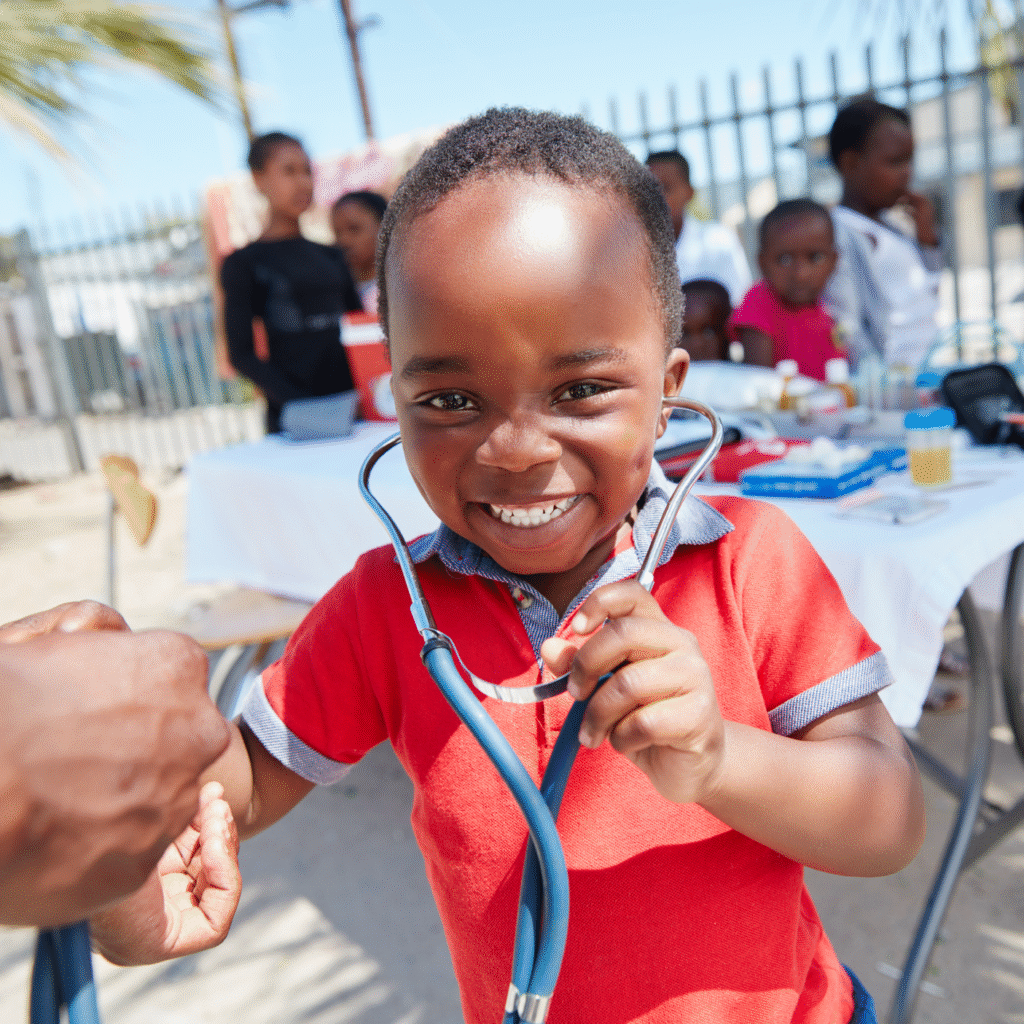
What happens when medical trainees step into a world where adolescent health challenges are amplified by resource constraints and discover that teens everywhere face strikingly similar struggles?
In part 2 of this series, the focus turns to mentorship, medicine and global partnership, examining the impact of the Nemours Ginsburg Institute Scholars’ work in Uganda through the eyes of clinicians and educators on the ground. The discussion centers on the realities of adolescent health in a resource-limited setting, the power of global research collaboration and the universal nature of young people’s experiences across continents.
Featuring:
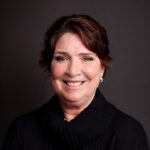
Sabrina Kitaka, MD, PhD, Pediatric Infectious Disease and Adolescent Medicine Specialist, Makerere University, College of Health Sciences
Lonna Gordon, MD, Chief of Adolescent Medicine, Nemours Children’s Health
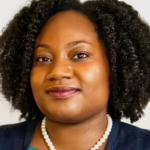
Viola Mrruku, former Ginsburg Scholar
Host/Producer: Carol Vassar
TRANSCRIPT:
Announcer (00:00):
Welcome to Well Beyond Medicine, the world’s top-ranked children’s health podcast, produced by Nemours Children’s Health. Subscribe on any platform at nemourswellbeyond.org or find us on YouTube.
Carol Vassar, podcast host/producer (00:12):
Each week, we’ll be joined by innovators and experts from around the world, exploring anything and everything related to the 85% of child health impacts that occur outside the doctor’s office. I’m your host, Carol Vassar. And now that you’re here, let’s go.
Music (00:30):
Let’s go. Well Beyond Medicine.
Carol Vassar, podcast host/producer (00:36):
Hey everyone. Welcome back. We’re talking about, this is part two of a series that we’re doing on our Nemours Ginsburg Institute Scholars who visited Uganda this past summer. Joining me at this time are Dr. Lonna Gordon, Chief of Adolescent Medicine for Nemours Children’s Health, Dr. Sabrina Kitaka, Pediatrics Infectious Diseases and specialist in adolescent health medicine at Makerere University College of Health Sciences in Uganda, and Viola Mrruko, a program assistant at the Ginsburg Institute for Health at Nemours. And one of the Ginsburg Scholars, another one of the Ginsburg scholars, went to Uganda on this trip. Welcome to everyone. I want to ask Dr. Kitaka. Your work has been really at the forefront of HIV and TB research in Uganda. How do partnerships like this one with Nemours help to advance some of the global conversations on pediatric and adolescent health?
Sabrina Kitaka, MD, Makerere University (01:43):
Thank you so much. I’m very, very excited to be on this podcast and see Viola and Lonna again after a while. I think that these partnerships help, one, first of all, to improve on the knowledge, but also to advance research. The interaction between the North and South creates a buddy system where researchers can collaborate, but also improve on the funding availability should research be developed.
Carol Vassar, podcast host/producer r (02:23):
Viola, you’re a Ginsburg scholar. You were a Ginsburg scholar. You spent a year doing that. You’re now working for the Ginsburg Institute. When you were a scholar, you worked with Dr. Gordon. Tell us about your experience as a scholar first, and then we’ll talk about your expectations, your experience going to Uganda.
Viola Mrruko, Ginsburg Institute Scholar (02:43):
Yeah. My experience as a scholar was amazing. Dr. Gordon was an awesome mentor. She was very open and willing to teach me anything about research. And we actually worked on a research project together where I was the research coordinator. And that was on menstrual poverty and examining how our patients faced menstrual poverty or didn’t face it. And so just examining what were the factors there at play. Yeah, that was an amazing research project.
(03:14):
And I also got to interact a lot in the community and do volunteer services. I was partnered with the Department of Health, so I saw how public health intersected with medicine at times. And so it was just a really awesome experience overall. And I think it gave me a holistic view of the kind of doctor I want to be in the future. And yeah, I’m really grateful for it.
Carol Vassar, podcast host/producer (03:42):
And you do want to be a doctor?
Viola Mrruko, Ginsburg Institute Scholar (03:43):
Yes, I do want to be a doctor.
Carol Vassar, podcast host/producer (03:44):
Go to medical school. Dr. Gordon, I want to bring you into the conversation. You and Dr. Kitaka recently had a fireside chat to talk about really a comparison between the US and Africa when it comes to adolescent health. I think specifically girls’ health. Talk about some of the differences, some of the things that you raised, that Dr. Kitaka raised. Dr. Kitaka, please join in as we’re talking here about those differences.
Lonna Gordon, MD, Nemours Children’s Health (04:20):
Definitely, I think one of the first key differences that we touched on was the idea of the age demographics of the country. Dr. Kitaka pointed out that Uganda is a young country in terms of its demographics. Young in terms of its history as well, but young in terms of the age population. Whereas adolescents make up about 12% of the population in the United States. In Uganda, correct me if I’m wrong Dr. Kitaka, but it was closer to 60% if I remember correctly.
Carol Vassar, podcast host/producer (04:54):
Wow.
Lonna Gordon, MD, Nemours Children’s Health (04:55):
When you’re thinking about how impactful caring for an adolescent and thinking about adolescent health issues is on the population at whole. And at large, that’s just profound in that sense.
Carol Vassar, podcast host/producer (05:09):
Dr. Kitaka, I want to follow up on that. 60% of the population is in that adolescent age range. How do you serve that number of kids? Well,
Sabrina Kitaka, MD, Makerere University (05:20):
We get overwhelmed many times. One out of every five people in my country actually is a young person, less than 30 years. And one out of every three people in my country is an adolescent between the age of 10 and 19. And yet we have very few providers who do adolescent healthcare.
(05:44):
It leaves many adolescents falling through the cracks of our healthcare system. Like Dr. Gordon correctly said, adolescent health is a very special area that needs to be supported throughout the world. But when you find a country that is young and yet has limited resources in terms of human resources, then you have to try as much as possible to develop opportunities for caring for these adolescents, either through training medical students or training other providers that are not necessarily pediatricians to ensure that they also understand how to take care of these young people.
(06:30):
Because of the pressure that we have, many adolescents end up seeking care from people who would have otherwise not provided them with care. And some of these people include their peers. By receiving care from their peers, either through knowledge receiving, they may get the wrong information. And that information includes wrong information on sexual and reproductive health to the extent that some adolescents have ended up becoming pregnant just because someone tells them you can block your periods by having early sexual activity.
Carol Vassar, podcast host/producer (07:07):
Misinformation is pretty global, it sounds like. Dr. Kitaka, what’s being done to help build up that workforce? It sounds like there is a strong need in that adolescent population for trained providers. What’s going on with getting providers? There are, I’m sure, trainees in the pipeline, but it sounds like there aren’t enough.
Sabrina Kitaka, MD, Makerere University (07:33):
Yeah, it’s certainly not enough. And that means that for us, it’s critical and important, one, to teach the large population of the medical students so that they can understand very quickly. Why is it important to treat adolescents in a special way? Who is an adolescent? Why should they be treated differently?
(07:57):
And the common thing that I usually tell medical students is adolescents are a special group of people. They need to be treated with a non-judgmental attitude. They need to be treated with respect. And then for our residents who are the postgraduate students, fortunately, now in their curriculum, they’re doing six weeks of training, and so they have better insights into the care and treatment.
(08:23):
At my university, we recently started general adolescent clinic where the scholars had the opportunity to come and work and serve and actually see that even with our meager resources, whereas we would have wished to have an advanced clinic such as Dr. Gordon’s, we work with a bare minimum.
(08:44):
And the bare minimum even includes having a general clinic only on a Friday. But all the other clinics have had training, and they try and infuse what we have taught them on how to care for an adolescent. We use a multidisciplinary approach so that even if an adolescent is sent to a psychiatrist or an endocrinologist or a pulmonary specialist, they will still do the HEADSS assessment, they will still treat these adolescents with a non-judgmental attitude. If the adolescent needs other care that is specific to the adolescent service, then they will send them to us on Friday.
Carol Vassar, podcast host/producer (09:29):
It sounds like you have some workarounds and are serving the adolescents of Uganda, at least in your practice and other practices in the area, as best you can. Viola, you were going to Uganda, you’d had this experience with Dr. Gordon working with adolescent girls in particular. What were your expectations, and what did you find when you got there that maybe was different?
Viola Mrruko, Ginsburg Institute Scholar (09:57):
I had high expectations for this trip. It was a mix of all the things that Nancy, my boss, was telling us about it as well as the preparations with the video calls. And I was just really, really excited to see what the culture was like there because I’d never been to any African country, let alone Uganda.
(10:18):
And so I was just so incredibly curious as to what the population was going to be like or what exactly the healthcare systems were like. I was really looking to learn a lot there, and I think I definitely did. I can’t be any more grateful for it. I want to go back and continue to help more there because I know that there’s still so much more to do. I was so nervous going into it because I felt like alone in this trip.
(10:47):
I’d never gone anywhere with work people. I’d mostly gone out with friends or family. And so I felt like, “Whoa, I’m going out here doing something that my family’s never done before.” I felt like a trailblazer of sorts. And I was like, “Okay, let’s do it. ” And so nervousness, excitement. I knew that something big was going to happen, and it did. And I know now that I want to continue to do more global pursuits in healthcare. Yeah, I learned so much there. And thank you, Dr. Kitaka, for all that you did for us.
Carol Vassar, podcast host/producer (11:23):
Did you experience or see some of the needs that Dr. Kitaka has laid out here in terms of not having enough resources, enough human resources, enough physical resources? What were your thoughts on that?
Viola Mrruko, Ginsburg Institute Scholar (11:41):
Right. I think I definitely saw a need and resources there, especially technology, which was a big thing. There wasn’t a lot of electronic records. Most of the records were paper. And that was just such a big disparity between the US and Uganda, I thought. I actually noticed at Baylor, where Dr. Kitaka was working at times, they had the EMR over there, but in other places, what was it? The Monomojimo, the malnutrition unit, everything was paper records.
(12:18):
It has to do with the level of resources that different institutes are given, obviously. The more money, the more technology, and the more better suited or well-prepared you are to handle these patients. But everyone is working the hardest they can there. Everyone really cares deeply about the patients. That’s definitely a given. But yeah, money, technology, those resources are always needed. And especially as an American, your knowledge and your service, that’s very helpful to be able to go there and be a support system there.
(12:53):
Because I remember hearing from Dr. Labega, a physician, he was saying how USAID and everything, the cuts to that have been detrimental to the country. Just being able to go there and serve, and it’s really helpful. So anything can help.
Carol Vassar, podcast host/producer (13:13):
What were some of the research projects, Viola or Dr. Kitaka, that the scholars were working on in their time there?
Sabrina Kitaka, MD, Makerere University (13:21):
Maybe I could say that. About a year ago, we moved our records from being paper-based to digital. This was through a grant from the Global Health Academy of the Nuvance and the Majid Sadigh Global Health Academy, which I received in September of 2024. We are entering all our paper records, totaling close to 12,000, into a digital system.
(13:53):
We requested that the scholars do data analysis of some of the work that we’ve done. In particular, we were interested in the mental health description of what our clients are facing. Depression is a big thing, and we analyze for it through the PHQ score, but also, we look at other things, risk factors, for psychosocial challenges. The young scholars were able to review the data and also analyze it.
(14:28):
And I’m very proud of all of them, Viola, Treasure, and Ariba, who worked so hard together with our data manager, Vanessa, and they were able to come up with abstracts. And those abstracts are going to help guide on what we can do better to improve on the outcomes of our client.
Carol Vassar, podcast host/producer (14:51):
Dr. Kitaka, having the scholars or any groups of young budding physicians come over and assist for four, six, eight weeks, however long they might come, is that helpful to you in terms of, maybe at least a little bit, stopping that gap of not having enough folks on the ground to provide services? I know they’re not providing services directly, but they are helping with research. Has their work been beneficial to the job that you’re doing?
Sabrina Kitaka, MD, Makerere University (15:26):
Certainly, yes. First of all, when the scholars come, they are assigned to a particular assignment, a particular project, and their time is carved out to do exactly that in a very short time. The scholars were highly self-motivated; they didn’t need pushing, and they did a good job. For me, the abstracts that they wrote, even though Viola says that they were not deep statistical analysis, I feel like they did a really good job and made a preliminary description of our dataset.
(16:08):
Now we have the opportunity to do even further deeper analysis. And my job is to see that this work will not stop at an abstract, but that we shall be able to write a whole paper. As a young scholar, I feel like Viola has an opportunity to learn how to write a paper. And maybe in future she will be able to learn how to write a grant. But it starts with that small analysis, and then in future she builds on it.
(16:42):
And I hope the scholars were inspired to understand the challenges between the teens in Uganda versus the teens that they’ve seen in the US, or when they themselves were teens. These challenges are not very different. The poverty issues, the fact that adolescents have stress crisis, including using drugs or failing to do exercise, or having eating disorders, or even being depressed, these are global things that transcend through different countries.
(17:21):
And for us to be able to understand or even compare the differences or similarities is what makes us interested in global health. Because a global health standard in the US, whereas it may seem different, it’s not actually different. An adolescent is an adolescent, an adolescent who abuses drugs has the same descriptive characteristics of lack of connectedness, of demotivation of some sort. Those similarities also guide in what better to do and what not to do.
Carol Vassar, podcast host/producer (18:00):
Dr. Gordon, that’s an interesting point. We talked about some of the differences between the US and Uganda in terms of adolescence. Can you add on to that in terms of the similarities between young people in the US and young people in Uganda?
Lonna Gordon, MD, Nemours Children’s Health (18:16):
Yes. I think certainly that desire to be understood and that desire to be able to receive care in a non-judgmental frame. I loved, as Dr. Kitaka and I were talking, how one of the things she mentioned is that to be good adolescent providers or just a good person who is providing care to an adolescent, one of the things that’s important is to have big ears, small eyes, and a small mouth.
(18:47):
And I think that that’s true also in the United States as well. I always say the most important gift that I give each of my patients is the gift of time, the gift of listening. The gifts that are truly trying to pause and understand, understanding their perspective because it’s through that pause that then we develop authentic connection. And that’s really the biggest diagnostic tool that I have.
Carol Vassar, podcast host/producer (19:14):
Dr. Kitaka, would you say that’s true across all cultures?
Sabrina Kitaka, MD, Makerere University (19:20):
Yes. The way, especially African children are brought up, is to listen to their parents or listen to providers or listen to people in authority. But in adolescent medicine, we are taught to listen to the adolescent. They have the ability to solve their own problems. And using the motivational interview approach, it’s important to find their strengths and support them to solve their own problems.
(19:53):
We cannot be prescriptive in guiding them. We cannot keep pointing fingers at them. But we are a support system. We are their advocates, and we are the ones that are guiding and sometimes even reducing conflict between them and their parents. And parents sometimes find that a little bit different as to how people provide care because in my country, there’s a lot of infectious diseases and a lot of health crises.
(20:23):
People are more in-built to understand curative medicine as opposed to preventative medicine; that healthy choices are things that need to be taught right from the time a child is little. But then, like we discussed in our fireside chat, as a pediatrician, I’ve always been told, “Care for the newborn baby. Care for the child below the age of five.”
(20:52):
But then what happens to them in their second decade of life? They are likely to die from drowning. They’re likely to die from road traffic accidents if I don’t tell them to make the right choices. If I don’t support them to wear a seatbelt or a helmet. There’s a lot of motorcycle usage in our country, and that’s mostly what the public uses. As Viola will tell you, we told them never to take a motorcycle because motorcycles contribute to the biggest number of patients in the orthopedic ward, or even in the neurosurgery ward. But adolescents are very adventurous. However much you tell them, wear a helmet or do not use a motorcycle, you can walk. Instead, they’re going to be daring, and they will try. So our job is-
Carol Vassar, podcast host/producer (21:51):
That’s a very universal.
Sabrina Kitaka, MD, Makerere University (21:53):
Yes, it’s very universal.
Carol Vassar, podcast host/producer (21:57):
I laugh because I had teenagers once. And daring they were. Viola, did you have any patient interactions or any observations that you made with patients to shape or change the way you look at health and healthcare and the way it’s delivered, that you’re bringing back to the US and informing your training and your future practice?
Viola Mrruko, Ginsburg Institute Scholar (22:26):
I think, like what Dr. Kitaka was saying, the importance of just listening to the patient. Because I saw so many times there in the infectious disease ward that the kids were just so almost defeated, I want to say. They were so shy, so tired of being there. Being that listening arm to them and just being showing care, that’s very important rather than just getting to the nitty-gritty.
(22:55):
What happened this? What happened there? But really showing that empathy towards them and compassion is important. Yeah, the resources there were incredibly drastic from what I’ve seen in the US. Being appreciative of what we have is something that I’m going to bring back home. And I definitely felt when I got back home, I was like, “Wow, I miss taking warm showers all the time.” But that just being grateful for what I have and knowing that not everyone, even here, honestly, has that level of accessibility.
(23:32):
Being aware of all the factors and showing compassion, no matter what, with patients is important. And I actually did interact with teenagers too, and I saw that level of respect that they have for their elders, I want to say. I’m not an elder, but they just show respect to anyone in an authority figure.
(23:49):
When I was in the secondary school, we volunteered there for a day and gave them a lesson on viruses and then gave them an opportunity to ask us questions for sexual health, menstrual health. They were so shy at first. They really did not want to raise their hand or show any kind of disrespect to the teachers. I wasn’t a teacher, but you know what I mean? They didn’t want to show any kind of disrespect. But at the end of the day, they warmed up to you more.
(24:23):
And I saw then that they’re not so different from us as teenagers. I remember being a super shy kid, too. I really saw myself in those teenagers and saw what Dr. Gordon and Dr. Kitaka are saying. We’re not so different. It’s universal teenagehood adolescents. And yeah, it reminded me of interacting with Dr. Gordon’s patients too. They really warm up to you after being in the room with them for a while. That’s just how teens are.
Carol Vassar, podcast host/producer (24:51):
Dr. Gordon, you’re seeing Viola right now after she took that trip to Uganda and had a wonderful experience, by her own assessment. What changes have you seen in Viola that you can attribute to her experience in Uganda?
Lonna Gordon, MD, Nemours Children’s Health (25:09):
I don’t know if I can say that they’re attributed to the experience in Uganda specifically, but certainly, what I’ve definitely seen over the last year and change, getting close to a year and a half now, is just her willingness to own her part as a part of the medical team.
(25:31):
Her ability to say, “I’m a health provider. I have the ability to provide education and to support individuals in improving their health outcomes.” And really feeling confident in her abilities to do that, which is incredibly rewarding and fulfilling to see in here.
Viola Mrruko, Ginsburg Institute Scholar (25:49):
Stop.
Carol Vassar, podcast host/producer(25:53):
We’re having a moment, folks. And I want to extend that a little bit, maybe go a little bit more global, if you will, the word of the day. Dr. Gordon, experiences like this for Viola, the other scholars, for others who make these kinds of trips over to Africa, Uganda specifically, how do these help prepare young, emerging health professionals to lead with empathy, with awareness of the global status of public health, and maybe a sense of service?
Lonna Gordon, MD, Nemours Children’s Health (26:31):
Certainly, I think that one of the things where these experiences are so important is that they remind, I think, young practitioners of the importance that just spending time with people, in the moment. I think sometimes we, as healthcare providers, think that what we offer our patients that’s most valuable is the knowledge that we have, the resources that we have, the diagnosis, the tests.
(27:00):
And those things are certainly important, but the most valuable thing that we offer our patients actually is our time, our compassion, our humanity, and seeing the human in them. I’m forgetting who this quote is attributed to. I think it’s Eleanor Roosevelt. People don’t care how much you know unless they know how much you care. I think that that’s one of those things that I think global trips really are impactful in helping people recognize is that, sure, you may represent an opportunity for additional tools, resources, maybe even knowledge, but at the end of the day, people don’t value those things if you don’t bring it with compassion.
(27:48):
The reality is that whether in a far distant place like Uganda or whether in the United States, and seeing a patient who’s just from five miles away, but living a very different life from you, you have to lead with compassion first. If you don’t, then all of the other knowledge you have won’t be able to be received.
Carol Vassar, podcast host/producer (28:08):
Hear, hear. Dr. Kitaka, I would be remiss if I didn’t mention that you are a leader in research on HIV, TB in the adolescent population. What are some of the most urgent challenges you are facing with your patients in Uganda, and specifically children and adolescents who are living with HIV there today?
Sabrina Kitaka, MD, Makerere University (28:34):
Thank you so much. Now, for me, the biggest challenge is lack of adherence. As you know, adolescents, especially those born with HIV, they get fatigued. They get fatigued of taking their medications, and so they’re failing on their first line treatment, they’re failing on their second line treatment, and have to be put on third line treatment.
(28:57):
And when they are put on third-line treatment, it’s more complex. Instead of taking one pill a day, they have to take three or five pills, and they have to be supported to adhere to that regimen, which is also very expensive. And especially adolescents who have poor connectedness, like a lack of social support or a lack of food, or if they’re in a boarding school and they’ve not disclosed to their teachers or the school nurse, they will not adhere. And as you know, the funding gap is increasing. Now, adolescents only get antiretroviral therapy.
(29:39):
The psycho support fell off the table. And the social services are also falling off the table. Whereas in the past, we were able to send a home health visitor to the houses, these days, it’s very limited. And so adolescents have to survive on their own, and yet they are starting sexual activity early.
(30:05):
They become high-risk parents. Like on the ward today, I saw three patients whose parents are, one was an adolescent, two were young adults, and those parents are not adhering to their own treatment. So their babies now have HIV as well. And for me, this breaks my heart because we would have wanted that every single person who is HIV positive is tested immediately and started on treatment, and they adhere to their treatment so that the story of elimination of HIV becomes a reality. I see this reality breaking now because when we see little babies with HIV, then it means that this is just a tip of the iceberg.
(30:58):
These are the ones who have managed to come to the hospital. Maybe the rest cannot come. So we are going to see more and more kids developing tuberculosis, TB, and other opportunistic infections, especially because the funding is less.
Carol Vassar, podcast host/producer (31:15):
And that’s a huge gap and not universal. Here in the US, it seems that we have the resources. Lots of work still to be done in Uganda in that area. Final question is, again for Dr. Kitaka, you’re a mentor. Clearly, that plays a powerful role in your work. As you look at the International Scholars, Ginsburg Scholars, and any others that you’ve had in your practice who’ve come to visit and come to help, what would you like them to take home with them after working alongside you and your team?
Sabrina Kitaka, MD, Makerere University (31:52):
One thing I’d like them to go away with is that there’s nothing impossible. Even with meager resources, you can change the life of an individual. And that driving innovation and collaboration certainly makes a difference in the lives of children and even adolescents. And that you can never think that the little you have inputted is not worth it. It’s certainly worth it.
(32:24):
For me, meeting these young scholars who are very upbeat and eager to learn made me imagine that it is possible. And I’m very grateful for the work that they did. I’m also grateful to the Ginsburg Institute. And I’m grateful to have met Dr. Lonna Gordon, who is a great inspiration. For me, these are the collaborations that keep me going. And I hope that they will not stop here. I hope that we can continue to work together.
Carol Vassar, podcast host/producer(32:58):
And work together again they will, this summer, as another cohort of Ginsburg Scholars prepares to head to Uganda, accompanied by the Ginsburg Institute’s Executive Director, Nancy Molello, as part of the Global Health Experience Program, a partnership between Nemours Children’s Health, The Center for Global Health at Johns Hopkins University, and Makerere University in Kampala, Uganda.
Thanks to Infectious Disease and Adolescent Medicine specialist Dr. Sabrina Kataka from Makerere University, Ginsburg Scholar Viola Mrruko, now serving as a program assistant at the Ginsburg Institute, and Adolescent Medicine Specialist Dr. Lonna Gordon for Nemours Children’s Health for their insights on the Global Health Experience Program – and thank you for listening.
The Nemours Well Beyond Medicine podcast is just a click away, especially if you subscribe to have it delivered to you each Monday morning. That happens through your favorite podcast app, or by visiting our website: nemourswellbeyond.org. It’s on this small sliver of the web where you can find big stories about anything happening outside of the clinical setting that affects children’s health through our podcast episodes. Visit there to leave a podcast episode idea, a review of our podcast, or to subscribe to our monthly e-newsletter. Once again, that’s nemourswellbeyond.org. You can also catch the podcast on the Nemours YouTube Channel, or by asking your smart speaker to play the Nemours Well Beyond Medicine podcast.
Our production team for this episode includes Cheryl Munn, Susan Masucci, Lauren Teta, and Alex Wall. Video production by Sebastian Reilla and Britt Moore. Audio production by Steve Savino and yours truly. Join us next time as we explore a new study out of Tufts Health, indicating the power of pediatric genomics to save lives and save money! I’m Carol Vassar. Until then, remember, we can change children’s health for good, well beyond medicine.