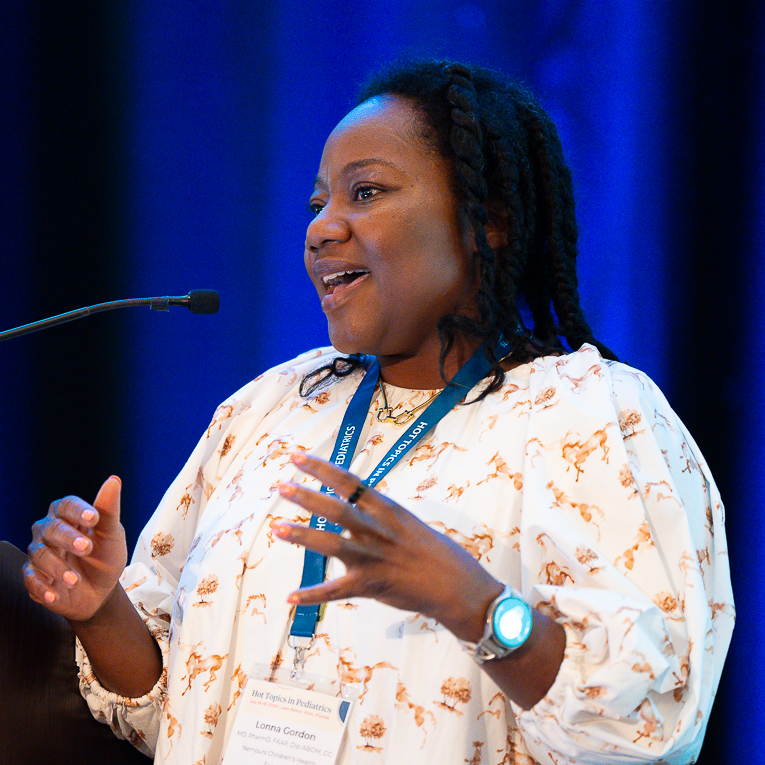
Lonna Gordon, MD, PharmD, FAAP, FSAHM, DipABOM, CCMS, Chief, Adolescent Medicine, Nemours Children’s Health, explores the challenges teens face as they develop healthy relationships with food, technology and themselves. From understanding avoidant/restrictive food intake disorder (ARFID) to navigating social media’s influence on identity, Dr. Gordon explains why understanding the reasons behind teen behavior matters. She also shares how parents and caregivers can build trust and become the safe, supportive adults teens need to thrive.
Featuring:
Lonna Gordon, MD, PharmD, FAAP, FSAHM, DipABOM, CCMS, Chief, Adolescent Medicine, Nemours Children’s Health
Host/Producer: Carol Vassar
TRANSCRIPT
Announcer (00:00):
Welcome to Well Beyond Medicine, the world’s top-ranked children’s health podcast produced by Nemours Children’s Health. Subscribe on any platform at nemourswellbeyond.org or find us on YouTube.
Carol Vassar, podcast host/co-producer (00:12):
Each week we’ll be joined by innovators and experts from around the world, exploring anything and everything related to the 85% of child health impacts that occur outside the doctor’s office. I’m your host, Carol Vassar. And now that you’re here, let’s go.
(00:36):
We’re in Orlando, Florida, at Hot Topics in Pediatrics. With me right now is Dr. Lonna Gordon. Dr. Gordon is chief of adolescent medicine for Nemours Children’s Health, and she has devoted her entire career to helping young people navigate life in general. She’s also been a podcast guest previously, so welcome back to the podcast, Dr. Gordon.
Lonna Gordon, MD, Nemours Children’s Health (00:58):
Thank you so much, Carol. It’s always a great time to be here.
Carol Vassar, podcast host/co-producer (01:00):
I love having you here. And I was looking at your presentations. You have a number of them, and I’m just going to go over them here based on what I have on my iPad. And they include avoidant restrictive food intake disorder. Is that called ARFID?
Lonna Gordon, MD, Nemours Children’s Health (01:15):
ARFID, yes.
Carol Vassar, podcast host/co-producer (01:16):
Culinary medicine, social media, and emotional regulation. And there’s definitely a pattern there. They seem to be helping young people, again, build healthy relationships, navigate through life with their peers and their parents and everyone who’s around them. Is that essentially the heart of adolescent medicine?
Lonna Gordon, MD, Nemours Children’s Health (01:39):
Absolutely. I tell people all the time that adolescent medicine is really about connection. That is the diagnostic tool. My goal in every single encounter is to figure out how do I connect with an adolescent so they’ll tell me what they’re actually thinking. Because without understanding what they’re doing, why they’re doing it, there just isn’t a way for me to actually get the information that will make a difference in their health and their life.
Carol Vassar, podcast host/co-producer (02:04):
A lot of people, when they hear about adolescent medicine or adolescent behavioral issues, they’re thinking about changing teen behaviors. Don’t do this, do that, make sure you’re there on time. You look at it a little bit differently. You try to focus on the why and what’s driving those behaviors. That distinction’s important. Explain it to us.
Lonna Gordon, MD, Nemours Children’s Health (02:28):
Yeah, no, it’s critical. So I always say that first of all, you cannot correct without connecting. So I always say correction before connection, or sorry, connection before correction. And then the reason why is what determines what it is that you’re doing, and it helps you understand the motivation behind it.
(02:46):
So if an adolescent tells me that they’re not doing something that’s risky, for instance, they’re not vaping, I’ll ask them, “Are you vaping?” Ask them the question directly. But then, in turn, when they tell me- whether they tell me yes or whether they tell me no- the next question I always ask them is Why? And so for the people who tell me no, they’re always a little shocked when I say why. And they’re shocked because what they’re expecting me to say is, “Good job. Absolutely, you know smoking’s bad. Don’t do that.” And I always say, “No, I want to know why you don’t vape.” And sometimes they’ll actually be a little stumped by it. And I always say to them, “Because if the reason that you’re not vaping is because you think you’re going to get in trouble, spoiler alert, you’ve done things before that you think you’re going to get in trouble for.” And they usually sheepishly smile at me. I’m like, “Yes, as have I.”
(03:35):
And so there needs to be something bigger than just a consequence. There needs to be a consequence that’s tied to something that’s important to you. “I don’t want to vape because it’s terrible for my lungs and I like to play this particular sport. I like to swim and I can’t hold my breath very well if my lungs don’t work well. So that’s why I don’t vape.”
(03:58):
And so for a young person who is telling me, “Yes, I am vaping,” I still ask them the exact same question: why? And they also look at me shocked because what they’re expecting me to say is, “Vaping’s bad, you need to stop. Don’t you know it’s going to kill you?” All the things. And they’ll look at me, and I’ll go, “I mean, I’m sure someone’s told you drugs are bad.” And they’ll again look at me sheepishly and smile, and I’ll say, I said, “I’m not naive. I don’t think you’re doing this because all your friends are vaping.” And they’ll look relieved because, again, I think we say that to young people all the time, like, “Oh, it’s your friends. It’s those bad friends you’ve had, the people.” I’m like, “So I need to understand what is it that is making you do something that you know is not optimal for your life and for your health, is something you know could get you into trouble, and yet you still need to do it. I want to understand that why.”
Carol Vassar, podcast host/co-producer (04:49):
There’s more behind it.
Lonna Gordon, MD, Nemours Children’s Health (04:51):
Right. And so once I understand that, then we can work on a plan for how we could cut back, how we could quit, how we could substitute it with something else. Because if I tell you to stop vaping and you’re anxious and I give you no tool to work on your anxiety-
Carol Vassar, podcast host/co-producer (05:06):
Then what?
Lonna Gordon, MD, Nemours Children’s Health (05:07):
… then you’re just going to go back to vaping. You might stop for a day or two, but you’re going to go back.
Carol Vassar, podcast host/co-producer r (05:13):
That’s an amazing way of looking at it. I’ve raised three kids, went through it all. I never thought of it that way. That is amazing.
Lonna Gordon, MD, Nemours Children’s Health (05:20):
It works with adults too.
Carol Vassar, podcast host/co-producer r (05:21):
Does it? Good.
Lonna Gordon, MD, Nemours Children’s Health (05:23):
I mean, it works for young adults. I mean, I’ve got a couple of those in my life that I’ve got things that I’m always trying to help them do. And additionally, yeah, it works for adults that you work with. It works for residents.
Carol Vassar, podcast host/co-producer (05:38):
Keep probing a little bit, folks.
Lonna Gordon, MD, Nemours Children’s Health (05:39):
Why? Why? It’s my favorite question. It was my favorite question when I was four. It’s my favorite question now, but almost 44.
Carol Vassar, podcast host/co-producer (05:44):
I love it. Let’s go through a couple of your presentations. We’re not going to go through all of them now or else we’d be here for several hours, but let’s talk about ARFID. Your presentation on ARFID uses the title, Try the Gray Stuff, borrowing from Beauty and the Beast, of course. Beyond picky eating, because some people are just picky eaters, what does a child’s relationship with food tell us about their overall health and well-being?
Lonna Gordon, MD, Nemours Children’s Health (06:17):
Yeah. I think that one of the things that’s a huge misconception about ARFID, especially as it’s gained a lot of mainstream popularity, is that it’s just a picky eater; it’s ultra-picky eating. And that is one subtype of ARFID for sure. But really any eating disorder is about control. And for ARFID, the motivation of the control is avoiding sensory input because sensory input is overwhelming.
Carol Vassar, podcast host/co-producer (06:44):
Which is a little different.
Lonna Gordon, MD, Nemours Children’s Health (06:45):
Right. So I mean, for someone who’s dealing with anorexia, which is our prototype eating disorder, it’s tied to the weight, but truly it’s not about the weight. It’s about control, as in the dopamine hits you get from accomplishing things. So you’re box-checking. I mean, my friends tease me because I will write my to-do list and on the top of it, I’ll put get up, and I’ll put a little box next to it.
Carol Vassar, podcast host/co-producer (07:09):
And you can check that box.
Lonna Gordon, MD, Nemours Children’s Health (07:10):
That’s right. Every day, guaranteed. Because if we’re doing the to-do list, I definitely woke up this morning.
Carol Vassar, podcast host/co-producer (07:15):
Thank you.
Lonna Gordon, MD, Nemours Children’s Health (07:15):
So always winning. And so that same level of need to win drives anorexia. But with ARFID, it’s driven more so by a level of, gosh… Food is a very sensory experience. The smells, the noise, the community, the tastes, all of that, the textures can all feel overwhelming to some people. And ARFID is like, “I don’t want to experience that.” And that may be related to external factors. So that may be related to, “I’m actually very nervous, and so when I’m nervous…” We get that gut feeling, our second brain. And so now all that sensation that’s happening, that feels uneasy. And so maybe I shouldn’t eat because eating also causes us to have sensation in our gut. And now that sensory input, that’s two things, and that feels like a lot. And maybe I can avoid that by not eating anything or not eating certain types of foods that seem to trigger more of that.
(08:17):
And so it really, what I find is, and I mean, not just what I find, but what is also outlined in the literature is that co-association between ARFID and other sensory disorders that we know about like autism, lots of anxiety disorders, but it’s different from those two. So not every kid with autism has ARFID, and not every kid with ARFID also has autism, but you can certainly get a flavor of how that sensory overwhelm can be very common in both of those. And certainly things that allow people to sit with sensory sensations and sit with difficult emotions is very integral to treating it.
Carol Vassar, podcast host/co-producer (08:53):
How do you approach the treatment of ARFID? I’m assuming you asked those similar questions that we talked about earlier, but then what happens?
Lonna Gordon, MD, Nemours Children’s Health (09:02):
So then from there, we’re now thinking through what is, one, how do we increase exposures, how do we increase safety, and how do we increase that adolescent’s attunement to things that lead them to feeling safe or unsafe? So I do a lot of work with adolescents even before we start talking about the food, in terms of thinking about something that in the psychological world is called resourcing.
(09:24):
So all of us have sensory inputs that feel very grinding to us and sensory inputs that feel very relaxing and comforting. So for instance, I love the texture of things that are fluffy, fuzzy socks, a fuzzy blanket, my dog’s fur. And so those are sensations that feel very good to me. So those might be things that we think about helping someone who has ARFID incorporate into mealtime. So maybe we’re wearing our favorite pair of fuzzy socks at the meal because that’s going to help. And so when I’m approached with a food, and I’m worried that it’s going to make my stomach upset, I can rub my socks together, and I can feel that sensation, and it can calm me. But I have to know that that’s important. So, one, to have on the fuzzy socks, but also to remember to use that tool.
Carol Vassar, podcast host/co-producer (10:12):
So there are approaches to this. There are ways to treat this.
Lonna Gordon, MD, Nemours Children’s Health (10:15):
Absolutely. Absolutely.
Carol Vassar, podcast host/co-producer (10:16):
Let’s move on to culinary medicine. Kind of adjacent to ARFID, but in a very, very different way. Culinary medicine is something that seems like it’s a passion for you. We think about nutrition oftentimes in terms of calories or food intake. Did I eat enough? Did I eat too much? Do I need to exercise to get this off? You frame food as something very different and much broader. It includes culture; it includes connection, identity. How can that change the way we think about caring for adolescents and other young people?
Lonna Gordon, MD, Nemours Children’s Health (10:54):
No, absolutely. So one of the things I think is the hardest thing is we’ve told people for so long, and we started really early, good foods, bad foods. And we’ve changed how we name it over the years: slow, more, all, or just different things- red light, green light, yellow. But at the end of the day, we’ve taught people that there are foods that are good and there are foods that are bad. And that then creates a lot of emotion around it. Because a lot of times foods that our families used to celebrate get put into that bad category. A lot of times, foods that maybe come from different cultural identities have no category, and people don’t know what they are. So a lot of times when we’re dealing with a young person who is concrete thinking, moving towards more mature, abstract thinking, not seeing a food might equal this is bad because it’s not on the green list.
(11:55):
Young people aim to please. They aim to really do a good job and to gain praise from adults that they think are important in their life. And so sometimes that inputting, that queuing, isn’t even intended to be that, but it is. It gets processed that way. And so, one of the things that’s really important in thinking about food is that food is fuel. And so some fuel is going to be high in nutrients, or I should say all fuel has some nutrient value to it; some of it will be high, some of it will be low. And then also some of it is also going to have high energy and low energy. And so when we’re thinking about foods, we want to just think about the balance of getting the right amount of energy and the right amount of nutrients and combining them literally in unlimited possibilities of combinations to do that.
(12:43):
And so I was having a really interesting conversation with a patient this week who has been struggling with PMOS, which was formerly known as PCOS. And she was talking about some of the food choices, differences that she had made. And she’d made some progress, and she had gotten some good results on the scale and metabolic parameters, things that, as a doctor, I should be excited about. But I did ask her how, before I decided whether I was going to congratulate or not.
(13:10):
And when she shared some of the things she was doing, her mom then interjected that she was also worried about some of the things, and there were some things that were red flags in there. And she was doing things like, “Not that hungry, so I had an apple and called it a meal.” And I said to her, “An apple can never be a meal, because,” I said, “the thing…” And she said, “But an apple is a good food.” And I said, “Well, define for me what’s a good food.” And she said, “It’s healthy.” I said, “Define for me what’s healthy.” And she was a little stumped.
(13:41):
I said, “So here’s the thing. An apple, just like every food, is neutral.” But I said, “What I would say about an apple is that it is high in nutrition, but it’s low in energy. And so that’s why it can’t be by itself for a meal. It has to be a part of a meal.” So I was like, “Apple with peanut butter, apple with cottage cheese, apple with…” And she kind of wrinkled her nose, and she said, “I don’t like any of those things with an apple. I don’t want…” And I said, “Well, you could also eat an apple with a sandwich. You could have an apple.”
(14:12):
And she said, “Well, but I wasn’t that hungry.” And I said, “Well, the only reason I was giving you those other foods is because, if you’re telling me you need low volume, you’re not that hungry, then we would try to pair it with quickly with something that would give us the other pieces of what we needed from energy as well as from nutrition.” But I said, “If you’re telling me you had space to eat a little more, then we could put more variety with that.” And so she was like, “Oh, okay.” And so I said, “That’s really why we think that. So when people tell you macros, and you need to combine this and this or food groups or…” I said, “It’s really just ways that people are trying to convey to you the idea of how you mix things.”
(14:54):
And so she then was able to think through the things she liked, and then we were able just to put together something that was what she could eat with her apple. She was like, “Well, I’ve never thought of that as a meal before.” I said, “Well, why have you never thought of that as a meal before?” She was just like, “Because no one eats that.” I said, “Well, you do apparently. And so congratulations, you’ve got a new meal.”
(15:17):
And so I think it’s super exciting to be able to really teach young people to be excited about how they can combine things in the kitchen. For me, the kitchen has been an incredible space of creativity. I did not historically think of myself as a creative person, but I realized that I’ve always loved to cook. I’ve loved to cook since I was a child, much to my mother’s dismay and her precision of how she liked her kitchen kept. She kind of softened a little bit when she realized I was good at it.
Carol Vassar, podcast host/co-producer (15:45):
Okay then].
Lonna Gordon, MD, Nemours Children’s Health (15:46):
But definitely I never cleaned up the kitchen to her standards. But it was a great place of creativity, and it still is for me. I love to come home and just see what I have in my fridge, go to the grocery store, see what looks exciting or interesting there, and just be like, “I’ve never used this ingredient before. I’m going to try some things with this ingredient and see what I get.”
Carol Vassar, podcast host/co-producer (16:07):
And now you’re sharing it in that culinary medicine spirit, putting on your doctor hat along with your passion for cooking and making that into culinary medicine, or food is medicine, which is quite a big topic in the world of pediatric medicine and medicine writ large. I want to talk about social media. Another area is just insane: people worrying about the health of people who use it, especially adolescents, as their brains are not completely and fully developed. I want to look at it from a different lens. I want to look at it and ask you about how the adolescents today, who are using social media, who are maybe developing their self-identity in part, if not in full, from that social media feedback, how is that different from previous generations? I mean, I didn’t grow up with social media. My kids were the cutting edge, I guess, of MySpace and the beginning of Facebook, so it wasn’t their full childhood with social media. So the generations that are coming up behind them have had this all their lives, and how is it changing the way they think about themselves?
Lonna Gordon, MD, Nemours Children’s Health (17:24):
So what’s interesting is it’s rooted in something that is the same and timeless. But what I’ll say is that the algorithm is shaping the identity and that’s the difference. But to backtrack, so what is the purpose of adolescence? The purpose of adolescence is developing your identity, because your identity is the one thing that makes you uniquely you. And so that has been always the task of adolescence since the beginning of time, and that’s what we’ve all sought to do during adolescence since the beginning of time.
(17:54):
It’s just that for your children, me, and everybody before us, we got to have an in-real-life identity. We had a real-life play. We had real-life problem-solving. We made friends, and then we disagreed with them, but then we still had to see them in class. We still had to see them on whatever sports team, whatever religious institution, the neighborhood we lived in. So we had to think through: how do I explain my shifting identity? How do I take the parts of that that are good from this relationship and leave out the parts that are not great or don’t fit me any longer and amalgamate that into who we became?
(18:37):
Social media instead takes that away, and instead the algorithm feeds the identity. So you have an identity that you think you might be interested in, you’re exploring, and then the algorithm sends you more and more things that are aligned with that identity, so then you don’t dissect, do you like it or do you not like it? What part do you like, or what part do you not? Because it curates a world that’s shaped in an idea. And then that’s the idea that then takes growth and continues to grow and becomes the entire identity. And then when someone gets to the space where they say, “But I don’t know if that’s actually me anymore,” the algorithm has fed them that this is all that’s in the world, so they can’t find other identities. And there’s also the fear that if I lose that identity, that I’ve lost my entire connection.
Carol Vassar, podcast host/co-producer (19:29):
Right. What do I have?
Lonna Gordon, MD, Nemours Children’s Health (19:29):
Right. And so that is the difference. You have adolescents who are still searching for the exact same thing that every adolescent has, but they don’t have as many options any longer. But they actually have limitless options. They have wilder options and wider options than the rest of us do. That would be the beauty of if social media was used appropriately and with the right guardrails.
Carol Vassar, podcast host/co-producer (19:52):
What do we do about this?
Lonna Gordon, MD, Nemours Children’s Health (19:54):
So I think some of it is that we have to really create a truly restorative hybrid world. So, there’s many places that have gone to banning social media. Australia I think is probably the most noted. And it was great at our national meeting, we had the adolescent specialists from Australia, they don’t have as many of them. And so we had the two premier ones speaking about what they’ve learned from a year into the social media ban. And one of the things that they learned was that, one, adolescents work around it, because you can just teach the algorithm things and feed the algorithm things so that it believes you’re older than you are.
(20:38):
But then the other piece was that parents actually really struggled with there not being the social media. It gets back to my thing about replacement. So if you take away social media, social media was feeding something for young people, but it was also feeding something for the adults in their life. And so that means that, as an adult, you have to work harder to create as in real-life world for the adolescent. And we don’t have social constructs in our society that do that well.
(21:10):
Because if I get home from work really late, there’s aftercare, third spaces, if you will, for younger children. We don’t have that curated for adolescents, and certainly not ones that are inexpensive and affordable. Certainly not ones that are aligned with just developing skills and not mastery of something. So you can play travel sports, but there’s not a great third space for if you just wanted to move and try out something that your parents don’t have to invest several hundred, thousands, maybe even, of dollars into. So we would have to arrange a society where either adults can be more present or that we have more third space activities that are designed appropriately developmentally for adolescents.
Carol Vassar, podcast host/co-producer (21:57):
Social media has really had a huge impact on the way kids grow up, hasn’t it?
Lonna Gordon, MD, Nemours Children’s Health (22:02):
It has.
Carol Vassar, podcast host/co-producer (22:04):
And the society has changed to move around that.
Lonna Gordon, MD, Nemours Children’s Health (22:07):
Exactly. And additionally, it’s not that adolescents actually like social media that much. So most adolescents who have parents who put pretty tight guardrails around their social media, yeah, initially they rebel a little bit, or they buck a little bit because their peers have it. So if they’re not in a pod of other adolescents who have similar rules… I always say adolescents fight very hard to look just like everybody else. So that is hard for them. But once you give them a safe pod, most adolescents actually tell you they like not having it because it’s a lot of pressure to curate a life that looks perfect.
Carol Vassar, podcast host/co-producer (22:49):
It sure is. It sure is.
Lonna Gordon, MD, Nemours Children’s Health (22:53):
But there has to be an alternative. The kids who struggle the most, and I think who will get left behind the most as we lean into some of the premises that have been exposed in books like The Anxious Generation and so forth, the research is solid, but unfortunately it hasn’t thought about the context of what it means to live in very disparate worlds. And so the kids who do not have the same resources are going to be left behind as we clamp down on that without creating those third spaces.
Carol Vassar, podcast host/co-producer (23:23):
What role do parents play? Obviously they play a huge role in raising their children. But what can they do to start taking back that role in that third space and those fourth spaces and beyond and really talk with their kids about, okay, it’s okay to try this and to try that, and we’ll let you do this? How do those conversations take place, and how do they differ from even my generation having the conversations with my kids 30 years ago?
Lonna Gordon, MD, Nemours Children’s Health (23:56):
I think one piece that will remain is teaching your kids your family’s values. And I think that that’s very important because it gives some guardrails – it gives some boundaries. I would hope though in the family values, it doesn’t just include things that we don’t do, it also includes things that we do do, things that we embrace. And so hopefully in a lot of families, the values are that we embrace curiosity, we embrace openness, we embrace authenticity. And if you’re embracing those things, then that means that naturally you may fail, you may not be perfect, and that means that you may have to do some repair, and that’s okay. But when you’re doing things purely for performance, adolescents start to feel like that is… It feeds into this idea that exactly that social media has created, that things must be done perfectly and executed perfectly.
(24:51):
And so what I would hope is that I want to understand your effort. I want to understand your thought process, not just your output. And so then that creates a space where adolescents are willing to meet people who have different ideologies in them, different views and vantage points and life experiences, are willing to try things that they may not get right perfectly, may not create the picture that’s perfect for the Gram or TikTok or whatever it is. But that also requires the adults in their lives to be okay with that.
Carol Vassar, podcast host/co-producer (25:23):
Yeah. And okay with them failing.
Lonna Gordon, MD, Nemours Children’s Health (25:25):
Yeah.
Carol Vassar, podcast host/co-producer (25:27):
10 years from now, what do you think the adolescent healthcare system is going to look like? Will we be able to make improvements? Will we be able to get a rein in on social media and the algorithms and make sure that parents are talking with their kids in an open and honest manner?
Lonna Gordon, MD, Nemours Children’s Health (25:48):
I certainly hope so. It’s for me, what I’ve devoted my career thus far to. And certainly when I think about where I see my career going over the next several years, it’s where I’m continuing to kind of drill deeper into thinking about how I help adults’ and adolescents’ lives bridge what I like to call that threshold space. Because adolescence is a time where you can see something that’s the future, adulthood, but it’s not fully formed yet, and you’re not exactly sure how you’re going to bridge that gap. And so the thing that I teach parents is something I call tongue-in-cheek PCOS. So pause, so that’s for you as the parent or the adult to really get your wits about whatever the emotion is that you’re feeling in the moment about whatever the information is that you’ve been brought.
Carol Vassar, podcast host/co-producer (26:42):
And that might be the hardest right there.
Lonna Gordon, MD, Nemours Children’s Health (26:44):
That is certainly the hardest. Because as an adult, we want to jump in and fix, protect, but we really have to regulate ourselves first to demonstrate good regulation and good handling of difficult situations for adolescents. Again, connect, connect before correcting. Open, that is definitely just being open to hearing what’s going on, open to understanding, using that why. And then secure, which is actually the most important step in terms of thinking about the relationship. So secure the next opportunity to connect, secure the space that you’re in. But also, most importantly, making sure that you are a secure person so that when an adolescent brings you something hard, they know that nothing that you say will scare me. Because at the end of the day, that’s what adolescents are looking for to determine are you an adult that they’re willing to let into their world, or they’re just going to give you the performative view, tell you what they think you want to hear, try to hide things. And it’s because they aren’t sure that they can trust us.
(27:52):
And so being able to be that secure adult I think is what I hope in the next 10 years. We have good training for any adult who’s interacting with adolescents, all of our facets of society create security. Because we think a lot about what does it mean to make a secure world for younger children, but we don’t really think about what it takes to make a secure world for people who are in that transition point at that threshold.
Carol Vassar, podcast host/co-producer (28:17):
Dr. Lonna Gordon is an adolescent medicine specialist and division chief of adolescent medicine at Nemours Children’s Health.
MUSIC:
Well Beyond Medicine
Carol Vassar, podcast host/co-producer
Our conversation with Dr. Gordon was recorded during the 2026 edition of Hot Topics in Pediatrics at Disney’s Grand Floridian Hotel in Orlando, Florida. More of those conversations are coming up soon on the podcast, so make sure you are subscribed to Well Beyond Medicine by visiting nemourswellbeyond.org. That’s our podcast website, and it’s THE place to leave podcast episode ideas, reviews, or subscribe to our monthly e-newsletter as well. Again, that’s nemourswellbeyond.org. You can also subscribe to the podcast on the Nemours YouTube Channel and your favorite podcast app, or you can listen to it by asking your smart speaker to play the Nemours Well Beyond Medicine Podcast.
Today’s episode was produced by Cheryl Munn, Susan Masucci, Lauren Teta, and Alex Wall. Video production by Josh Hansborough. Audio editing and production by Steve Savino and me. Join us next time as when I’m once again joined by Nemours president and CEO Dr. Larry Moss for Leadership Dialogues, with our special guest, health visionary Kody Kinsley, North Carolina’s 18th Secretary of Health and Human Services.
I’m Carol Vassar. Thanks so much to Dr. Gordon for joining me, and thank you for listening. Until next time, please remember that together, we can change children’s health for good – well beyond medicine.