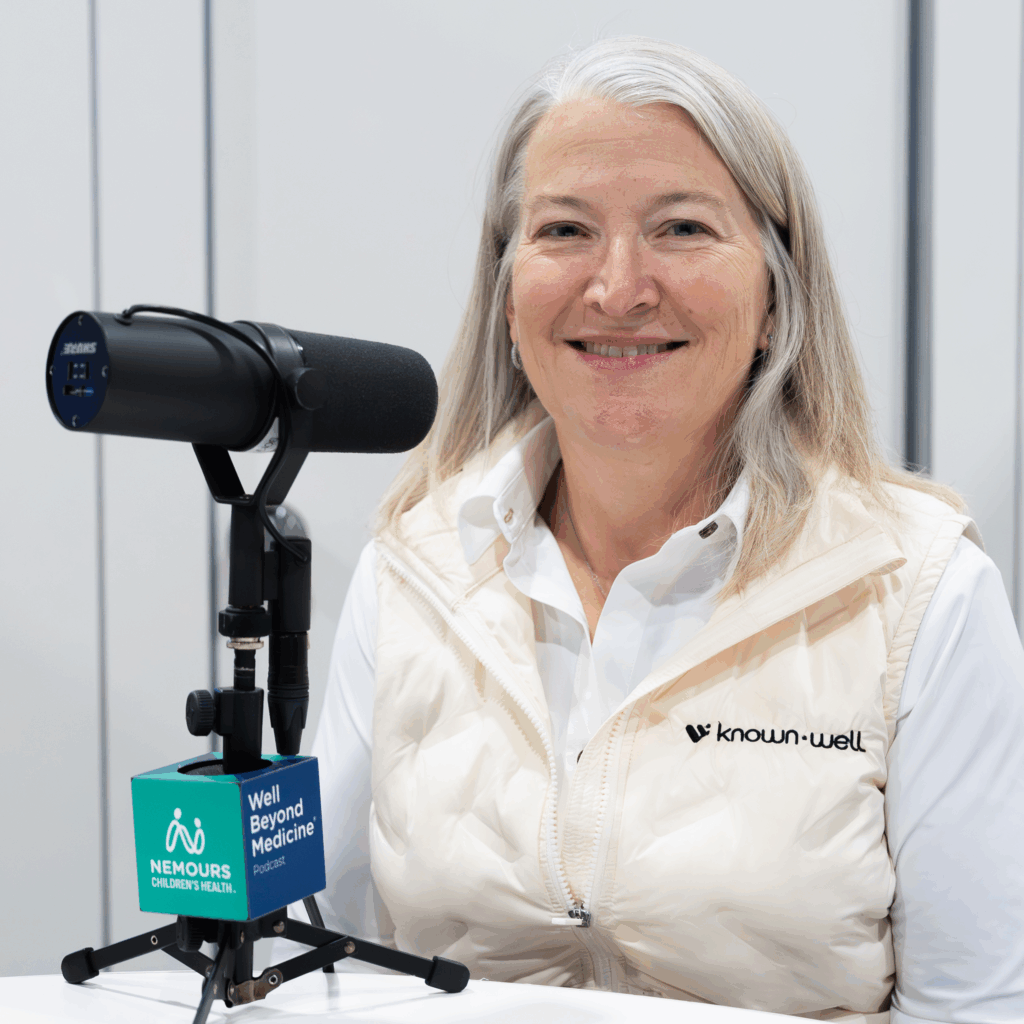
Angela Fitch, MD, FACP, FOMA, Dipl. ABOM, co-founder and Chief Medical Officer, Knownwell Health, is a leading expert in pediatric and adult obesity medicine. She joined us at HLTH in Las Vegas to discuss obesity as a complex disease and why children with this diagnosis need supportive, stigma-free care. Dr. Fitch covers the growing use of GLP-1 medications in adolescents, what is known about their safety, and how families and clinicians can make informed decisions together. She also shares strategies to help kids build healthier habits and shift the focus from “the number on the scale” to managing weight for overall health.
Featuring:
Angela Fitch, MD, FACP, FOMA, Dipl. ABOM, Co-Founder, Chief Medical Officer, Metabolic Health & Primary Care Physician, Knownwell Health
Host/Producer: Carol Vassar
TRANSCRIPTS
Announcer (00:00):
Welcome to Well Beyond Medicine, the world’s top-ranked children’s health podcast, produced by Nemours Children’s Health. Subscribe on any platform at nemourswellbeyond.org or find us on YouTube.
Carol Vassar, podcast host/producer (00:12):
Each week, we’ll be joined by innovators and experts from around the world, exploring anything and everything related to the 85% of child health impacts that occur outside the doctor’s office. I’m your host, Carol Vassar. And now that you’re here, let’s go.
MUSIC (00:30):
Let’s go, oh, oh, Well Beyond Medicine.
Carol Vassar, podcast host/producer (00:36):
Hey, everyone. We’re at HLTH in Las Vegas. Joining me right now is Angela Fitch. Dr. Fitch is a leading expert in pediatric and adult obesity medicine, an early pioneer of GLP-1s for use in young people. We’re going to talk a little bit about that. And the co-founder of Known-Well. Now, for listeners who are not familiar with Known-Well, tell us what it is. I know you were up and doing some virtual appointments here in Vegas with folks back on the East Coast. Talk about that.
Angela Fitch, MD, CMO, Known-well (01:06):
Yeah. So we have developed the first of its kind, what we call click and mortar, because we do both in-person and virtual care. So about 80% of our care is delivered virtually because a lot of people like that today. But also, people like to come into the office sometimes. So we have clinics across the country, and we have 50-state virtual care for adults for weight management as well as primary care. So we’re wrapping around primary care around the idea of metabolic health and obesity treatment combined with your primary care longitudinally.
Carol Vassar, podcast host/producer (01:36):
So you have the full package?
Angela Fitch, MD, CMO, Known-well (01:37):
Full package.
Carol Vassar, podcast host/producer (01:38):
You have the behavioral health, you have the provision of medical-
Angela Fitch, MD, CMO, Known-well (01:42):
Care.
Carol Vassar, podcast host/producer (01:42):
… advice and care, nutritional health. How does this help to support people who are living with obesity?
Angela Fitch, MD, CMO, Known-well (01:50):
Yeah. So I mean, we all need this support. Right? Whether we’re living with obesity or not, meaning the world we live in is not healthy for us by default. Right? So in other words, we have too much stress, we don’t move enough, we don’t sleep enough, as I did last night. Our nutrition is inherently not as helpful as it could be by nature of what we have available to us.
(02:17):
So we all sort of need this in a primary care setting, really. And there’s a lot of patients out there, a lot of people out there that have abnormal metabolic health, even despite their body size or not dependent on their body size, right? So…
Carol Vassar, podcast host/producer (02:30):
Right.
Angela Fitch, MD, CMO, Known-well (02:31):
We really want to focus on doing things for the health of it and not the weight of it. Right? This isn’t about-
Carol Vassar, podcast host/producer (02:36):
I love that.
Angela Fitch, MD, CMO, Known-well (02:36):
We’ve got to get rid of this idea. People come in all the time, they’re like, “I want to weigh this amount.” And I’m like, “Well, why do you want to weigh that amount?” Because we shouldn’t be striving to have a number on a scale show our worth. Right?
Carol Vassar, podcast host/producer(02:50):
Right.
Angela Fitch, MD, CMO, Known-well (02:51):
We want to be leaner, not lighter. We want to be lean and fit and be able to-
Carol Vassar, podcast host/producer (02:56):
Right. Be able to move.
Angela Fitch, MD, CMO, Known-well (02:58):
Yeah. I want to be able to get up out of this chair without using my hands, or heaven forbid, another human to help me out of the chair when I’m 80 or 85 or 90.
Carol Vassar, podcast host/producer (03:06):
Or 62.
Angela Fitch, MD, CMO, Known-well (03:06):
62. And so we want to live pain-free. We want to do as much as possible. We want to be active. We want to have a high-quality life in addition to a long life. Right? I think it is the goal.
Carol Vassar, podcast host/producer (03:20):
Absolutely. Let’s face it, there’s still stigma around obesity. It goes back probably before the nineteen 50s and 60s and 70s, when I was growing up, where a lot of people thought it was a matter of willpower. Just stop eating, and that is going to help you with your weight. It’s really a complex issue. Talk to that.
Angela Fitch, MD, CMO, Known-well (03:40):
Well, in 2013, the American Medical Association said obesity as a disease, like other diseases, like cardiovascular disease, like diabetes, like high blood pressure, like cancer. Right? These are diseases that we get because this is what happens to us as humans. Thankfully, we have modern medicine that has evolved to treat those diseases. Right? With different medications, procedures, interventions, lifestyle interventions, procedural interventions, et cetera, surgery. Right?
(04:08):
We have a lot of treatments for diseases, and obesity is not any different. Although we still, even today, and even with all the stuff that we’re talking about here at this conference, right? People always come back to, “Well, we’re going to get people off their medication. Right? Because they’re going to learn how to live healthy.” And it’s like, well, a lot of people are living healthy right now, and they’re still having trouble with their weight because it’s a disease. Right?
Carol Vassar, podcast host/producer (04:35):
Right.
Angela Fitch, MD, CMO, Known-well (04:35):
It’d be like saying, “Oh, we’re not going to do a cardiac cath on a patient that has heart disease because they should just eat better and exercise more.” And that would be silly, or we would think that would be silly. We still have them do cardiac rehab, still have them do work on lifestyle factors related to their cardiovascular disease, but it’s not the only thing we hold ourselves to in order to get the best outcome or the best treatment.
Carol Vassar, podcast host/producer (05:02):
There’s so much that goes into obesity.
Angela Fitch, MD, CMO, Known-well (05:04):
Yeah.
Carol Vassar, podcast host/producer (05:05):
There is biology, genetics, environmental factors, behavioral factors.
Angela Fitch, MD, CMO, Known-well (05:12):
Social determinants of health.
Carol Vassar, podcast host/producer (05:13):
Social determinants of health.
Angela Fitch, MD, CMO, Known-well (05:14):
That’s aren’t controlled by the person who didn’t choose to have that in there-
Carol Vassar, podcast host/producer (05:18):
Exactly. And these have been-
Angela Fitch, MD, CMO, Known-well (05:19):
Structural racism.
Carol Vassar, podcast host/producer(05:20):
Structural racism, all sorts of factors that account for… Lack of sleep.
Angela Fitch, MD, CMO, Known-well (05:25):
Yep.
Carol Vassar, podcast host/producer (05:26):
These are all things that contribute to obesity. It’s not just willpower.
Angela Fitch, MD, CMO, Known-well (05:31):
Right. That’s what we’ve been trying to say for a long time, as long as I’ve been doing obesity medicine for the past 20 years, we’ve been really trying to get that across. And it’s still a challenge even today for people, I think, to accept that because it still lives ingrained in us that this is something that we can just change ourselves and control ourselves when it really is dictated.
(05:52):
It’s controlled by our hypothalamus, which is an area of our brain that does things for us that we can’t control on purpose, so we can stay alive. It’s the central part of our brain that keeps us going. It’s responsible for our fertility. It’s responsible for our menstrual cycles as women. Right? We can’t control our menstrual cycle anymore than we can control our metabolism. I mean-
Carol Vassar, podcast host/producer (06:12):
hear! hear!
Angela Fitch, MD, CMO, Known-well (06:13):
… this is like we can’t just say, “Oh, today I would like to not do that,” or “I’d like to menstruate today.” No, we can’t say that, right? We don’t control that. And to think that we control our metabolism and actually control what our body has as it relates to fat storage is what’s been sort of irrational for decades, centuries.
Carol Vassar, podcast host/producer (06:33):
And that leads to the stigma, it leads to the shame.
Angela Fitch, MD, CMO, Known-well (06:35):
Right.
Carol Vassar, podcast host/producer (06:36):
You have some personal experience with this. Your co-founder has some personal experience with this. Talk about that.
Angela Fitch, MD, CMO, Known-well (06:42):
Well, that’s why we created Known-well because there is this shame and stigma and we wanted a place where people could come and not experience that stigma in the clinic. Right? We have data to show from really good research trials that patients feel that stigma all the time. I mean, imagine my co-founder who’s had obesity since she was a teenager. Right? Or a younger child. And the first thing she remembers about going to the doctor when she was 12 years old is the doctor telling her mom she should go to fat camp.
Carol Vassar, podcast host/producer (07:10):
Ugh.
Angela Fitch, MD, CMO, Known-well (07:10):
And that sticks with you, right?
Carol Vassar, podcast host/producer (07:12):
Yeah.
Angela Fitch, MD, CMO, Known-well (07:12):
And so that is a bit of trauma essentially that you’re dealing with. Right? And then imagine then for the next 30 years or 20 years as you go through life, you’re coming into the office every time, you’re getting on the scale, you’re trying to make changes to it, you’re trying to… people are telling you, “You need to get this number under control,” and you can’t.
Carol Vassar, podcast host/producer (07:34):
Right.
Angela Fitch, MD, CMO, Known-well (07:35):
That’s just demoralizing. Right? Every time-
Carol Vassar, podcast host/producer(07:36):
You’re taking your shoes off, you’re taking the keys off, and all the change out of your pocket. Yeah.
Angela Fitch, MD, CMO, Known-well (07:41):
Yeah. And it’s like, but that’s like every year you do that, you do the same thing over and over again, that’s the definition of insanity.
Carol Vassar, podcast host/producer (07:49):
Right.
Angela Fitch, MD, CMO, Known-well (07:50):
Right? Doing the same thing over and over again, getting the same result.
Carol Vassar, podcast host/producer (07:52):
Exactly.
Angela Fitch, MD, CMO, Known-well (07:53):
And so that’s what you’re doing. So you’re literally becoming insane by the fact that you’re trying to do the same thing over and over, and you’re not seeing the result that you want, which is to change that number, to make a difference with the amount of fat storage. Biologically, we are not designed to lose weight. It’s not normal to lose weight.
(08:12):
When we lose weight, when our body loses weight by maybe, let’s say we do increase our physical activity, we do burn more calories, we do eat a little less calories as we’re focusing on eating healthier alternatives, eating more vegetables, eating more things with more volume. It fills us up more, less calories, more volume. I said earlier, we talk a lot about crowding things out instead of cutting them out because we don’t want to be in a diet with a big D. We talk about our diet with a little D.
Carol Vassar, podcast host/producer (08:42):
It almost makes-
Angela Fitch, MD, CMO, Known-well (08:43):
But how to diet with a big D.
Carol Vassar, podcast host/producer (08:43):
It almost makes the food more desirable when…
Angela Fitch, MD, CMO, Known-well (08:46):
When you say you can’t have it.
Carol Vassar, podcast host/producer(08:46):
You’re told… exactly.
Angela Fitch, MD, CMO, Known-well (08:48):
Yeah. And that’s everything, whether that’s food or you can’t have this money or you can’t have this thing or this toy or whatever. When you tell people, humans, that you can’t have that, then they’re like…
Carol Vassar, podcast host/producer (08:59):
“I want that. I want that.”
Angela Fitch, MD, CMO, Known-well (09:01):
And so you really want to crowd things out and not cut them out. Right? And so again, this is really creating this weight-inclusive place where people can come, get their healthcare, get their comprehensive healthcare, get their weight management care or their metabolic healthcare, even if they’re not focusing on that as a penultimate goal. Right? But maybe they’re making a different small changes that can then lead to results. One of my patients the other day was frustrated that she was only losing about a pound a month. And I said, “Well, if you keep doing that for two years, you’ll lose 25 pounds.” And she’s like, “Oh, I never thought of that.”
Carol Vassar, podcast host/producer (09:40):
Perspective.
Angela Fitch, MD, CMO, Known-well (09:40):
That’s good. That’s a good idea. If this keeps up, if I keep going down even ever so slowly, in the long run, it’s going to be more advantageous versus the average person, especially the average midlife woman gains one and a half pounds a year during the menopause transition, which is 15 pounds of weight gain, potentially if that transition is 10 years, 15 pounds of fat gain that you don’t want to gain.
Carol Vassar, podcast host/producer(10:06):
Right.
Angela Fitch, MD, CMO, Known-well (10:06):
You’re just gaining it. And you didn’t ask for it. You didn’t say, “I’d like to gain 15 pounds of fat.” No, it just is happening because of the metabolic changes that are happening during menopause.
Carol Vassar, podcast host/producer (10:16):
I want to talk about something in the pediatric space, which we’ve heard a lot about here at HLTH, especially on the first day, and that’s GLP-1s.
Angela Fitch, MD, CMO, Known-well (10:24):
Right.
Carol Vassar, podcast host/producer (10:25):
We’ve covered this topic ever so slightly on the podcast. Use in the pediatric set, and I’m assuming it’d have to be 13 or older.
Angela Fitch, MD, CMO, Known-well (10:34):
12.
Carol Vassar, podcast host/producer(10:35):
12, okay.
Angela Fitch, MD, CMO, Known-well (10:35):
It’s a print down to age 12.
Carol Vassar, podcast host/producer (10:37):
Down to age 12. Talk about that. How efficacious is it to use it in this population? How long have you been using it with this population? And what have been the long-term results?
Angela Fitch, MD, CMO, Known-well (10:50):
Well, we did one of the first clinical trials in terms of a trial looking at, would this actually work? Right? Just sort of investigating the idea. So it was an idea-generating trial, right? It was only 30 kids, but we said we’re going to take 30 kids with severe obesity, and you were going to see how they do with giving them GLP-1. And this was back in our first GLP-1 that we had on the market 20 years ago was a drug called Byetta or Exenatide. That was our first GLP-1 that comes from the… We found out about GLP-1 because of the saliva of the Gila monster.
Carol Vassar, podcast host/producer (11:28):
Oh.
Angela Fitch, MD, CMO, Known-well (11:28):
So the Gila Monster can live for very long periods of time without calories, and it can alter its metabolism in order to live that way. And then it can eat a lot, and then it can take in those calories, and then not eat for long periods of time. So it has a special relationship with its GLP-1.
(11:45):
And so they figured out that in the spit of the Gila Monsters, they would harvest the spit from these Gila Monsters in order to get the GLP-1 in the early days before they had produced it. So that’s the story of GLP-1, in case you didn’t know. But we did this trial in a subset of pediatric patients just to see how would they respond because we were using it in adults. Right?
Carol Vassar, podcast host/producer (12:06):
Right.
Angela Fitch, MD, CMO, Known-well (12:07):
At the time. And they did great, actually. They lost weight. It’s very challenging for any of us to lose weight, but they lost weight, and they did quite well, and they tolerated it quite well.
Carol Vassar, podcast host/producer(12:20):
And the safety longitudinally, have you studied that at all?
Angela Fitch, MD, CMO, Known-well (12:23):
So in the adult world, right? The longest trial we’ve had of GLP-1 in the adult world is a five-year clinical trial, randomized clinical trial. But these drugs have been on the market now for 20 years. So there’s been a lot of retrospective look back at large population sets. I mean, millions of type people, millions of people in a population to look at, are there any signals for any safety concerns? And so far, there’s not.
(12:49):
As long as you can manage the side effects and you’re not personally feeling the side effects, such as nausea, diarrhea, constipation, that are interfering too much with your life, right? As long as you manage those side effects, we don’t see any signals to suggest that there’s a long-term problem, whether it be pancreatic cancer, thyroid cancer, or any type of signal with using these medications long-term. We don’t have a lot of pediatric long-term data, though, because we haven’t used them in pediatrics as long as we’ve used them in adults. So we don’t have those large data sets of our pediatric population to be able to say, this is what happens with our pediatric kids.
Carol Vassar, podcast host/producer(13:29):
Do you feel that there’s a stigma of using or prescribing GLP-1s in the pediatric set? And how do you kind of dispel any myths around that?
Angela Fitch, MD, CMO, Known-well (13:38):
Well, there’s even a stigma today in the adult set, right?
Carol Vassar, podcast host/producer (13:41):
Okay.
Angela Fitch, MD, CMO, Known-well (13:41):
Because people get stigmatized for their body size, for having obesity.
Carol Vassar, podcast host/producer (13:46):
First.
Angela Fitch, MD, CMO, Known-well (13:47):
They get stigmatized if they decide to take a medication.
Carol Vassar, podcast host/producer (13:48):
Second.
Angela Fitch, MD, CMO, Known-well (13:49):
Because they’re told it’s the easy way out. You’re taking the easy way out. Right? Because you don’t have the willpower. Right? And so they can’t win. They can’t win if they don’t treat their obesity, and they can’t win if they do, which is also what happens a lot with the pediatric population as well. Right? It’s hard for them to sort of become advocates.
(14:07):
I’m on the board of the Obesity Action Coalition, which is the patient advocacy arm. So if there’s anybody listening as a patient that wants to sort of belong to something that would support them. Right? Whether it’s support in their journey. We have a yearly convention where people come together. We have a teen version of that now that teenagers come.
Carol Vassar, podcast host/producer(14:28):
We’ll have to get that in the show notes.
Angela Fitch, MD, CMO, Known-well (14:29):
That was just remarkable last year when the teenagers… We had probably 25 teenagers there, and they were so… By the end of the weekend, they were crying, they were laughing, they were dancing. I mean, just to see so much, having people to support. We need people like us to support us in our journeys, and having that support, I think, is really key.
Carol Vassar, podcast host/producer (14:51):
I’m going to refer back to something I heard you say yesterday, and I heard you say earlier in our conversation today, and that is we should do things for the health of it, not for the weight of it. How do you keep families, children in particular, but families and support of them make that mind shift from I’m-
Angela Fitch, MD, CMO, Known-well (15:10):
Well, it’s hard, right?
Carol Vassar, podcast host/producer(15:11):
Yeah. Go ahead.
Angela Fitch, MD, CMO, Known-well (15:11):
Because as an adult, nobody wants to take medication. I’ll have patients come in and say, “Well, I don’t want to take medication.” Well, I don’t want to take medication either. If we surveyed everybody on the show floor here today and said, “Who wants to start a new medication today?” I don’t think anybody would raise their hand and be like, “Please, I’d like to start a new one.” The point is, we don’t want medications.
(15:30):
We don’t want surgery, but we might need them if we’re going to have a different outcome as it relates to our health. And so some of our pediatric patients already have insulin resistance, pre-diabetes, high cholesterol, liver. Some of our pediatric patients have fatty liver disease or metabolic-associated steatohepatitis. MASH is the new way of talking about it. And that is something that you have to think about, what are the consequences if I don’t treat this?
Carol Vassar, podcast host/producer(16:00):
Thank you.
Angela Fitch, MD, CMO, Known-well (16:00):
Right? And those consequences are different for different people. Right?
Carol Vassar, podcast host/producer(16:04):
Right.
Angela Fitch, MD, CMO, Known-well (16:05):
If you don’t have any of these conditions, then maybe you work on other things, or maybe you want to take a different medication that might have more safety behind it or more years of taking it behind it, right? More years of being on the market. Maybe you feel more comfortable taking an oral medication instead of an injectable medication.
(16:23):
We have those too to help even our pediatric patients down to the age of 12. So there are a lot of treatment options, but not treating the disease of obesity. We have data to show that kids do not outgrow their weight. So there has been a feeling for so long that when a child had obesity, that at some point they would just grow taller, and then their growth spurt-
Carol Vassar, podcast host/producer (16:43):
And thin out.
Angela Fitch, MD, CMO, Known-well (16:43):
And they would thin out, right? And that can happen. And that’s why it’s important to treat it early, even if you’re treating it with… Starting with lifestyle interventions and other types of treatments. Because you can help the child lean out or thin out. Right? By growing taller and taking advantage of that growth spurt. Because a lot of our younger kids, even when they’re on therapy with our GLP-1 agents, we don’t want them to lose weight. We want them to grow taller, but not gain weight.
Carol Vassar, podcast host/producer (17:15):
Okay.
Angela Fitch, MD, CMO, Known-well (17:15):
Right? Because that is this leaning-out sort of situation.
Carol Vassar, podcast host/producer (17:18):
Yes.
Angela Fitch, MD, CMO, Known-well (17:18):
So we lean into that growth spurt, right? Because it’s not about losing weight per se. It’s about changing your body composition and changing your size. So what you’re effectively doing during that period is you’re losing fat, and you’re gaining muscle. Bones, organs, everything’s getting bigger, right? And normally you would gain weight during that time, but if we can keep your weight the same. Right? We can then…
Carol Vassar, podcast host/producer(17:42):
It’s about proportion.
Angela Fitch, MD, CMO, Known-well (17:43):
It’s about proportion. Yeah. But my point of that is it doesn’t happen by itself without… And nine times out of 10, it’s eight times out of 10, I’ll say that, people need something beyond just lifestyle. To say that… And that’s not their fault. For the two people that are lifestyle responders, that’s great for them. For the eight people that aren’t, that’s not their fault.
Carol Vassar, podcast host/producer(18:09):
Right.
Angela Fitch, MD, CMO, Known-well (18:09):
And that’s what we have to stop thinking about. It’s just like if a patient had asthma and they ended up in the ER in the ICU because they have asthma, we would treat them then with stronger medication.
Carol Vassar, podcast host/producer (18:20):
An inhaler, right.
Angela Fitch, MD, CMO, Known-well (18:21):
And they would have to take that, presumably, a lot of times for the rest of their lives. Right? And some people, their asthma changes as they get older, but for the most part, it becomes a chronic disease, and they have to choose to have medication, not because they want medication, but they want to live a higher quality, longer, more productive life, more active life.
Carol Vassar, podcast host/producer (18:40):
Do you hear a lot of hesitation, especially on the part of parents, when you’re considering a GLP-1 for their child about the long-term use?
Angela Fitch, MD, CMO, Known-well (18:49):
Yeah. Because we don’t know, right?
Carol Vassar, podcast host/producer (18:51):
Right.
Angela Fitch, MD, CMO, Known-well (18:51):
But I tell them, “Well, we don’t know either.” In other words, I mean, the other alternative, you have to think about the alternative. Like I said, I mean, the alternative of that child needing a liver transplant when they’re 25 or my brother, who struggled with his weight as a child with obesity back in the ’70s, which we really weren’t talking about it like we do today, who I saw him get bullied and all this stuff that went along with that. Right? That’s what you have to think about. And he got diabetes when he was 22 years old. Right? Related to his excess weight. And we don’t want that to happen if we can try to avoid it.
Carol Vassar, podcast host/producer (19:33):
What’s the criteria when you’re looking at the 12 to 18 or maybe even into the young adult ages for consideration of a GLP-1?
Angela Fitch, MD, CMO, Known-well (19:43):
Yeah. So it’s typically a… We still, unfortunately, use body mass index. That’s the easiest tool that we have. In our clinic, we also look at body composition. So we look at, we do bioimpedance testing, which is also validated in pediatrics now to look at how much muscle, bones, organs, and fluid that the child has or the patient has in order to try to get rid of that fat. Right? And keep that muscle or keep that child growing and get rid of that fat. So a lot of our kids, like I said, their weight is even staying the same, and they’re getting better.
(20:13):
We can see that on the body fat percentage going down while they’re growing into their weight, so to speak. So right now it’s a BMI greater than a 95th percentile. So BMIs are on a percentile curve versus an absolute number, like for adults. We have greater than a BMI of 30 for adults or greater than 27 with a comorbidity. That’s for adult population. For pediatric populations, it’s greater than that 95th percentile would be what we would consider someone that could benefit from treatment, whether it be GLP-1 or other medications. We have other medications such as Phentermine and Topiramate, which is a combination pill called Qsymia that’s also approved down to the age of 12.
Carol Vassar, podcast host/producer (21:00):
Any parent working with their kid has had issues, struggles, getting them to eat something, getting them to eat anything at times.
Angela Fitch, MD, CMO, Known-well (21:10):
Right.
Carol Vassar, podcast host/producer (21:10):
How do you deal with that family dynamic when the parent might be saying, “You’re eating too much” or “You’re eating too much processed food.”
Angela Fitch, MD, CMO, Known-well (21:17):
I know. It’s really challenging, especially today. I mean, it was challenging even 20 years ago, but I think it’s gotten more challenging, especially as we’ve gotten more busy. We’re eating on the run, we’re having to go to soccer and this place and that place, and we don’t have time to sit down. I mean, the best thing to do is to try to instill in your children the… We sit down-
Carol Vassar, podcast host/producer (21:40):
Dinnertime.
Angela Fitch, MD, CMO, Known-well (21:41):
… at the table and we eat at the table. And then the other thing we try to talk about a lot in pediatric weight management is that you’re making dinner, and that’s what you have. Right? You’re not a short-order cook. So if you are having chicken and broccoli and mashed potatoes for dinner, that’s what’s for dinner. Right? And if they don’t want to eat it, they don’t want to eat it, but then…
Carol Vassar, podcast host/producer (22:06):
That’s it.
Angela Fitch, MD, CMO, Known-well (22:07):
They don’t make something else instead, something else that they might want instead.
Carol Vassar, podcast host/producer (22:14):
So that’s one way of dealing with that. And I’m sure developmentally it’s different at 13 than it would be at 18.
Angela Fitch, MD, CMO, Known-well (22:21):
Exactly, because the more autonomy they get, they can make their own choices. So you’re not going to be like, “No, you cannot go in the kitchen and make a peanut butter and jelly sandwich.” I mean, so they’re going to make those choices to do that. But trying to, on a regular basis, encourage, even 60% of the time, that type of we’re sitting at dinner, we’re eating together, this is what I made. Right?
Carol Vassar, podcast host/producer (22:44):
Right.
Angela Fitch, MD, CMO, Known-well (22:45):
And trying to instill in that, and that takes repeated exposure. I learned early on from the dieticians at Cincinnati Children’s, where I trained, that it takes 17 tries of something before you can say you don’t like it.
Carol Vassar, podcast host/producer (23:00):
Okay.
Angela Fitch, MD, CMO, Known-well (23:01):
So I’ll teach parents and families that, because what happens classically is we don’t want to get in a fight with our kids, because for anything, no matter homework, food, whatever it is.
Carol Vassar, podcast host/producer (23:10):
What they’re wearing. Yeah.
Angela Fitch, MD, CMO, Known-well (23:10):
What they’re wearing, et cetera. And then we’re stressed out. We’ve been working all day. So it’s like you’re trying to minimize any kind of strife at all costs. Right?
Carol Vassar, podcast host/producer (23:21):
Right.
Angela Fitch, MD, CMO, Known-well (23:21):
And so again, really sort of not just giving up on the food when they don’t want it, because we tend to be like, “Oh, Johnny didn’t eat that, so I’m not going to serve it to him again, because he doesn’t like broccoli,” when he only tried it once. Right? And the point is, you can’t really decide. I’m sure all of us can think of a food that we didn’t like, maybe when we were younger, but now we eat it today. Right?
Carol Vassar, podcast host/producer (23:46):
Oh yeah. Broccoli is one of them.
Angela Fitch, MD, CMO, Known-well (23:47):
Yeah. And you have to make things too. We teach people, make them palatable. There’s nothing wrong with putting cheese on broccoli.
Carol Vassar, podcast host/producer (23:55):
Right.
Angela Fitch, MD, CMO, Known-well (23:55):
I mean-
Carol Vassar, podcast host/producer(23:56):
Oh, I love it.
Angela Fitch, MD, CMO, Known-well (23:56):
Especially if you can put real sort of shredded cheese versus cheese whiz. But again, putting something on there, less processed. Right? But adding Parmesan, adding cheddar cheese, adding something to it is not butter, salt, and pepper. We want things to taste good, and people like things better when they taste good.
Carol Vassar, podcast host/producer (24:17):
You talked about the GLP-1s from 2005 that were introduced in your practice and the study that was done at that time. We’re looking at, I think, according to what you were saying yesterday, 120 or more…
Angela Fitch, MD, CMO, Known-well (24:30):
New medications.
Carol Vassar, podcast host/producer (24:31):
… new medications in the pipeline for weight management. What are your thoughts on this new wave of treatments? Can pediatricians access those? What do pediatricians need to know about them, et cetera?
Angela Fitch, MD, CMO, Known-well (24:45):
Yeah. Right now, we have two GLP-1s. We have Saxenda, which is our Liraglutide, which is the first GLP-1 for weight management. And that’s a daily injection, and that is approved down to the age of 12. In fact, they’ve done some studies now, randomized control trials, not little investigational things like we did, but actual randomized control trials, even down to the age of six.
Carol Vassar, podcast host/producer (25:07):
Oh.
Angela Fitch, MD, CMO, Known-well (25:07):
For children with severe obesity that are quite young. So it’s FDA approved, though, for 12 and above. And then we have Wegovy, which is Semaglutide, which is also approved for 12 and above. Next year, we’re going to have Tirzepatide, which is known as Mounjaro or Zepbound, depending on the Mounjaro’s for diabetes, but Zepbound is for weight management, and that should be approved coming out hopefully next year or early 2027 as well.
(25:36):
So we’re going to have, at least that’s going to be the next one that comes out. Unfortunately, in a lot of the early research that’s being done right now with all the newer molecules, they always start in adults. And I don’t say that, unfortunately, meaning I don’t want to put our pediatric patients at undue risk. I think it’s important to start in adults, but I really wish they would overlap them a little quicker.
(25:54):
They tend to do the adult trials, which might take like two years to do, and then they start on the pediatric trials. So I just wish they’d overlap them a little faster. Kind of like women’s health and studying women’s health, we’ve understudied women’s health, and we’ve also understudied pediatric diseases in general. Right?
Carol Vassar, podcast host/producer(26:15):
Absolutely.
Angela Fitch, MD, CMO, Known-well (26:16):
I mean, we don’t get as much study necessarily as the adult diseases.
Carol Vassar, podcast host/producer (26:21):
What gives you hope in this area of weight management, of obesity management? You’re an expert, you’re a world-renowned expert on this. What do you see that we can look forward to? I want to leave on a note of hope.
Angela Fitch, MD, CMO, Known-well (26:34):
Yeah, that’s good. It’s always good to leave on a note of hope. I think I’m really looking forward to a day when people don’t have this stigma. Right? And when we don’t blame ourselves, because we blame ourselves a lot.
Carol Vassar, podcast host/producer (26:47):
Yes.
Angela Fitch, MD, CMO, Known-well (26:48):
You mentioned my own journey. I’ve been on a GLP-1 medication for 12 years in order to treat my obesity. And I’m a world-renowned obesity expert, as you mentioned. I should know what I should do. Right? I mean, I know what I’m doing. You don’t have to teach me with some app as to what to do. But this is biological, this is genetic, this is complicated. Right? As a disease state.
(27:09):
And when I come off medication, I tend to gain the weight back, and then I notice I’m gaining it back, and then I go back on medication. Right? And so that’s going to be what it’s going to be. Right? We’re going to have to take care of people across their lifetime, across a long period of time. Right?
Carol Vassar, podcast host/producer (27:23):
Yes.
Angela Fitch, MD, CMO, Known-well (27:23):
I’ve been on it for 12 years. I’ll probably be on it for another, hopefully… Try and do the math, 30 at least. But there’ll be new stuff out too. When people ask, “Well, what about putting my child on this?” Well, we don’t know what the future’s going to hold. There might be gene therapy, there might be some other things that we can do that will actually cure obesity. Because many of the companies now are trying to figure that out. Right?
Carol Vassar, podcast host/producer (27:47):
Yes.
Angela Fitch, MD, CMO, Known-well (27:48):
How do we actually cure it versus treat it? Right now, we’re treating it as a chronic disease, and we really need to get that chronic care management, which is what we’re trying to build at Known-well for patients centered around that metabolic health and that disease that they’re living with.
Carol Vassar, podcast host/producer (28:06):
So there is definitely hope.
Angela Fitch, MD, CMO, Known-well (28:08):
There’s definitely hope. Well, the biggest hope I would have too is that the biggest struggle we have in the United States is not a standard benefit on our insurance.
Carol Vassar, podcast host/producer (28:16):
Okay.
Angela Fitch, MD, CMO, Known-well (28:17):
So it’s an elective for you to have coverage for your disease of obesity. It shouldn’t be elective for you to have coverage for a disease. Right? It should be elective to have coverage for a facelift or something.
Carol Vassar, podcast host/producer (28:29):
Right.
Angela Fitch, MD, CMO, Known-well (28:30):
I mean, something cosmetic. Right? But it shouldn’t be elective to have coverage for a disease that takes eight years off people’s lives, that creates a lot of secondary diseases such as heart disease, stroke, liver transplant, kidney disease, all the other secondary diabetes diseases that we get related to that obesity. And I long for a day when we can have a world that it’s just something we take care of in medicine, like the other diseases. Like hypertension, you don’t have to worry that your medication for hypertension isn’t covered.
Carol Vassar, podcast host/producer (29:07):
Covered.
Angela Fitch, MD, CMO, Known-well (29:08):
Right?
Carol Vassar, podcast host/producer (29:08):
Exactly.
Angela Fitch, MD, CMO, Known-well (29:08):
And not everybody’s going to have the latest, greatest, most expensive medications either, but let’s just get some medication. We have medications that can produce 10% weight loss on average, very nicely, that are $100 a month. They’re not expensive relative to… I mean, that’s expensive certainly if you’re paying cash, but I mean, relative to other costs that we have for other medications on the market. Right? As far as treatment goes. So-
Carol Vassar, podcast host/producer (29:35):
So much more.
Angela Fitch, MD, CMO, Known-well (29:36):
… we should have coverage.
Carol Vassar, podcast host/producer (29:37):
So much more we could go into on this. We could talk for hours. This is just an absolutely fascinating topic. Dr. Angela Fitch is a leading expert we’ve established in pediatric and adult obesity medicine, an early pioneer of GLP-1 use in young people, and co-founder of Known-well. Check them out. We’ll put a link at our website. Dr. Fitch, thank you so much for being here.
Angela Fitch, MD, CMO, Known-well (29:59):
Thank you for having me. It’s been a pleasure.
Music (30:01):
Let’s go, oh, oh, Well Beyond Medicine.
Carol Vassar, podcast host/producer:
Dr. Angela Fitch joined us during our October 2025 road trip to HLTH in Las Vegas. It’s there that we interviewed her and more than a dozen movers and shakers from across healthcare who are changing children’s health for good. It’s part of an occasional series you’ll hear in episodes in the coming weeks and months right here on the Nemours Well Beyond Medicine Podcast. You can check out this series and all of our podcast episodes on your favorite podcast app and smart speaker, the Nemours YouTube channel, and on our website, nemourswellbeyond.org. Visit there to leave a podcast episode idea, a review, or subscribe to the podcast and to our monthly e-newsletter. Again, that’s nemourswellbeyond.org.
Our production team for this episode includes Alex Wall, Cheryl Munn, Susan Masucci, and Lauren Teta. Video production by Sebastian Reilla and Britt Moore. Audio production by yours truly. On-site production assistance in Las Vegas provided by Robbie Dorius and his team from HLTH, and we thank them.
I am Carol Vassar. Thank you for listening. Join us next time as we continue the discussion on food and health with Dr. Nate Wood, the inaugural director of Yale’s Culinary Medicine program. Until then, remember, we can change children’s health for good, well beyond medicine.