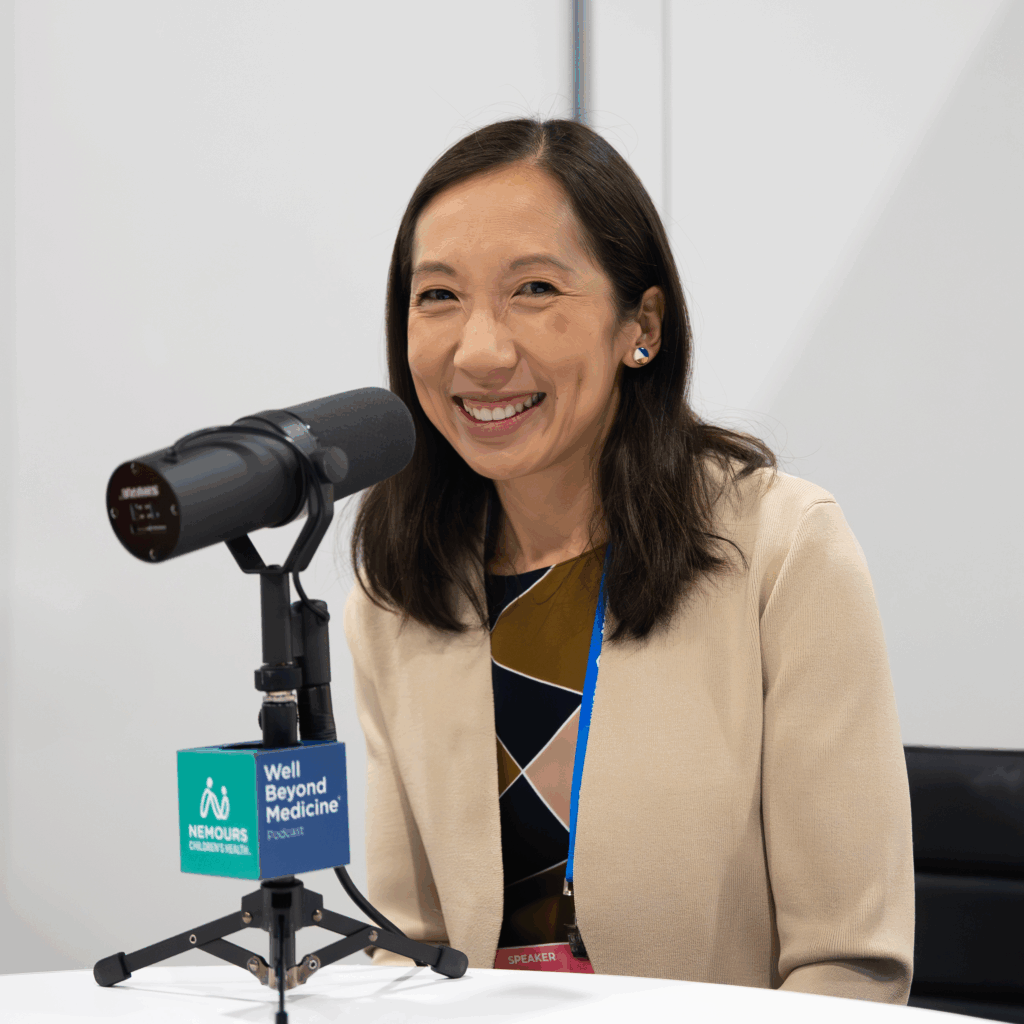
Leana Wen, MD, MSc, FAAEM, health columnist, The Washington Post, is one of today’s most trusted voices in public health. She shares her perspective on whether AI can meaningfully address health care’s biggest challenges and discusses her concerns about bias, privacy and the potential for a two-tiered system. She also reflects on how parenthood reshaped her views on medicine, paid leave, childcare and empathy, and how her mother’s misdiagnosis inspired her to advocate for clinicians to enhance their listening skills in the exam room.
Featuring:
Leana Wen, MD, MSc, FAAEM, health columnist, The Washington Post
Host/Producer: Carol Vassar
TRANSCRIPT:
Announcer:
Welcome to Well Beyond Medicine, the world’s top-ranked children’s health podcast, produced by Nemours Children’s Health. Subscribe on any platform at nemourshwellbeyond.org or find us on YouTube.
Carol Vassar, podcast host/producer:
Each week, we’ll be joined by innovators and experts from around the world, exploring anything and everything related to the 85% of child health impacts that occur outside the doctor’s office. I’m your host, Carol Vassar, and now that you’re here, let’s go.
MUSIC:
Let’s go-oh-oh Well Beyond Medicine.
Carol Vassar, podcast host/producer:
Hi, everyone. Welcome to the Nemours Well Beyond Medicine Podcast. I am excited because we are at HLTH 2025 in Las Vegas, and our guest is the distinguished Dr. Leana Wen. Dr. Wen is an op-ed columnist for The Washington Post. I’m a regular reader, although Carolyn Hax probably is my very favorite over there.
Leana Wen, MD, Author and Health Columnist, Washington Post:
Thank you. I think she’s terrific as well.
Carol Vassar, podcast host/producer:
You are a very close second. An emergency physician by training and experience, you’ve really come to the fore as an information person, a trusted place to go for information.
I’m going to start, since we are at a tech conference, really with your columns of recent note and those have to do with technology today, especially AI, artificial intelligence. You are of the belief, you’ve argued that technology might be helpful in fixing healthcare’s stubborn failures. What are those stubborn failures and how can AI be brought to bear to work on those?
Leana Wen, MD, Author and Health Columnist, Washington Post:
Might may be the operative word here as well because I’m not convinced, but I remain optimistic.
So the stubborn failures that you’re referring to, I think, is this idea of how can we achieve the Triple Aim? How can we have accessible healthcare for all, but at a reasonable cost and in a way that’s high-quality? That’s what we want to aim for. And I think there are some that would argue, and again, I remain optimistic that this could be the case, that AI could help us to get better care. For example, we know that AI can help with improving diagnostics, can maybe make care safer and help to reduce medical error. So on the quality front, I think there is definitely hope there.
There may also be hope for increasing access. We know that there are people around the world and also in the US who do not have access to health and smartphones and then AI may be a way to democratize health information, could empower, for example, people with less training to operate at a higher level. For example, there are projects around empowering community health workers with pretty minimal training to do ultrasounds to help pregnant women. Now, the comparison should not be, is this better than an OBGYN who’s trained? Of course not. But if these women are otherwise going to get no care and now they’re going to get some care with the help of AI, could that be a way for us to increase access?
Now, the question of cost, though, is the one that’s the major unknown. I don’t think I have seen convincing data that somehow AI is going to be reducing cost in the long run. And on that matter, that’s one of the stubborn failures you mentioned, I’m less convinced.
Carol Vassar, podcast host/producer:
There are people who say there are inequities inherent in AI, just the way that they’re created, the way that they are built, the algorithms that they employ. What are your thoughts on those kinds of inequities? How do we overcome them? How do we prevent them? How can we move forward with AI, perhaps get to that democratization space that you were talking about?
Leana Wen, MD, Author and Health Columnist, Washington Post:
I think there are ways for us to reduce bias. The data that AI produce are only as good as the data that go in. And so I think there are ways to be conscious of bias and for AI to be trained on recognizing bias. So I think that’s one part of the inequities.
But the other part, I fear, is inevitable. As in, I think we are on track to having a two-tiered system where maybe the gold standard is going to be AI aiding a physician, but then there’s going to be a second tier of AI aiding a non-physician clinician. Maybe there’s another tier of just using AI. And I think that may be inevitable in our future. However, could that be outweighed by the democratization of information overall? As in, is it better for everyone to have something rather than for some people to have nothing, even if we do have increasing inequalities?
I don’t know the answer to this, and I think this is a societal question, but something that I had written about recently, too, is this idea of what it is for? As in, if AI can help us to improve diagnoses, but patients still cannot afford treatment, is that the kind of society that we want to live in?
Carol Vassar, podcast host/producer:
There are people who are putting their entire medical records into platforms like ChatGPT. What are your thoughts on that? I mean, they’re getting information back. What are the warning signs? What are some of the things that people should bear in mind as they do this?
Leana Wen, MD, Author and Health Columnist, Washington Post:
So I think there are two competing ideas here. One, of course, is the idea of, well, this is personal information. Maybe you don’t want to have your birth date, your name, your address, and all your medical history out there because who knows how this information is going to be used by tech companies?
Carol Vassar, podcast host/producer:
And it is out there.
Leana Wen, MD, Author and Health Columnist, Washington Post:
It is out there, and tech companies have access to it. And so will they use it so that you start getting ads for your condition? Are they going to be selling these data in some way? We don’t know.
On the other hand, we also know that chatbots are the most useful if you give context. So if you just say, “What’s the treatment for diabetes?” it’ll give you general answers, but if you say, “I’m a 69-year-old with diabetes, I just got diagnosed, here’s my A1C, here’s my blood glucose, here are all my data,” it’s going to give you much better, more personalized responses.
And so I think the way to think about it right now is I think there are a lot of physician informaticists or people who work in this space who would say that, “Look, you should provide as much context as you can, but maybe take out your name, take out your birthday, take out your address, take out other specific identifying information, but leave in the rest of the context, including what medications you’re on, what dosages, the context of your symptoms, and the diagnosis, because AI can actually be really good in explaining to you your diagnosis and your treatment plan and how best to proceed.”
Carol Vassar, podcast host/producer:
I want to change the subject a little bit and really focus on you, Dr. Wen. You did a piece in 2017 for NPR, an opinion piece about becoming a mom. You talked very poignantly, very candidly about what you experienced. How did that change your thoughts on being a doctor and the way that you do the work you do?
Leana Wen, MD, Author and Health Columnist, Washington Post:
I think that parenthood has, for lack of better words, totally changed my perspective on life and on being a physician and being a leader too. I think prior to becoming a mom, I don’t think I quite understood the stress that my colleagues with children felt. Every time we had meetings past a certain hour or going up against the time that they had to pick up their kids from school or from daycare, even something that simple was something that I understood, perhaps, but I didn’t have that visceral empathy as I certainly do now.
But I wrote that piece when, I think, when my son, who’s now eight, was a baby. And there was so much I had not considered about paid family leave, about the difficulties of finding reliable childcare, the cost of childcare, even something as basic as where do women go to breastfeed and to pump in the middle of the day while they’re working? And so I think there’s a lot that we can and should be doing as society, but also a very long way for us to go as a society to really support women and families.
Carol Vassar, podcast host/producer:
You supported a community piece in that particular piece of writing of yours. Talk about how important it is that community gather around parents and support parents as they move forward in whatever their life’s plan is.
Leana Wen, MD, Author and Health Columnist, Washington Post:
Well, I’ll give you an example. Even as I’m here at this conference, it’s something that I’ve had to really think about. My children are now eight and five. They are older, but they’re certainly not self-sufficient. They can’t feed themselves, and it would not be legal for me to leave them at home.
Carol Vassar, podcast host/producer:
No.
Leana Wen, MD, Author and Health Columnist, Washington Post:
And while I’ve been here, my husband was also away on a business trip, and so we’ve had to rely on babysitters who were passing off the kids to one another. That adds an enormous amount of stress. And my husband and I talk often about how our families are very far away in different countries and how we really do rely on the community of friends and caregivers around us to be able to support us for something as basic as being able to do our work while also helping our children. And we are fortunate to have the means to be able to pay for babysitters and then to be able to travel and come back for work at times that are best for both of these purposes, but I think that having reliable childcare and, very importantly, also having paid family leave is something that our society really does a very poor job of currently.
Carol Vassar, podcast host/producer:
Listening is a through line in your career. You wrote a book called When Doctors Don’t Listen: How to Avoid Misdiagnoses and Unnecessary Tests. How has listening really been that through line from your authorship, through your work as an emergency physician, to your work now as a journalist with The Washington Post?
Leana Wen, MD, Author and Health Columnist, Washington Post:
Part of the reason why I wrote my book and the impetus really behind it was that when I was a medical student, my mother was diagnosed after many months of misdiagnoses with what turned out to be metastatic breast cancer, that, by the time of her diagnosis, had spread to her lungs, her bones, and her brain.
Carol Vassar, podcast host/producer:
Oh, no.
Leana Wen, MD, Author and Health Columnist, Washington Post:
And I learned so much through the process of being my mother’s caregiver, because her entire medical treatment coincided with my training, because she passed away when I was a resident.
Carol Vassar, podcast host/producer:
I’m sorry.
Leana Wen, MD, Author and Health Columnist, Washington Post:
Thank you. But I saw in that process how much of a disconnect happens between what it is that patients and caregivers desperately need and also what the medical system is trying to do, that health providers are trying to do the right thing to care for their patients, but there are many things in the way of them trying to get there, including not having time or systems that are in place to make them really look at a chart and treat the chart instead of treating the patient.
And so I think that’s a part of this, of how do we really make care patient-centered? But I think now, as we are in a time of misinformation and polarization, I do think that empathy, listening, caring, that dialogue is really essential too.
Carol Vassar, podcast host/producer:
Let’s talk about misinformation since you brought it up. You’re a trusted journalist. You check your facts, you make sure what you’re presenting is evidence-based. How do you maintain that integrity in a world where things around you seem to be scattered in terms of what is real information, what is good information for the health of people in general?
Leana Wen, MD, Author and Health Columnist, Washington Post:
Well, I think we still have to rely on the basics. There are medical journals that I would go to. There are medical organizations that I would go to. There are health systems that produce medical information that are well-trusted, including Nemours. Right?
Carol Vassar, podcast host/produce):
Yep.
Leana Wen, MD, Author and Health Columnist, Washington Post:
I mean, there are many sources of information that I think we can and should still be able to depend on. And normally, when I research my stories, I would go to these sources for basic information, but I would also interview experts. And I generally draw upon a wide variety of experts from institutions across the country who may have expressed different opinions in the past. And usually, what I would find is that even though they may disagree on some things, there are core aspects that they can agree on.
I did several pieces, for example, on autism. Is there really an increase in the number of cases? What may be the causes? And again, while the experts that I spoke to might disagree on some parts, overall, they agreed on some central components, which were also backed up by data and by advocacy organizations and medical organizations. And so I think that’s a way to cross-check and verify that what you think is the case is really the consensus among people from very different backgrounds, and that’s backed up by evidence too.
Carol Vassar, podcast host/producer:
Do you worry about the polarization of public health?
Leana Wen, MD, Author and Health Columnist, Washington Post:
Of course. Of course. I mean, we’re living in a world where there are people who understandably are concerned about what is the right thing to do for their families, but they may not always know what sources to turn to. And there are many, many sources that propagate misinformation or disinformation. And unfortunately, due to algorithms and various things with social media, people can be drawn further into those circles where they hear nothing but those voices that may be propagating misinformation.
At the same time, I think that the gulf between what we would have traditionally considered to be trusted experts and individuals who are just concerned and are asking for information, I think that gulf has increased and I think it behooves us as clinicians to really listen and understand the sources of people’s concern and worry. And instead of labeling individuals as conspiracy theorists or something else, I think it’s important for us to listen to address each of these concerns because I think at the end of the day, that’s our best hope for overcoming that kind of prevalent mistrust and polarization.
Carol Vassar, podcast host/producer:
Do you see that as the way of creating or recreating and building, again, confidence in public health officials and medical officials so that people can, again, trust them?
Leana Wen, MD, Author and Health Columnist, Washington Post:
I’m not sure how we will be rebuilding trust in public health entities and public health officials, but I do think that there’s a crucial role that clinicians can have, and health systems can have, and local health officials can have, because those are individuals who have a face. That’s the individual that someone can turn to and say, “I know my pediatrician. I know my family doctor. I know that they have my best interest at heart, and they’re the ones I turned to help my child through their pneumonia or through their surgery, and so I’m going to turn to them. I will trust them when it comes to this information around the polio vaccine as well.”
So I think that one-on-one relationship is going to be crucial. I’m not sure how we’ll rebuild that relationship when it comes to federal agencies or systems, but at least on a one-to-one basis, I do have hope.
Carol Vassar, podcast host/producer:
You’ve talked about putting that face on public health. Public health, when it works, we don’t hear from it. That’s kind of its role and kind of a downfall for it in terms of PR. How do we put a public face on public health when it’s doing its job and it’s doing it well?
Leana Wen, MD, Author and Health Columnist, Washington Post:
Yeah, it’s really hard because, as you say, public health is invisible when it works by definition because we have prevented something from happening. I mean, how do you put the face of … What is the face of a child who could have been lead poisoned but was not because of remediation measures that were done or-
Carol Vassar, podcast host/producer:
Right. It’s that double negative.
Leana Wen, MD, Author and Health Columnist, Washington Post:
Exactly. And I actually think that vaccines, in a way, are a victim of their own success, that there are whole generations that have never seen vaccine-preventable diseases. And therefore, now that they’re of the generation where they’re having children, they’re saying, “Well, why do I need to vaccinate against polio and measles? I’ve never seen it. I don’t know anyone who’s had these, so why is it important?”
But I think that now we are beginning to see the consequences. We’ve had three people die this year from measles, including two children who were unvaccinated. We are seeing a resurgence of diseases that we previously thought were eliminated, and perhaps that could spur people back into action. Although, as a clinician, I do find it really sad that we have to have that proof of concept in order to see the importance of public health.
Carol Vassar, podcast host/producer:
One of the things that convinced my daughter to vaccinate her own daughter was my mother, her grandmother, telling her, “I remember when people had polio,” and those people now are starting to disappear. So I think having some way to convince people that’s better than having a relative see that is a way to go.
Before I let you go, Dr. Wen, I want to ask, if you were to build a public health system from scratch today, looking at all the technology we have here at HLTH, looking at the information, the evidence-based facts that you are aware of and that you have access to, how would you start to build that?
Leana Wen, MD, Author and Health Columnist, Washington Post:
I think that system would have to be a combination of high-touch and high-tech. And what I mean by that is I believe in data. I think that the data can help us to really target individuals who are most at need. We could use predictive analytics. If we had integrated data systems across, for example, schools and health, we would be able to see which are the students who are at high risk for absenteeism and what are the health issues that they may have? So how can we address those students, for example? We can also use it to address needs and communities, whether it’s food insecurity or housing insecurity, which, of course, we know significantly impacts health issues too.
So I think there are ways to incorporate data, but that does not take the place of that high-touch, the human aspect as well. I’m a huge fan of nurse home visits before, during, and after pregnancy, as a way to improve women’s health and to improve family health. And I think that there is a way for us to incorporate the data to identify those at highest risk, and then to also incorporate that human touch in order to build a better system.
Carol Vassar, podcast host/producer:
What’s next for you, Dr. Wen? Are you going to stay with The Post?
Leana Wen, MD, Author and Health Columnist, Washington Post:
Well, literally today I have quite a lot of interviews that I’m also doing for HLTH, and so I think my mind is quite focused on that. But no, I love the work that I’m doing to help to illustrate the issues that we’re seeing in our patients, in our community, to describe also the innovations that are hopeful for individuals. But what I also really love is being a practicing clinician and being able to be there for patients who are particularly vulnerable in my community.
Carol Vassar, podcast host/producer:
Well, I’m so very glad you took some time to stop by our booth here at HLTH and share your thoughts on a variety of topics. Dr. Wen, thank you for joining us.
Leana Wen, MD, Author and Health Columnist, Washington Post:
Thank you very much, Carol.
MUSIC
Well Beyond Medicine.
Carol Vassar, podcast host/producer:
Dr. Leana Wen is an emergency medicine physician, author, and op-ed columnist for the Washington Post. Our interview was recorded in October 2025 at HLTH in Las Vegas, and is part of a series of podcast episodes recorded at that time featuring healthcare leaders from across various sectors speaking to the work they’re doing that positively impacts children’s health. More of these episodes are coming your way in 2026, right here on the Nemours Well Beyond Medicine Podcast. Check out this series and all of our podcast episodes via your favorite podcast app and smart speaker, the Nemours YouTube Channel, and on our website: nemourswellbeyond.org. Visit there to leave a podcast episode idea, a review, or subscribe to the podcast and our monthly e-newsletter. That address again is nemourswellbeyond.org.
Our production team for this episode includes Susan Masucci, Lauren Teta, Cheryl Munn, and Alex Wall. Video production by Sebastian Reilly and Britt Moore. Audio production by yours truly. On-site production assistance provided by Robbie Dorius and his team from HLTH. Thank you to them.
I’m Carol Vassar. Thank you for listening. Join us next time as we talk with Ysabel Duron, founder and CEO of the Latino Cancer Network. Until then, remember, we can change children’s health for good, well beyond medicine.
MUSIC:
Let’s go-o-o – well beyond medicine!