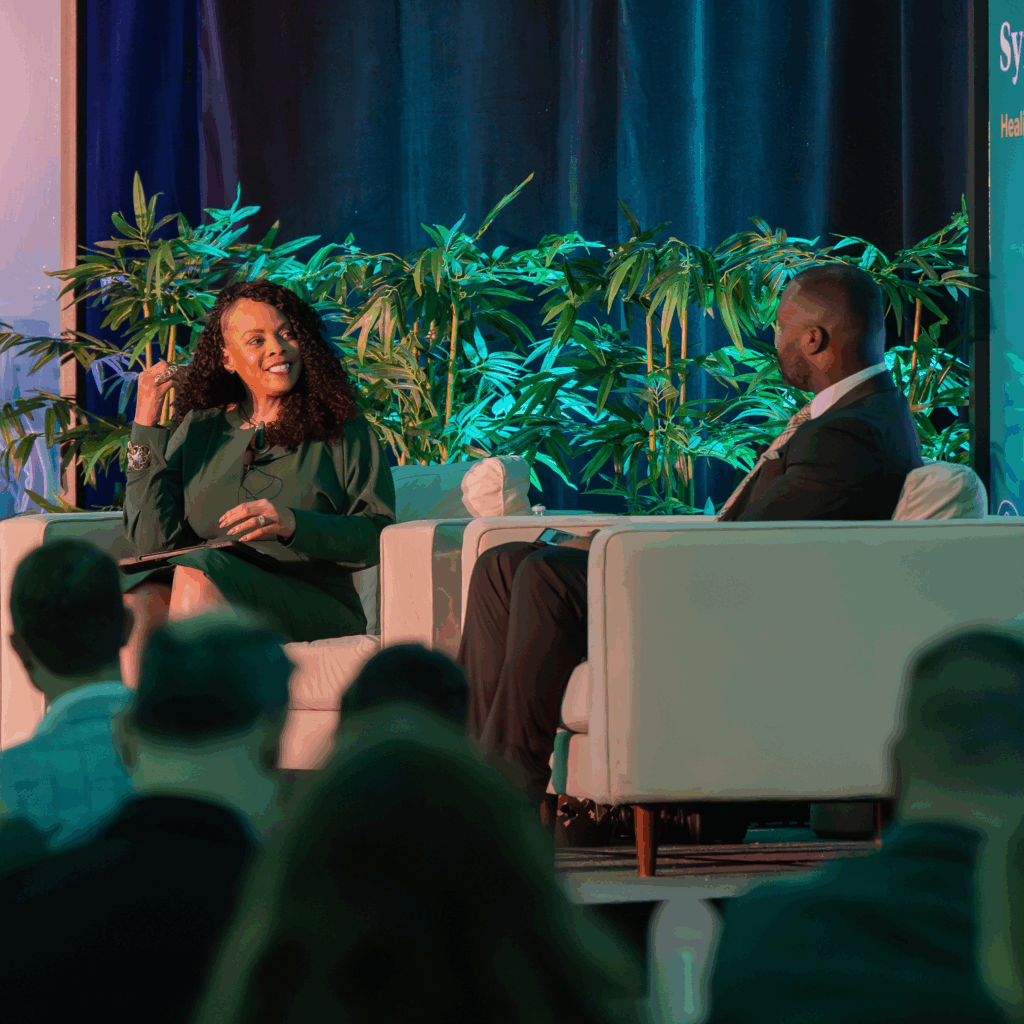
At the 2025 Ginsburg Institute Symposium in Orlando, themed Healing Through the Arts, the fireside chat brought together two self-described “theater kids” and leaders in children’s health: Wizdom Powell, PhD, MPH, CMHC, CEO, Unified Youth, and Myron Rolle, MD, MS, former NFL player and current pediatric neurosurgeon, Nemours Children’s Health. Together, they explore how creativity and play are essential to child development — strengthening brain architecture through neuroplasticity and supporting emotional regulation and resilience. Drawing on science, medicine and personal experience, the conversation underscores why the arts, nature and other whole-child approaches should complement traditional health care to help children thrive.
Featuring:
Wizdom Powell, PhD, MPH, CMHC, Chief Executive Officer, Unified Youth
Myron Rolle, MD, MS, Pediatric Neurosurgeon, Nemours Children’s Health
Host/Producer: Carol Vassar
TRANSCRIPT
Announcer:
Welcome to Well Beyond Medicine, the world’s top-ranked children’s health podcast, produced by Nemours Children’s Health. Subscribe on any platform at nemourswellbeyond.org or find us on YouTube.
Carol Vassar, podcast host/producer:
Each week, we’ll be joined by innovators and experts from around the world, exploring anything and everything related to the 85% of child health impacts that occur outside the doctor’s office. I’m your host, Carol Vassar. And now that you’re here, let’s go.
MUSIC:
Let’s go, oh, oh.
Well Beyond Medicine.
Carol Vassar, podcast host/producer:
I had the privilege of being in Orlando recently to attend the Ginsburg Institute Symposium, which each year brings together leaders from healthcare, education, nonprofit organizations, and the community at large to connect and ultimately to work toward whole-child health solutions to some of healthcare’s biggest issues.
This year’s Ginsburg symposium theme was Healing Through the Arts, exploring how creativity, art therapy, music, and storytelling foster resilience, well-being, and healing for children. At its center, each year’s symposium features a fireside chat, and this year’s special guest for that incredible conversation was psychologist and friend of the podcast, Dr. Wizdom Powell.
Dr. Powell is the CEO of Unified Youth, a nonprofit working to restore imagination, creativity, connection, and play as foundations of youth mental health and future readiness. She’s also a professor at my alma mater, the University of Connecticut, and the former chief purpose officer at Headspace.
Hosting the fireside chat was Nemours’ neurosurgeon, Dr. Myron Rolle. If that name is familiar, he’s a former All-American college football player who also played in the NFL for both the Tennessee Titans and the Pittsburgh Steelers. He’s also a road scholar and the author of The 2% Way. What you’ll hear today are highlights from the fireside chat, along with a post-chat podcast interview.
We started our post-chat interview talking about how exposure to the arts in the early years helps to bring about brain development and helps us all to live longer and healthier lives. Here’s Dr. Wizdom Powell.
Wizdom Powell, PhD, CEO, Unified Youth:
Well, I’m really appreciative of this question because I think when we talk about the arts, people assume that having artistic expression opportunities is something that is a nice to have and not something that’s fundamentally important to youth and child development. But science tells us that the truth is that creativity and all of the ways that young people get an opportunity to express themselves in those ways can fundamentally rewire the neural networks that are responsible for emotion regulation, cognitive flexibility, and imagination. And those are critically important to young people for navigating emotional experiences, metabolizing trauma and childhood adversity, and also in right setting, their capacities to function in the world.
It’s really important to know that when people create art or engage in creative expression, they’re creating the fundamental architecture for emotion regulation, cognitive flexibility, problem-solving, and imagination. And if there was one wing, I think, that’s important to underscore, it’s how much of an imagination crisis we’re facing currently. And young people in particular, in communities who are finding themselves grappling with difficult or wicked problems, need more imagination to solve the problems that are before us.
Carol Vassar, podcast host/producer:
Dr. Rolle, expand on that. You are a pediatric neurosurgeon. You know the brain pretty well. Why is it so important to introduce kids to arts, music, dance, the culinary arts at a very early age?
Myron Rolle, MD, Nemours Children’s Health:
Well, I think what Dr. Powell mentioned about the rewiring and the neuroplasticity that exists in the early brain is so critical and so important. Developing those synapses and those connections in the brain is powerful, especially early on. I often see kids who have either encephalomalacia because from a prenatal stroke or have a tumor or maybe have a bleed that cause some sort of scarring on the brain. And then their brain now has to sort of really rewire and try to find functions that will do the same things that the cells that are now lost did before they got injured. And so I see the neuroplasticity happening all the time. And by introducing other treatment modalities like art, like creative expression, we have these sort of healing gardens that we have at our hospital. We have nature walks that we do. We have spiritual guidance that we do. These ideas are sort of open up the mind, open up the brain, and allow those synapses to fire, especially when you have insults and injury to the brain. I think it works a lot and it helps a lot.
And sometimes people may not see the sort of immediate benefits of this process, but if you sort of track these children long term, I think you’ll see them be some of the thriving members of our community, and it starts early.
Carol Vassar, podcast host/producer:
And Dr. Powell mentioned during your fireside chat that she grew up as a theater kid, if you will, and also you were a singer.
Wizdom Powell, PhD, CEO, Unified Youth:
When I was a young girl, literally in a community that had a lot of material challenge but a lot of promise left to be untapped, that community itself was being ravaged by a joyed epidemic. And many young people who were in those communities didn’t make it out. If any of you listened to gospel music, you might know the song Millions. Millions didn’t make it, but I was one of the ones who did. And I did because there was a jazz vocalist, Margie Day Walker, who started the center stage children’s theater. And that children’s theater actually was a community-driven solution. It was before the days when parents would get wary of people arriving in the community in station wagons, asking if they could take your children away for the whole day, even in [inaudible 00:06:38] times.
So Margie really wanted to create a pathway to artistic discovery for young people. And she essentially plucked me and my three sisters out of our community. So on the Saturday nights when there was a lot of gun violence happening, we were not there. We were performing. We were learning how to play the piano. And then I went on to the Governor’s Magnet School for the arts, where I actually studied vocal arts and composition, and went on to sing with a Virginia opera company.
Let me tell you that it wasn’t just that those experiences opened up my artistic capability. They provided a window and a door to a future possibility that I could not imagine. And when I look at the young people, the peers that were in my community who lived right next door to me, it was my three sisters and I who made it. We were one of the millions who made it.
Carol Vassar, podcast host/producer:
Dr. Rolle, did you have an arts background? Any opportunity to the arts when you were a child? I know athletics were big for you.
Myron Rolle, MD, Nemours Children’s Health:
Did you do some research?
Carol Vassar, podcast host/producer:
I did not. This is just a throwaway question.
Myron Rolle, MD, Nemours Children’s Health:
Wow. That’s fantastic because I did actually. I was a white Russian Jewish milkman named Tevye in Fiddler on the Roof.
Carol Vassar, podcast host/producer:
Really?
Myron Rolle, MD, Nemours Children’s Health:
Yeah. With five white daughters as a 6’2″ black man. But I mentioned on the fireside chat, sort of getting introduced to the arts by my football career, because one of my physical education teachers said that, “Myron, if you want to get your footwork to be better in football, you should do ballet.” I said, “I’m not doing ballet. That’s so girly. That’s so soft. That’s not me. I’m a tough guy. I’m big, I’m strong, I’m fast. No way I’m wearing a tutu or doing anything like that or wearing tights.” But then she told me that Herschel Walker, one of my favorite running backs, and then Walter Payton, and all these other great grit iron giants were doing ballet. And I said, “Oh, if they can do it, then I can do it.” It made it cool.
And so that introduced the idea that maybe I don’t have to have this sort of lens, this myopia of arts being something that’s not for “tough guys” or alpha males, so to speak. And it allowed me to even consider being a part of Fiddler on the Roof, something I had never done before. I was singing Marvin Gaye in my shower, in my dorm room at my prep school, and the dorm prefect came by and said, “Oh, you actually have a good voice.” And I said, “Okay, cool.” And so he put me into the play. And next thing you know, I’m having a blast with it. It was probably the most exhilarating moment of my childhood. And that’s saying a lot. I scored a lot of touchdowns and had a lot of success on the football field, but being on stage and hearing that roaring applause after I sang If I Were a Rich Man, Ya Diddle Diddle, I was like, “This is amazing.”
Carol Vassar, podcast host/producer:
I want to ask a very foundational question. And this is a question that I grew up with. My parents are both educators, my father especially in the gifted and talented area. He talked a lot in the ’60s and ’70s and wrote a lot about creativity. How do each of you define creativity? Dr. Powell?
Wizdom Powell, PhD, CEO, Unified Youth:
Well, I would like to sort of echo a definition that someone shared with me more recently that resonated so deeply. And when we asked this educator, this healthcare systems provider, what creativity is for them, he said, “Creativity is the alchemy of the soul.” And I think that definition is so pitch-perfect because to me, creativity is not just what you do with the artistic expression that you’ve been given.
Creativity is a pathway to possibility. Creativity is a foundation of imagination and foresight. Creativity is at the root of everything we’ve done in human existence to be here. Creativity is what pioneering Americans had to leverage when they had to determine how they were going to build a new world. It is both a window and a door to possibility. And I see it as a super skill of the future, the foundations of what we are going to become. Without creativity, we can’t create any innovations. We can’t move our society forward.
Being at the University of Connecticut and having the opportunity to bring this vision for integration, the integration of the arts into everything we do, was a dream because it gave me the chance to make real what some people see as fuzzy, artsy, fartsy kind of endeavors. And in that initiative, we created a cross-sector collaboration of individuals who work in policy, education, justice, and in healthcare to build a sort of wraparound support for young people and to create artistic-led rather and read it conversations in the community.
We’ve all been in a gallery or in an artistic experience where something happens in us that your walls go down. All of a sudden, everything in you lights up in a way that connects you to every person in the room. You begin to see something in you and them that is common. And what happened in those community conversations was that we started to think about how we might bring people together around difficult topics like justice involvement and gun violence, which, in Hartford, Connecticut, there was a significant challenge with gun violence and community violence. How do you get people talking about those challenges, but with a future-focused way of being?
And the only way you can get people to move beyond the usual conversations of dread is to fill their own with art. So we started to have art installations like re-imagining joy among boys. How many of us have boys in our lives who have been taught that they need to be strong, stoic, and silent, and are hardwired to believe that emotion suppression is a symbol of masculine ways of being without recognizing that that part of a person is a part of a suite, of a full range of human capacity that every person deserves and a young person deserves.
So what we began to see there through the Art and Health Equity Collaborative is that we could revisualize, reconstitute what it means to be a boy in America. And that became a catalyst for me of thinking about how do we create systems and environments where young people can heal, grow, and thrive. That takes an ecological vision. For people to feel whole, systems, communities have to rise up to meet them as their highest intention for that wholeness. And that’s what art does.
Carol Vassar, podcast host/producer:
Dr. Rolle, do you want to try and follow that wonderful…
Myron Rolle, MD, Nemours Children’s Health:
I think that was perfect. I guess the only thing that I would say is that when I see creativity, I see it as the ability to be limber in your thinking. I think so many times… Especially in my career as a pediatric neurosurgeon, we’re so rigid and dogmatic with how we do things, right? It’s like stepwise, like you do this, you do this. One outcome leads to another. Cause/effect. Cause/effect. Keep moving forward. But I think creativity allows for that gray area and the expansion of those stepwise modalities to get to a specific goal that gives you that freedom, that sort of flexibility, that ability to be limber in those spaces and put almost like your individual unique stamp on whatever it is that you’re doing, whether it’s creating music, art, whether it’s a piece that you’re writing, or whether it’s finding a new way to redirect cerebral spinal fluid in somebody’s brain out into their belly because they have hydrocephalus.
Creativity exists all around us. It’s not just limited to one particular ecosphere. So I would say flexibility and being limber is part of that definition as well.
Carol Vassar, podcast host/producer:
Would you make the connection that creativity is rooted in exposure to the arts?
Wizdom Powell, PhD, CEO, Unified Youth:
I would, but I’d also say that it’s rooted in exposure to play, right? I mean, play is one of the most profound exemplars of creativity. Watch a child do what my granddaughter does all the time, which is to stand in a room with a bunch of toys and objects that aren’t connected to each other and make a new world.
So I think that creativity in that way is more likened to play and what we hope we all can retain as we advance and grow older. It’s what we lose often in our world, right? As we adultify, we forget to do the things that brought us joy, that helped us recenter and ground, and that really helped us to connect to something that wasn’t even in the sphere of our imagination before. That, to me, is a powerful demonstration of how creativity shows up in our lives every day. And if we were to reconnect to those foundations of play, imagination, dreaming, oh my goodness, what we would be as a world, as a society.
As a clinical psychologist, as someone who’s treated people who are standing at the edges of cliffs, I know the power of a psychopharmacological intervention for some people. I am not naive about that. But what I’ll also know is that if we read that with interventions that focus on helping people creatively express what words won’t release, if we give people the opportunity, young people, especially imperialists of sensitive and critical development, opportunities for creative expression, we might be setting a pharma foundation upon which the whole lifelong wellbeing might be built.
Creativity is care. Arts is care. And I’ve seen hospitals integrated. I just got back from Bradley Hospital in Rhode Island. They have an integrated arts-based care delivery model for their young people there, and also delivering that side by side with all of the therapeutic interventions. Our children need whole solutions. That’s what I’m saying. We have systematically licked away from creativity and the arts by treating it as a nice-to-have when it is essential to well-being, and it’s essential to our nation’s future readiness and innovation. We cannot be able to cultivate a nation of dreamers and imagineeers if, in fact, we rob young people of access to the thing that could help set that firm foundation. We can do better; we should do better. And arts is a critical, essential component of how we do that.
Carol Vassar, podcast host/producer:
One of the things that you said in the fireside chat that caught my ear is that we have an imagination crisis. Is that a function of just losing that edge, because we adultify, or are we in a larger crisis of imagination? Expand on that idea for us.
Wizdom Powell, PhD, CEO, Unified Youth:
I actually think we are. And as you were asking before about whether or not it has to be the arts, the arts is one really important pathway to creativity and deepening our creativity. And there are some individuals who are talking mostly in the conversations around the human brain economy about our imagination and creativity deficit.
The Harvard Business Review actually wrote about the creativity deficit that’s facing our world. I do think we are. And it seems kind of oxymoronic because we’re surrounded by so much stimuli. How could it be possible that we’re in an imagination crisis where we have a thousand options on Netflix and Hulu and all those places, but it’s not about those kinds of mediums that we’re talking about that the deficit exists. I think we are so rooted in crisis response and short-termism that we have lacked the ability that we need to see the world, problems, and solutions as a whole.
So it shows up in the ways we make policies, even related to how we’re going to care for and fund youth and mental health wellbeing. We have only decided that we’re going to fund and support programs for young people that are rooted highly in medicalized models and approaches only. And not that those things aren’t important, but to me, that’s exemplar of our imagination deficit that we’re in right now.
So yes, I do think it exists, and I think it’s preventable. And young people are asking us to step up and do something about it. They are the reservoirs of the imagination we have yet to unleash.
Carol Vassar, podcast host/producer:
Have we forgotten how to unleash it in them as adults?
Wizdom Powell, PhD, CEO, Unified Youth:
I absolutely think we have. Ask any young person whether or not they think the adults in the room see them whole, and they will probably answer that question with a resounding, “No. They don’t understand me. They don’t get me. They think I’m too loud, too much. I’m on my phone too often. They have not gotten curious about who I am and who I want to be.” And to me, that’s the imagination crisis in its purest exemplary form. The fact that we have forgotten to see young people as human beings who are on a path to becoming. We’re so busy seeing them as problems to be fixed, crises to be solved, risks to be managed, that we don’t see them whole. That’s an imagination crisis. That’s why we need not only creativity, as we think about it for them, like opportunities to express themselves through creative art. We need to be more creative and imaginative and how we solution. And that to me says that we have an opportunity to bridge that deficit and that gap in a way in our society, in our lifetime.
Carol Vassar, podcast host/producer:
I want to throw a question at Dr. Rolle, which he actually threw to you in the fireside chat, which is somewhat related. And that has to do with traditional medicine. We’re talking about being imaginative and thinking outside the box. In traditional medicine, have you yourself seen kind of this siloing, this idea that, “I’m not going to look left or right, or I’m going to just do what is told to me by the clinical decision support system rather than looking at the patient as a whole.” And how do you battle that?
Myron Rolle, MD, Nemours Children’s Health:
Yeah, I absolutely have. I think that the ideas around regimented treatment plans for patients has really taken hold into our current medical infrastructure because, one, it’s safe. It’s been evidence-based. It’s one that has been written about and has been subscribed to by hospital administrators, hospital leaders, and medical leaders. Not even just hospital. Honestly, it’s a systemic-wide sort of idea of, if you have a patient who comes in with Moyamoya disease because they have sickle cell anemia, this is the steps you do to manifest their care in this particular way.
And you shouldn’t deviate from that because if you do, then you’re potentiating worse outcomes. And our ideas that have great outcomes, low hospital stays, low blood risks, low operating room times. So, all these sorts of metrics and measurables that a hospital is looking for to sort of put pressure on you as a medical provider that you got to get this done. And the best way to get it done is by this proven formula that we’ve seen in the past couple of years, be scrutinized and tested by a lot of your colleagues who have come before you. So yes, there is definitely a silo into academic medicine, how you treat patients.
Wizdom Powell, PhD, CEO, Unified Youth:
Those resistances will exist because we have gotten so accustomed to a hierarchy of healing where, at the top of that hierarchy, are medications and medicalized approaches. But think about the amount of money we spend every year in our country on mental health crises and haven’t really made any serious momentum for, not collective momentum, in pockets. And what I would say to people who are resistant to the idea that creativity could be a powerful prevention is I tell them about the ROI, that for every dollar we spend on a creativity-based intervention with young people, there’s like a 7% return on that investment. So if the math isn’t mathing, then perhaps we need to be rethinking our strategy. And it’s not an either/or proposition. It’s not a zero-sum game.
Myron Rolle, MD, Nemours Children’s Health:
What I love about what Dr. Powell espouses, and in this whole symposium, is finding these alternative methodologies that don’t have to replace what we do in surgerizing a patient. You’ve got a brain tumor, I’ve got to take that out. There’s not many options around that, right? But there are other ways that we can sort of fulfill the wholeness of a patient and sort of meet who that patient is in a way that sort of allows them to, one, participate in their recovery process, and to enhance their recovery process, and to move forward into their future with a neurosurgical condition that doesn’t have to be their scarlet letter. It can just be a part of their journey, but they’ve been able to be healed and cured in many ways than just a knife. And I think that is critical. It’s hard to step outside of that siloed regimen, as you were mentioning, but I think it’s possible.
Carol Vassar, podcast host/producer:
Final question for you. I’m going to say it, you’re both theater kids. I’m going to put you in that category, Dr. Rolle.
Myron Rolle, MD, Nemours Children’s Health:
Yeah.
Carol Vassar, podcast host/producer:
You said, Dr. Powell, in the fireside chat that creativity has helped me as a leader. I want to know how the arts, how creativity, how having an imagination has helped you in your leadership journey, your confidence, and your belonging, and can help others. Second part of the question, how can we make that happen for others, Dr. Powell?
Wizdom Powell, PhD, CEO, Unified Youth:
Well, creativity for me has been the fountain of resilience in my life. And I think about resilience not just as the capacity to bounce back from adversity, but to break open and bounce forward to birth something new. I think that process of resilience, as I think of it, has really been interwoven into the ways that I think about how do I address challenges as a leader. It helps me to solution in ways that I think are sometimes to some people like, “Wow, where did that idea come from?” I think that it helps me birth ideas and connections between ideas that are difficult to see. As one of my mentors once said, “You have this capacity to think through multiple layers of abstraction.” And I think that that cognitive flexibility is represented in everything I’ve done as a leader, both the science that I’ve published, the policies that I’ve helped to advance, and the community-driven solutions that I help to co-create with leaders across the nation.
I think that as a creative person, I do have a reservoir of empathy and a capacity to sit with difference and to be able to metabolize those things, not as a threat, but as a challenge in a positive way. So it builds attributes and strengths in me and adaptability as a leader and a thinker that I think shows up in what I hope I’m doing with the time I have here.
I would love to think that it would be as easy as saying we need to cultivate creativity in young people, and then therefore they will have the life and the opportunities that were in front of me. I’m really aware that there were a lot of people who saw my creative potential and leveraged that as a way to help me get connected to more opportunities. And for that reason, I don’t think we can cultivate wonder just in young people. We have to create environments around them, therapeutic landscapes, healing landscapes that actually help them to do the same. That means making arts and creativity more accessible in all the ways we think about it in terms of having places in the community where young people can go to express themselves, as well as making sure that the art modalities that we lift up in community speak to all of the neural divergence that exist in our world, that speak to the linguistic difference that exist in our world.
We have to make art and creativity more accessible so that every young person has access to that place of wonder and imagination waiting to be unleashed in themselves. I think that’s possible. If someone would have looked at me years ago and seen the circumstances that I grew up in, they would not have imagined that I would be sitting here. And I am really, really clear that without creative expression and an opportunity to do so, without Margie Day Walker’s vision for children, I wouldn’t be here. And I hope to be that same visioneer and imagineeer for other young people. I want to stand in the gap in between what is and what can be for young people, just as someone did for me.
Myron Rolle, MD, Nemours Children’s Health:
Yeah. No, definitely. I think creativity has sort of underscored my entire life’s journey. And I spoke to you off of this podcast about my upbringing in the Bahamas and then here in the state of Florida. In The Bahamas, we’re a small country, mighty country. We call ourselves the best small country in the world. And we’re obviously limited with resources, not abundancy of opportunities like there are in America, but it’s a beautiful place. And I think in order to have that sense of wonder, to have that sense of reach that you can go beyond this small archipelago island, I think the creative juices have to start churning. And that was fed and allowed to breathe by my parents. I give them a lot of credit. Mommy and daddy have been married 55 years now and still alive today and kicking and doing incredibly well. And they love being grandparents to my two sets of twins that … I’ll tell you a quick aside, my father never truly liked dancing and singing with me when I was younger, but now with his grandkids, he’s doing that. And I’m like, “Who are you? You’re like a new”-
Carol Vassar, podcast host/producer:
It’s a whole different relationship….
Myron Rolle, MD, Nemours Children’s Health:
… that’s a new man, right there.
But nevertheless, he did allowed me, and mommy allowed my sort of creative expression to exist in this body, this corporate material body that I hold. And so I just never thought that they were bounds of society that were placed on me. Why not be a road scholar? Why not be a football player? Why not act as Tevye in the school play? Why not play saxophone? Why not be a pediatric neurosurgeon? They say you can’t. Let’s box you in and create this sort of structural violent system that says you have to be this or that because it’s easy for my mind to conceptualize, “Oh, you’re a jock. Okay, you’re going to take this pathway. This is what you are.” Oh, you’re a scholar? Okay, you’re going to be this, and that’s what I see you as.” But no, we can do a little bit of everything and do it both and do it very well and not feel ashamed of it.
And so I think my life choices have been, like I said, underscored by creativity. And now, as a physician, as a father of young kids, as a husband to a wonderful woman, Latoya Rolle, a pediatric dentist, so we’re building our community of creative expression in our home and trying to spread that to the next generation. Like our parents allowed our expression to breathe, we’re trying to do the same thing here. And so I hold it very dear. I think it’s an incredibly important facet of my upbringing in my lif,e and it’s played a pivotal role in my professional and personal life today.
Carol Vassar, podcast host/producer:
Dr. Myron Rolle is a pediatric neurosurgeon with Nemours Children’s Health. We also heard from psychologists, Dr. Wizdom Powell, CEO of Unified Youth.
MUSIC:
Well beyond medicine.
Carol Vassar, podcast host/producer:
It’s always fun to head to sunny Orlando. And what a great job I have to meet smart and accomplished people like Dr. Powell and Dr. Rolle. Thanks to each of them for taking a bit of time to share their thoughts and wisdom with all of us.
We are your one-stop shop for anything and everything that happens outside the doctor’s office and affects children’s health. Check out all of our podcast episodes on your favorite podcast app and smart speaker, the Nemours YouTube channel, and on our website, nemourswellbeyond.org. You can visit there to leave a podcast episode idea, a review, or subscribe to the podcast and our monthly e-newsletter. That address again is nemourswellbeyond.org.
Our production team for this episode includes Susan Masucci, Lauren Tata, Cheryl Munn, and Alex Wall. Audio production by Steve Savino and yours truly. Thanks so much to Nancy Molello and Claudia Tejeda from the Ginsburg Institute for logistical support.
I’m Carol Vassar. Thank you so much for listening. Join us next time when our guest is Washington Post health columnist and author, Dr. Leana Wen. Until then, remember, we can change children’s health for good, well beyond medicine.
MUSIC:
Let’s go, oh, oh.
Well beyond medicine.