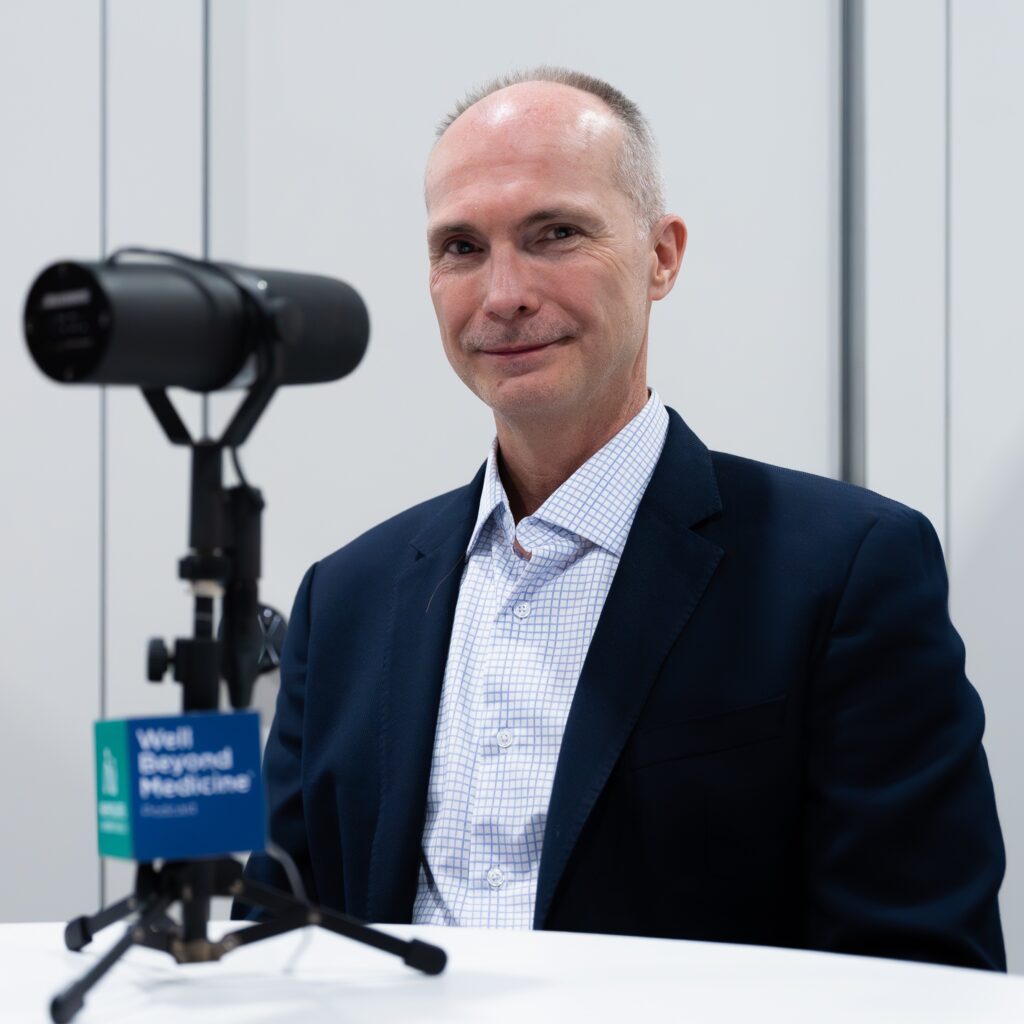
GE HealthCare has launched Care Intellect for Perinatal, a cloud-first digital solution designed to improve safety and outcomes for mothers and babies during labor and delivery.
Jeff Caron, Chief Digital and Technology Officer, Patient Care Solutions, GE HealthCare, shares how the platform unifies multiple, previously disconnected data sources into a single, real-time patient view that all clinicians can access — a true “single pane of glass.” By reducing data overload and streamlining workflows, it enables care teams to spot emerging risks sooner and respond more quickly and effectively.
The conversation also examines how standardized, data-driven perinatal care can support clinicians without adding to their workload, help address persistent gaps in maternal health outcomes, and create greater consistency across care teams.
Featuring:
Jeff Caron, Chief Digital and Technology Officer, Patient Care Solutions, GE HealthCare
Host/Producer: Carol Vassar
TRANSCRIPT:
Announcer (00:01):
Welcome to Well Beyond Medicine, the world’s top-ranked Children’s Health podcast produced by Nemours Children’s Health. Subscribe on any platform at Nemourswellbeyond.org, or find us on YouTube.
Carol Vassar, podcast host/producer (00:13):
Each week, we’ll be joined by innovators and experts from around the world, exploring anything and everything related to the 85% of child health impacts that occur outside the doctor’s office. I’m your host, Carol Vassar, and now that you are here, let’s go.
Music (00:31):
Let’s go, oh, oh, Well Beyond Medicine.
Carol Vassar, podcast host/producer (00:37):
We’re at HLTH in Las Vegas. With me right now is Jeff Caron. He is the Chief Digital and Technology Officer, Patient Care Solutions at GE Healthcare. And you made a big announcement here at HLTH yesterday. Can you give us a sense of what that was?
Jeff Caron, GE Healthcare (00:55):
Yeah, no, absolutely. So yesterday, we actually announced the release of our CareIntellect for Perinatal Solution, really focusing on helping moms and babies come home safer when they go through labor and delivery. So, it’s a great example of technology coming together based on our CareIntellect platform, which is cloud-first. Built on our building blocks, it provides real-time view of multiple data feeds that represents that patient, so the clinician can see exactly what’s going on with that patient at that point in time. Provides some risk scores to allow us to detect postpartum hemorrhage, shoulder dystocia, so that clinicians can take action and intervene before the problem occurs.
(01:42):
It also looks at a simplified workflow for clinicians. Today, it’s quite surprising. Clinicians, from a fetal monitoring point of view, print out the strip and annotate on paper. So I’ll say that again, annotate on paper. All right? So, what this does is it provides digital tooling that increases consistency and accuracy in scoring the data types for patients, making that available almost in real time for clinicians.
(02:10):
And the last thing that’s pretty exciting is it’s all built on the cloud, and it really creates a different deployment model for our customers. So one is, it allows us to actually deploy that solution within the unit, within the bedroom, within the enterprise, as well as from a mobile point of view. We can actually provide a user experience or the solution to a clinician, regardless of where they are in the world.
Carol Vassar, podcast host/producer (02:37):
So much to unpack there, but I think we go back to the issue to start with, and that was maternal and fetal health outcomes, which are really on the radar of most, if not all, healthcare systems across the world. How does CareIntellect fit into GE Healthcare’s bigger mission to impact outcomes for moms and their babies?
Jeff Caron, GE Healthcare (02:59):
Yeah. If we take a step back and actually talk about the problems within maternal and fetal health, well-being, I usually start with a global statistic.
Carol Vassar, podcast host/producer (03:08):
Okay.
Jeff Caron, GE Healthcare (03:08):
Yeah. So, the WHO had an article or a publication back in 2021. Very surprising factoid: 800 women die from maternal fetal complications every day. Yeah, so very, very interesting and unfortunate.
(03:27):
So if we take that back to the United States, the United States is not doing as well if you think about industrialized countries. About 700 women die yearly, 70 for every 700 almost do. Now, if you think about the load that’s on our existing care teams today, patients are getting sicker, nurse turnover, there’s a lot of burnout. And then lastly, the labor and delivery space is actually one of the highest litigated areas within the United States. So, how is perinatal health? That’s probably where you want to go next, right?
Carol Vassar, podcast host/producer (03:58):
Yes.
Jeff Caron, GE Healthcare (03:59):
So, what we’re doing now is, if you really think about it, going back to what I was talking about, providing a single pane of glass where it aggregates information across all disparate health systems into one single pane of glass, that removes the burden or data overload for clinicians. And they can look at that patient with all the individual data feeds in one place, allowing them to create pretty much an immediate decision on what to do with that patient.
Carol Vassar, podcast host/producer (04:27):
So really, CareIntellect helps to alleviate that data overload. You employ AI, I presume, to help with that. Talk about that.
Jeff Caron, GE Healthcare (04:35):
Yeah. Not AI yet. So ultimately, the CareIntellect solution largely started off with a foundation. And the foundation is leveraging data from disparate data sources, centralizing that, making it available for AI. We have concepts, actually, right now we’re working on, on automatically annotating the fetal heart strip to remove subjectivity. We’re starting to look at gen AI to support automatically summarizing data, and even considering chatbots. So, a companion where the clinician can actually talk to the companion, asking about the condition of the patient.
Carol Vassar, podcast host/producer (05:13):
You mentioned disparate sources. Define that for me. Are we talking about the woman’s health record that might be in a different part of the country or even a different part of the world? Are we talking about clinical decision support that brings forth evidence-based information for the clinician at the bedside that can help with this specific patient? Things like that?
Jeff Caron, GE Healthcare (05:36):
Yeah, yeah. Yes, and. So if you think about the information of the systems that are required to support or to be interrogated or reviewed as a part of the labor care pathway or care area, there’s pumps, pumps that are connected to the drugs or the medications that are provided. Second is the EMR, so the electronic medical record. The third is the fetal heart monitor, so the actual monitor that’s sitting on mom’s belly to understand what’s going on with the baby. There’s the actual patient vitals of the mom, along with protocol information that comes from other systems. These today are all sitting in separate locations, disconnected.
Carol Vassar, podcast host/producer(06:18):
Really?
Jeff Caron, GE Healthcare (06:18):
Really.
Carol Vassar, podcast host/producer(06:19):
And you’re bringing them all together?
Jeff Caron, GE Healthcare (06:21):
Bringing them all together, so that instead of looking at five different systems, the nurse has five different data sources to immediately understand the condition of that patient.
Carol Vassar, podcast host/producer (06:30):
And this is a cloud-first application, isn’t it?
Jeff Caron, GE Healthcare (06:32):
Yeah, cloud-first application.
Carol Vassar, podcast host/producer (06:35):
Talk about the advantages of using that kind of architecture.
Jeff Caron, GE Healthcare (06:38):
Yeah. So, there’s a couple of angles. One is mobility; we can start with that. So there’s a very light IT infrastructure. So your ability to actually deploy this solution at multiple sites without IT getting involved in procuring servers or desktops or laptops, is number one. So, it makes care more accessible to smaller institutions that don’t have a large IT staff. So, that’s one really good one.
(07:06):
Two is scale. As I mentioned, you can actually deploy this in the room, you can deploy this at the unit. You can deploy this at the enterprise, as well as to doctors or clinicians that are not even in the country. So, it allows for immediate scale and the same experience no matter who the persona is.
(07:26):
And then the last thing with cloud is, I probably say elasticity. Right? So one thing that’s with cloud is, you may not know exactly how many babies that are coming in that month. Right? So you can actually scale up automatically with the load that comes in when high periods and months, and actually scale down and spend a little bit less when you’re actually not having a lot of babies coming through.
Carol Vassar, podcast host/producer (07:54):
That’s amazing stuff. Now, one of the other disparate sources of information are the people that are surrounding the labor that’s ongoing, the baby, the mother. How does this platform help to facilitate the communication between labor and delivery nurses, OBGYNs, and others who might be involved in the process?
Jeff Caron, GE Healthcare (08:16):
Yeah, for sure, for sure. Again, CareIntellect for Perinatal being a single pane of glass with all the information that’s required. It’s actually now a tool or is a tool that allows an OBGYN or the nurse, the charge nurse, to have a constructive conversation to look at all the information together at the same time, looking at the exact same information. Typically, you’d have a nurse in a room with a fetal monitor, and you’d actually have an OB in their office looking at the EMR, looking at two different pieces of information.
Carol Vassar, podcast host/producer (08:49):
Yes.
Jeff Caron, GE Healthcare (08:50):
Now, by creating the same experience, you can actually have a very constructive conversation, regardless of who you are and where you are in the hospital.
Carol Vassar, podcast host/producer (08:57):
So, you’ve moved the communication light-years ahead.
Jeff Caron, GE Healthcare (09:01):
Yeah, that’s the goal.
Carol Vassar, podcast host/producer (09:03):
You are working with HCA Healthcare on implementation and validation. Talk about that. How’s it working out there in the field? They’re a big system.
Jeff Caron, GE Healthcare (09:14):
No, absolutely. I mean, the big system is, it’s actually a bonus, right? And you say validation and deployment, it’s actually more than that. How the engagement started is we work with their innovation team, so as the digital technology and innovation organization. And their goal is actually to work with companies like us to help design and develop and collaborate in creating new solutions, with two key goals. One is increasing care, and the second is not adding load to the system. Right? So technology’s great, but if it just adds load, then nurses and clinicians won’t adopt it.
(09:53):
So, through working with the digital technology and innovation organization within HCA, they actually created an environment where we could test, evaluate, and really troubleshoot the workflow to make sure that it was something that nurses would use. And then from a verification validation point of view, it was actually quite cool. We were able to test with a large number of nurses. Was at 29 physicians, 85 nurses, and 14 caregivers.
Carol Vassar, podcast host/producer (10:21):
So you had nurses, OBGYNs, caregivers, right there at the development stage?
Jeff Caron, GE Healthcare (10:27):
Correct, yeah, as well as in the test stage. So after we developed and thought we did something well, we can now scale that and test it across the HCA system, which is actually quite novel. It’s very few companies or hospitals where you can go from five users to testing with over 100, within couple of days.
Carol Vassar, podcast host/producer (10:45):
What’s the early feedback from the physicians, the clinicians, and even the parents?
Jeff Caron, GE Healthcare (10:50):
Yeah, I mean, so-
Carol Vassar, podcast host/producer (10:51):
Do the parents even notice?
Jeff Caron, GE Healthcare (10:52):
Yeah, that’s a great question. I mean, we’ll start with the clinicians. Feedback’s been great, right? So what we’ve been seeing is, again, that single pane of glass and directed workflow, allowing for consistent annotation, has been one of the number one features. The second, we’ve added a search feature. So it’s very difficult sometimes to find data within the EMR. So we’ve allowed for a quick natural language search to say, “Hey, show me all the times that this patient was injected with oxytocin,” and it’ll quickly pull up a list. If you were to look through that within the EMR, could take up to 10 minutes. Right? So that search time has been awesome.
(11:29):
Family-wise, I think that’s something we’ve got to test in the future, but we see CareIntellect as Perinatal as a tool to also help communicate to the patient as to their clinical status.
Carol Vassar, podcast host/producer (11:41):
How do you balance, I mean, we’ve got human beings at every stage of development, every stage of the rollout, every stage of the process. How do you balance the technology and the human aspect of the product?
Jeff Caron, GE Healthcare (11:54):
Yeah, yeah, that’s a great question, and I think that’s where HCA has helped a ton. Right? So one is, you can make the best technology but without change management, it just doesn’t work. And change management comes with adoption, right? So that’s the first thing. Having a strong change management plan when you’re deploying a technology, which includes education, it includes communications, as well as includes training.
(12:20):
Now the second part is trust, right? So you talked about AI. So, clinicians need to trust it. And the advantage of actually collaborating with HCA and developing it hand-in-hand, they’ve achieved trust almost immediately because they’ve been part of the process instead of something being handed to them.
(12:41):
And I think the last part is really a mentorship program. So you’ll always have new nurses and senior or more experienced nurses, and creating a community where you help each other really allows for the nurses to help each other in adopting the technology that they may not understand.
Carol Vassar, podcast host/producer (12:57):
Where do you see this going now that you’ve announced it, now that HCA is using it? You’ve got some early results from them. Where’s it going next? How are we going to scale this?
Jeff Caron, GE Healthcare (13:07):
Yeah, I mean, ultimately it’s ready for sale, right? So we’re actually, so that’s probably the first thing. So, we’re looking to deploy it across our system. Not a lot of people know this, but we’ve actually been in the fetal monitoring or perinatal space for about 30 years now.
Carol Vassar, podcast host/producer (13:24):
Oh.
Jeff Caron, GE Healthcare (13:24):
Yeah. So, we’ve birthed over 75 million babies in the past 30 years, as well as probably have about 40% market share. Right? We’ve got a huge US base with a ton of trust. So first is, we’re looking to engage our existing customers and show them the new technologies that we’re bringing in. The second is, we’re looking at scaling outside of our existing customers. And then last, which is probably most pertinent, is providing clinical evidence that the tool is working to help adoption.
(13:59):
So we have a couple of peer-reviewed papers that we’re going to be publishing. One is already published around our fetal heart rate. The second is around the value of clinical decision support and how it minimizes or impacts or lessens C-sections. And then last is, we have an oral presentation. And these scientific publications, all peer-reviewed, are really to help us and clinicians understand what we’re building to help adoption and scale in the future.
Carol Vassar, podcast host/producer (14:26):
We began our conversation laying out the issue of maternal health, fetal health in the US, in the world today. It could be much better. How do you see the tool moving forward, especially in areas where we’re seeing some not-so-great numbers, especially in Black maternal health? How do you see this tool raising all the boats here?
Jeff Caron, GE Healthcare (14:52):
Yeah, that’s a great question. I mean, so one of our statements or one of the visions is to provide the same level of care, regardless of who’s treating the patient, regardless of who’s in the bed, no matter where they are in the world. Right? So, that’s kind of our number one mandate.
(15:13):
And if we think about it, and you’re 100% right, three times the Black women are impacted by maternal fetal complications. So what we’re thinking with this technology, it provides more consistent and accurate recording of fetal measures, patient conditions, specifically mom. It allows for a more consistent, more continuous fetal tracing for our decelerations, accelerations, and contractions. And this consistency will actually help create a better, more solid, and constructive record that can be used to treat a specific patient.
Carol Vassar, podcast host/producer (15:52):
Ten years down the line, where do you want to see this?
Jeff Caron, GE Healthcare (15:55):
I mean, ultimately solve world peace, of course.
Carol Vassar, podcast host/producer (15:58):
Of course. That’s number one. Always number one.
Jeff Caron, GE Healthcare (16:01):
Number one. But one step back from that, we’d love to see a solution like this scaled, globally used across the world.
Carol Vassar, podcast host/producer (16:08):
What does success look like 10 years down the line?
Jeff Caron, GE Healthcare (16:10):
Success? I’d probably say if we can reduce maternal fetal complications by a certain percentage, 2%, 3%, 4%, that would be an absolute success.
Carol Vassar, podcast host/producer (16:25):
Technology that is putting the focus on patients and their care! Just one of the many topics we cover on the Nemours Well Beyond Medicine podcast. Thanks to Jeff Caron from GE HealthCare for joining us to talk about CareIntellect and its applications in the perinatal space.
Our interview was recorded in October 2025 at HLTH in Las Vegas, and is part of a series of podcast episodes recorded at that time featuring healthcare leaders from across a wide range of sectors speaking to the work they’re doing that positively impacts children’s health. Check out this series and all of our podcast episodes on your favorite podcast app and smart speaker, the Nemours YouTube Channel, and on our website: nemourswellbeyond.org. Visit there to leave a podcast episode idea, a review, or subscribe to the podcast and our monthly e-newsletter. That address again is nemourswellbeyond.org.
Our production team for this episode includes Susan Masucci, Lauren Teta, Cheryl Munn, and Alex Wall. Video production by Sebastian Reilla and Britt Moore. Audio production by yours truly. On-site production assistance provided by Robbie Dorius and his team from HLTH. Thank you to them.
I’m Carol Vassar. Thank you for listening. Join us next time as we explore the definition of the word “fact,” and the importance of facts in the healthcare space! Until then, remember, we can change children’s health for good, well beyond medicine.