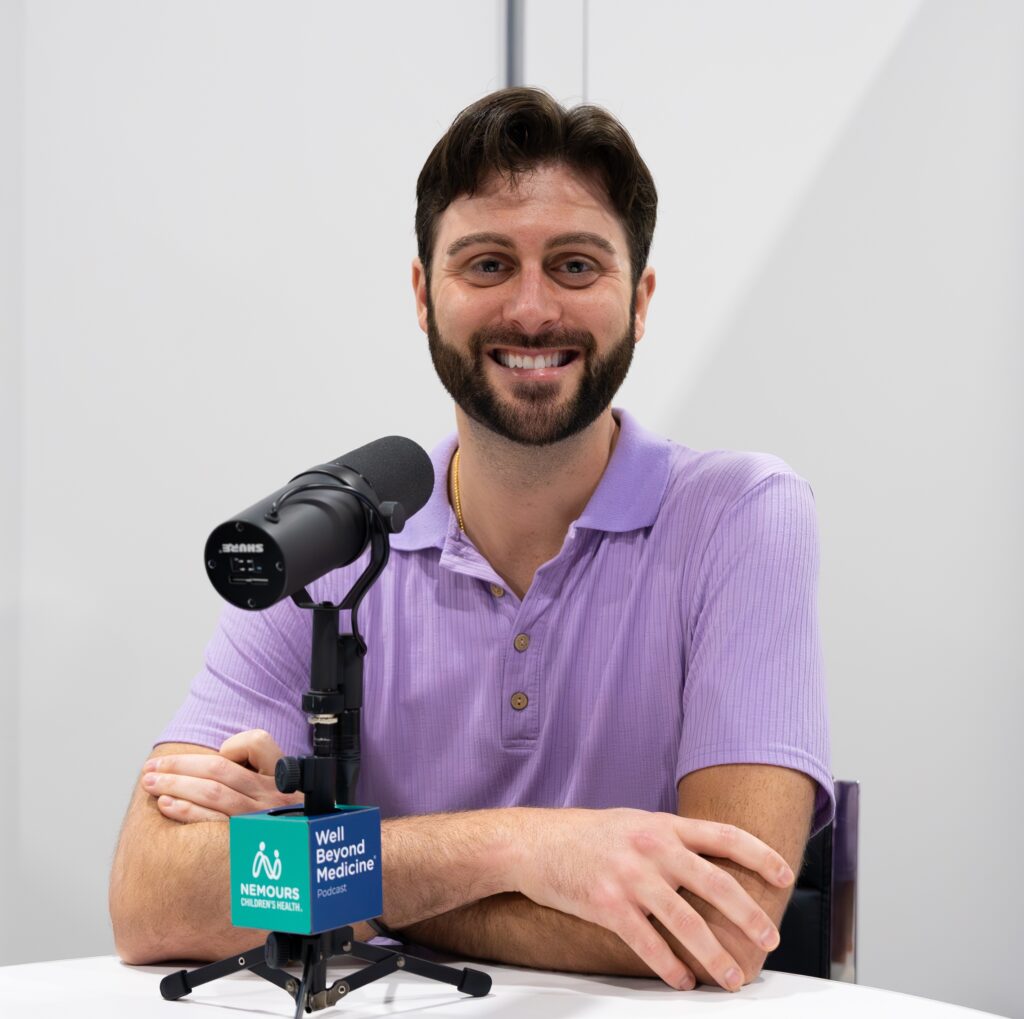
What if one of the most powerful tools for preventing disease is already in your kitchen? Dr. Nathan Wood is a physician, trained chef and director of culinary medicine at Yale School of Medicine. He discusses how teaching kitchens translate nutrition science into practical, hands-on training for medical students, patients and families. Dr. Wood also explains why home cooking is one of the most accessible tools for disease prevention, particularly in pediatrics and shares strategies to help families make healthy eating affordable, realistic and engaging for children and teens.
Featuring: Nathan Wood, MD, Director, Culinary Medicine, Yale School of Medicine/Yale-New Haven Health System
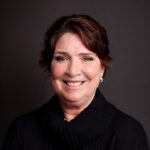
Host/Producer: Carol Vassar
Announcer (00:00):
Welcome to Well Beyond Medicine, the world’s top-ranked children’s health podcast, produced by Nemours Children’s Health. Subscribe on any platform at nemourswellbeyond.org or find us on YouTube.
Carol Vassar, podcast host/producer (00:12):
Each week, we’ll be joined by innovators and experts from around the world, exploring anything and everything related to the 85% of child health impacts that occur outside the doctor’s office. I’m your host, Carol Vassar. And now that you’re here, let’s go.
MUSIC (00:30):
Let’s go, oh, oh.
(00:33):
Well Beyond Medicine.
Carol Vassar, podcast host/producer (00:36):
We are at Health 2025. The Nemours booth is on podcast row, and I am so pleased to have with me Dr. Nathan Wood. Nate.
Dr. Nate Wood, Yale School of Medicine (00:44):
Nate.
Carol Vassar, podcast host/producer (00:45):
Who is not only an MD, but he’s a chef, and he is the very first, I believe, director of culinary medicine for the Yale School of Medicine and Yale New Haven Health System. Welcome.
Dr. Nate Wood, Yale School of Medicine (00:58):
Thank you. Thank you for having me.
Carol Vassar, podcast host/producer (00:59):
We’re going to be talking about food as medicine and all the work you’re doing in that culinary sphere, but I want to talk about you first. You trained as a professional chef.
Dr. Nate Wood, Yale School of Medicine (01:08):
Yes.
Carol Vassar, podcast host/producer(01:09):
You trained as a physician first.
Dr. Nate Wood, Yale School of Medicine (01:10):
Yes.
Carol Vassar, podcast host/producer (01:10):
Went on to become a chef, came back to the world of medicine.
Dr. Nate Wood, Yale School of Medicine (01:13):
You got it.
Carol Vassar, podcast host/producer (01:14):
What inspired that kind of transfer and that path to get you to where you are now as the inaugural head of culinary medicine at Yale?
Carol Vassar, podcast host/producer (01:24):
Yes. Yeah. Well, thanks again for having me. Yeah. I was in medical school, and I knew I loved cooking, I loved food, but suddenly my whole life was consumed with studying the human body, which I also found interesting, but I just really missed that variety of thinking about food and cooking. And at the same time, as we were learning in medical school about how to prevent and treat chronic diseases, really, I was learning nothing about nutrition. And so I saw that kind of gap. And at the time, there was this new field called culinary medicine coming to be, and I thought, “Oh, maybe, maybe that’s the secret here, how I can combine my interests in food and nutrition and cooking with my love of medicine and helping people improve their health.” So that’s when I decided to go to culinary school to better prepare myself to do that. And I’ve been really lucky to find a way to be practicing culinary medicine in my career now.
Carol Vassar, podcast host/producer (02:09):
So you went to culinary school to enhance your medical education in some ways.
Dr. Nate Wood, Yale School of Medicine (02:14):
Yeah. I felt there was something missing in my medical education, and I found it in culinary school. Interesting.
Carol Vassar, podcast host/producer(02:18):
Culinary medicine is a new term.
Dr. Nate Wood, Yale School of Medicine (02:20):
Yes.
Carol Vassar, podcast host/producer(02:20):
A lot of people are not familiar with it. What is it?
Dr. Nate Wood, Yale School of Medicine (02:23):
Yeah, great question. So culinary medicine, we have teaching kitchens. It can either be on Zoom, which is super easy, or we have an in-person teaching kitchen. And what we’ll do is we’ll bring in either patients or trainees, and we teach them about nutrition, and then we immediately do hands-on cooking to reinforce those learning objectives. So it’s kind of like our biology lab after our biology lecture, and we find that it really helps people understand the content. And so the goal is to help people improve their health, whether that’s preventing disease down the line, or better managing blood sugars, or their blood pressure, or their blood cholesterol. And it works for patients, and it works for our medical students and residents, too. It’s really fun.
Carol Vassar, podcast host/producer (02:54):
Let’s talk about how it works for each of those populations. I’m curious about the medical students. What is it they do? They come in, they cook. How do they take to that? What’s their response to it?
Dr. Nate Wood, Yale School of Medicine (03:05):
Yeah, I mean, it’s just so much fun. So that’s the deal, is that cooking with your friends and your colleagues is just fun. It’s team building, and it’s really a nice break from all the lectures that you’re otherwise doing in medical school. So the med students come in, we sit down, we do a lecture or a small group discussion. You could do a journal club. You could break them into small groups and have some discussions in that way. And then we go, like I said, into the kitchen and actually do the hands-on cooking. So, for instance, we teach a class on food and nutrition insecurity, talking about food deserts and swamps and kind of the systemic underpinnings of why we have these areas where it’s difficult for people to get access to nutritious food, what we can do about it, how that impacts our health.
(03:40):
And then we go into the kitchen and cook recipes made from ingredients found in the local community at our patients’ grocery stores that they’re shopping at. The recipes cost three-ish dollars a serving. They make use of canned legumes and frozen vegetables. And it really brings it to life. And they’re able to see like, “Oh, this is how if I live in a food desert and I only have access to a corner store, how I might be able to improve my nutrition.” And it gives them a better idea of how they can counsel their patients, which is the ultimate goal.
Carol Vassar, podcast host/producer (04:06):
And when you bring patients in, how do you decide who comes in, gets those classes, how do they react?
Dr. Nate Wood, Yale School of Medicine (04:11):
Yeah. And so, compared to the med students, we’re teaching the med students how to talk to patients, hoping that the patients can improve their health. When you bring the patients in, it’s very, very direct. You are coming in because you want to improve A, B, C, X, Y, Z. How can we counsel you on diet in order to improve some of those things? And so it’s much more direct, but we take everyone. So all Yale New Haven Health patients can be referred by any one of their doctors, and they can all come in for free. So it’s not like a gated system, and there’s not an application where we’re grading people and deciding who can come in because we really think everyone could benefit from this, no matter their health conditions.
Carol Vassar, podcast host/producer (04:44):
And I think you mentioned you do have kids starting at age 13 who take some of the classes. Talk about that 13 to 18-year-old group and how they react when they come in.
Dr. Nate Wood, Yale School of Medicine (04:53):
Yeah, it’s fun. They come in with their parents, of course. And so often the parents are being referred for one of their health conditions, but then they say, “Oh, this is something that runs in the family.” Or, “I want my kid to be on board with these changes that we’re going to make at home when it comes to our diet.” And I think bringing in the teenagers is like a really great way to get their buy-in. If you can convince the teenager to come into the kitchen with their parents, but they have so much fun. I mean, we do cool classes. We do one on snacks. There’s one where we make a cheeseburger pasta, which is like a perennial favorite of the teenagers, and healthier versions, sneaking in a whole bunch of vegetables and using a whole grain pasta and a lean, lean ground beef, things like that.
(05:31):
So yeah, I find that they really enjoy it because we’re not saying you have to stop eating all these snacks that your friends are eating at school and switch over to just vegetables. We’re saying like, “How can we make food that tastes good and feels accessible to teenagers, but still make it healthy?”
Carol Vassar, podcast host/producer (05:46):
When it comes to culinary medicine, and we’re talking in the pediatric realm, how can families cook
Dr. Nate Wood, Yale School of Medicine (05:59):
Yeah, that’s a great question. I think that even just cooking at home is step one. So I think a lot of folks find that they just don’t have time to cook at home, which I totally understand. So they’re getting most of their food from fast-food restaurants or takeout places, or they’re doing a lot of frozen foods that you just heat up in the air fryer or in the oven. And I think all of those options are valid. And I don’t see a world where all of those things are going away. But the more that you can teach your kids how to cook at home, I think the better. And it’s not necessarily like bring them into the kitchen, this becomes a classroom. Class has started, this is how you use a knife, this is how you cook. It’s just like a fun, it can be a fun family activity where you have your little sous chefs and you’re all working together on something that you can get to sit down and enjoy.
(06:42):
And I think showing those kids those lifelong skills and then being able to enjoy the fruits of your labor together as a family, they’re going to appreciate it much more. And I think be willing to try more foods that they might not otherwise be willing to try.
Carol Vassar, podcast host/producer (06:54):
Are the parents adventurous enough to bring in those new foods? I know I wasn’t, but my daughter with my granddaughter is.
Dr. Nate Wood, Yale School of Medicine(07:00):
Yeah. Yeah, that’s a good point. Yeah. Sometimes it’s the parents who are like, “We’re going to try this new thing.” And sometimes it’s the kids who maybe had something at school, and they’re like, “I want to try this. I want to try that.” And then you have to find that middle ground where both are willing to try it. But I think the key is cooking it together at home. It really brings people together.
Carol Vassar, podcast host/producer (07:16):
Cooking together and eating together is a big component of making sure that the family is staying together, communicating together, isn’t it?
Dr. Nate Wood, Yale School of Medicine (07:23):
Certainly. But eating together is the most fun part. Yeah, absolutely.
Carol Vassar, podcast host/producer (07:26):
Of course. After all that labor, you want to eat.
Dr. Nate Wood, Yale School of Medicine (07:28):
Oh, definitely. Yeah, sure.
Carol Vassar, podcast host/producer (07:29):
Talk about how getting off on that right food really is a preventative. Pediatrics is a preventative field in terms of cardiovascular health, preventing diabetes, and that kind of thing.
Dr. Nate Wood, Yale School of Medicine (07:40):
Yeah. So I run a weight management clinic at the New Haven Primary Care Consortium with our residents, and we see a lot of patients who have gained weight and are interested in losing weight. And one of the questions that we ask is, when did this first become something that you were thinking about? Was this something that where you gained weight in college, or you went through a stressful time in your 40s, and you gained weight? Or is this something that, for as long as you can remember, has been an issue? And for a lot of patients, it’s something as long as I can remember, going back to early in childhood.
(08:06):
And so I think back to my childhood and both of my parents worked and my mom would make dinner every night and I’m sure that was such a burden for her that’s a lot of work to think about what I’m going to make, to make sure we have all the ingredients, to come home after working eight or more hours and then being standing in the kitchen for an hour to do all that, to do all the cleanup. It can be a lot, right? But then we would sit down as a family, and we would eat. And at every meal, there was a grain, a protein, a vegetable, and if we didn’t eat the vegetable, we couldn’t get dessert. And it was, I mean, just common sense, old school rules that I think really set us off on the right foot of this is what a balanced meal looks like. This is what it’s like to cook food at home in a realistic way.
(08:45):
She wasn’t at the stove for hours every day making elaborate influencer-worthy meals, right? But they were healthy-ish, and we made them at home. We grew some food in our backyard to save money, not because it was like hip or anything like that. And that really set us all up to where now me, my brother, my sister, we all cook, and I think we all also eat and enjoy snacks and things like that, but it really just set the stage for if you want a lifetime of health, eating vegetables and cooking at home is where to begin. And that simple message was conveyed not through deliberate effort, but just through everyday actions. And so I think a lot of folks could benefit from that.
Carol Vassar, podcast host/producer (09:21):
How can pediatricians, when they are facing patients, they are primary care, the first step, when kids are being seen for their well visits or for their sick visits. How can pediatricians emphasize and underscore what you just talked about, that parents, you really have a responsibility here for getting your kids, as I said earlier, off on the right foot in terms of their food intake.
Dr. Nate Wood, Yale School of Medicine (09:45):
Yeah. It’s so hard, I think, because from the doctor’s standpoint, I so often, I’m asking so much of my patients, “Take all these meds, go to all these specialist appointments, get all these tests.” And then I’m going to say, “And also, be sure you’re cooking every day at home. This is really important for you and your kids, and it’s your responsibility.” And I think we as physicians feel that weight like, “Oh, gosh. I’m asking so much of my patients.” So I feel for the pediatricians who know that’s important, but don’t necessarily want to ask that of patients. But I would say that if parents are coming in and they’re concerned about their kids’ nutrition, which I feel like probably most parents are, that we can have this really simple message of you don’t have to deeply understand nutrition science, you don’t have to go down these rabbit holes on social media of specific food additives and ingredients.
(10:29):
It’s just cook at home, just cook at home. And it doesn’t have to be every day, it doesn’t have to be the world’s healthiest recipes, but the more you can cook at home, the healthier kids are going to be, and that’s going to set them up to be cooking at home the rest of their life, which we just know is one of the most important things that we can do for our health. And like we’ve talked about before, it can be a fun family activity. And then 40 years down the line, when your kids have long moved out of the house, when they’re cooking with your now grandchildren, I just can’t even imagine how enjoyable that must be to watch, knowing that you set that into motion decades ago.
Carol Vassar, podcast host/producer (10:58):
Many families look at healthy eating as expensive.
Dr. Nate Wood, Yale School of Medicine (11:02):
Yes.
Carol Vassar, podcast host/producer(11:02):
They worry that “Oh, I have to buy all organic ingredients.” Or what kinds of strategies should parents employ? And I think you alluded to this a little bit earlier, is it doesn’t have to be expensive so that they can make sure kids are eating nutritiously.
Dr. Nate Wood, Yale School of Medicine (11:19):
Yes. It’s difficult. It requires a lot of planning, but it can be done. So ultra-processed foods, convenience foods, fast foods, they can be cheap, but oftentimes they’re very expensive. If you go to a fast food restaurant or a restaurant, you’re paying for them preparing that food, right? Whereas if you prepare it yourself at home, you don’t have to pay for that labor, right? So it can be money-saving. We tell patients a lot to focus on canned and frozen ingredients. I think canned ingredients get really villainized because the amount of sodium, but you can buy lower no-sodium versions, or if you can’t, you just rinse it off in a colander in the sink. Very simple, like having those pantry staples available at all times, grains are extremely cheap, right? So I work with a chef dietician, and his name is Max, and he always talks about how grains and beans, you buy them dried and they’re the only things that get bigger when you cook them, right?
(12:04):
So, like, you buy these things, they’re cheap, and then you boil them at home, and they get even bigger, right? So when you’re thinking about cost, the more room it takes up in your stomach, the cheaper it’s going to be, kind of per volume. We focus on frozen veg a lot because it’s just as healthy, if not healthier than fresh, and it lasts much longer. So that’s really empowering for patients. We talk about buying in bulk, things that you use a lot, things that you can buy on sale, of course, will save you money. If you can eat with the seasons, especially when it comes to that fresh produce where people think about it being so expensive, you can save a lot of money buying things that are in season. Right now, I’m buying a lot of peaches, right? A couple months ago, it was a lot of tomatoes, right?
(12:39):
So eating with the seasons. And then coupons can be really good for things that you’re buying already. And so I tell this story about growing up, my mom, every Tuesday night, would sit down, and she would take all of the grocery stores, and she would look at their ads and say, “What are the things I want to buy at each of these grocery stores?” Circle it in a big black Sharpie, and then take all of these ads and all of these coupons to Walmart, where they would price match. And then she would get all of our food for the week at all of the lowest prices with all of the applicable coupons. And through that savvy, we were really able to eat in a time when we were on a single income without any concern for food or nutrition insecurity. And so I’ve seen this done because my mom used to do it growing up. And so, as silly as it sounds, “Oh, clip coupons, buy with sales.” It really can make a huge difference.
Carol Vassar, podcast host/producer (13:27):
And it’s different today because it’s all digitized.
Dr. Nate Wood, Yale School of Medicine (13:27):
Right. It kind of is a little bit easier. You can just do a little search and take your app. You don’t have to have this big coupon expandable book.
Carol Vassar, podcast host/producer (13:32):
Which I used to have.
Dr. Nate Wood, Yale School of Medicine (13:33):
Yes. Love it.
Carol Vassar, podcast host/producer (13:34):
It’s how I fed my family.
Dr. Nate Wood, Yale School of Medicine (13:35):
Yep, yep.
Carol Vassar, podcast host/producer (13:36):
I want to talk about the pandemic and a totally different subject. You went viral. You’re a singer. You have a fabulous voice.
Dr. Nate Wood, Yale School of Medicine (13:47):
Oh, thank you.
Carol Vassar, podcast host/producer(13:47):
And you did this rendition of Lean On Me, and it was pretty early, and you were talking, it seems like you were dedicating that to your colleagues who were working, you yourself working, on the floors with COVID patients. What did that tell you about health education, and did it help you to kind of renew a sense of trust in humanity?
Dr. Nate Wood, Yale School of Medicine (14:12):
Yeah. Yeah. That was a really different time, wasn’t it? Yeah, it was an interesting time in my training because I was a brand-new doctor. I was still an intern. So it’s not like I had been practicing in medicine for a long time, had gotten burnt out, and then this renewed some sense of the purpose of medicine for me. It was really at a fragile time where I was just beginning to learn medicine, and I looked to my attendings and those above me as really knowing everything about how to treat human conditions, right? And then COVID came, and suddenly no one knew anything about how to treat this, including my attendings. We had no research, and suddenly, I as the intern, and my attending, we were on an even playing field and it was really, really jarring to see that like, oh, I was jarred by this, but so were all the people who I generally would look to for advice and medical knowledge, right?
(14:58):
So that was jarring. But then at the same time, the whole world was… Remember, at that time, we really thought highly of medical professionals, right? It seems so different than where we’re at today, but it was really like early in my career being like, “Oh, what I’ve chosen to do for a profession really is profoundly important.” Whereas I don’t think I had really realized that yet. It was so early in my career. I was just writing little notes as an intern and putting in orders here and there, but like the big thoughts behind the medicine were coming from my residents and my attendings. And I was just doing a bunch of little tasks, or so it felt. And then suddenly we were thrust into this, and I’m like, “Oh, I am walking into what has to be one of the most professionally fulfilling jobs.” It’s life or death. So I think realizing that so early on was a big blessing to set me up for the rest of my career.
Carol Vassar, podcast host/producer(15:50):
In what ways? Do you think you’ll carry that with you, it sounds like?
Dr. Nate Wood, Yale School of Medicine (15:52):
Yes, definitely. Yes. Yeah. A lot of big T trauma coming from COVID and having to take care of all those patients, but just realizing that even when we don’t have a lot of medical treatments, that having someone trusted at the bedside with the patients was such a gift to those patients. And then I think perhaps even more so to the families who were really just looking for answers or going through this traumatic event where they were watching what was happening to their family members in the hospital. And to be able to be a source of like calm, clear communication and empathy showed me that even when we don’t have medicines or treatments that are really effective and sometimes we don’t know what we’re doing and we’re just hoping for the best and sometimes we’re just waiting on the tincture of time to do its work that being that empathetic and calm presence can be a good source of medicine.
Carol Vassar, podcast host/producer (16:49):
And here you are, director of culinary medicine at Yale.
What’s happening in the world of research under your umbrella?
Dr. Nate Wood, Yale School of Medicine(16:58):
Yeah. So we do a couple of types of research. I was really trained in medical education scholarships. So we develop curricula and then test them in novel ways, and really focus on medical trainees, which is, of course, becoming a huge topic now in the current administration, how we’re looking to better train our nation’s physicians in nutrition. And so we focus on teaching medical students and residents, and really a wide variety of residents, urology, psychiatry, primary care. We had the nephrology fellows in recently because we really believe that so many people deserve to know about nutrition. So we develop curricula and test those. And then we do some patient outcomes research as well. So all these patients are coming into our kitchen, and we’re saying, “How is this impacting your life and your health and improving things for you at home and in your kitchen?” And so we do a couple different types of research there.
(17:42):
And then in the research community writ large, I think there’s this growing movement towards food is medicine, of which culinary medicine is a part, but really thinking about how can we take medically-tailored groceries, medically-tailored meals, produce prescription programs, and combine that with culinary and nutrition education in teaching kitchens, and what might those outcomes look like? So it’s an exciting time, for sure.
Carol Vassar, podcast host/producer(18:04):
Still a lot to come. What do you want to see in the world of culinary medicine or food as medicine in five years?
Dr. Nate Wood, Yale School of Medicine (18:11):
Yeah, that’s a great question. Culinary medicine is really being utilized, I think, quite well to teach medical trainees, and there’s a lot of literature out there on that. It’s increasingly being used in community-based settings where people go to a community teaching kitchen and learn some healthy cooking from folks in the community. I think we need a larger uptake in healthcare. And so we’re lucky, like we’ve been talking about, to have this teaching kitchen embedded in our healthcare system at Yale, but that’s actually not a very typical model. Most of these are in schools or in communities. So I would really like to see more culinary medicine in teaching kitchens in healthcare for patients to be referred to. So that’s a big one. And then these, as I mentioned, produce prescription programs, medically-tailored groceries, and medically-tailored meals; they pair so well with culinary medicine.
(18:56):
Imagine, you get a diagnosis of pre-diabetes and then your doctor is able to prescribe you a produce prescription program so that you have access to lots of fresh fruits and vegetables because they can be so expensive or perhaps folks aren’t willing to buy them at the store because they’re not sure if their family’s going to like it and they might end up wasting them, right? But imagine that it’s delivered to your door for free, and then you might as well try it. And then, but you get an eggplant, and you don’t know how to use an eggplant. What am I going to make with that? But you can go to the teaching kitchen that week and learn how to make something with eggplant, and then you can go ahead and try it at home and show your family. So even when that produce prescription program ends, you still have gained all that knowledge. A, we like eggplant. B, here is how I make it. C, I know the recipe, and I know that my family likes it.
Carol Vassar, podcast host/producer (19:35):
As we look at a very tech-heavy, screen-heavy, fast-food-heavy world, how would you like to reimagine family mealtime to avoid all of that?
Dr. Nate Wood, Yale School of Medicine (19:46):
Yeah, that’s a great question. Yeah, take away the screens. Maybe that was the leading question. Yeah. But I think back to my childhood, and we had like a 30-minute per day screen limit on weekdays and an hour on weekends, my mom would kick us outside and be like, “Go kick the can, have fun.” And it’s not like I grew up in an era when we didn’t have screens. We did. But like the parents, I feel like sometimes don’t feel empowered to put on that old school parenting hat and be like, “Go be rough and tumble in the yard and get away from the screens.” And you can do the same thing at dinnertime. So at dinnertime, we would do like a rose and a thorn, basically like, “What’s one good thing about your day? What’s one bad thing about your day or something you didn’t like?”
(20:22):
And then we would all eat together. And this is not like a long French-style hour and a half. It was 20 minutes we were at that table, eating and chatting, but it was like a nice diastole, kind of a break at the end of my parents’ workday, at the end of our school day and homework time, before we all kind of were relaxing in the evening or we’re off to soccer practice or who knows what. That diastole in between is so important for bonding and for the appreciation of food. We eat so fast in our cars, at work, and over the sink. And I always tell people that food is one of life’s greatest pleasures, and it deserves to be enjoyed. And I think family mealtime’s a great way to do that.
Carol Vassar, podcast host/producer (20:59):
There is so much more I want to talk to you about. We’re running out of time. We have run out of time, actually. Nate Wood is an MD, Dr. Wood. He’s a chef, and he is the director of culinary medicine for the Yale School of Medicine and Yale New Haven Health Systems in New Haven, my home state of Connecticut. Thank you so much for being on the podcast.
Dr. Nate Wood, Yale School of Medicine (21:19):
It’s such a pleasure. Thanks for having me.
MUSIC:
Well Beyond Medicine
Carol Vassar, podcast host/producer
Thanks again to Dr. Nate Wood for joining us on the podcast, and check out our show notes for some healthy recipes from the Irving and Alice Brown Teaching Kitchen at Yale New Haven Health, including recipes for black bean burgers, one-pot vegetarian cajun pasta, and crispy chicken bites, complete with homemade ranch dressing.
Our interview was recorded in October 2025 at HLTH in Las Vegas and is part of a series of podcast episodes recorded at that time featuring healthcare leaders from across various sectors speaking to the work they’re doing that positively impacts children’s health. More of these episodes are coming your way, right here on the Nemours Well Beyond Medicine Podcast. Check out this series and all of our podcast episodes via your favorite podcast app and smart speaker, the Nemours YouTube Channel, and on our website: nemourswellbeyond.org. Visit there to leave a podcast episode idea, a review, or subscribe to the podcast and our monthly e-newsletter. That address again is nemourswellbeyond.org.
Our production team for this episode includes Susan Masucci, Lauren Teta, Cheryl Munn, and Alex Wall. Video production by Sebastian Reilla and Britt Moore. Audio production by yours truly. On-site production assistance provided by Robbie Dorius and his team from HLTH. Thank you to them.
I’m Carol Vassar. Thank you for listening. Join us next time as we learn what Nike is doing to advance healthy lifestyles for kids and adults alike. Until then, remember, we can change children’s health for good, well beyond medicine.
MUSIC:
Let’s go, oh, oh.
Well Beyond Medicine.