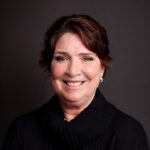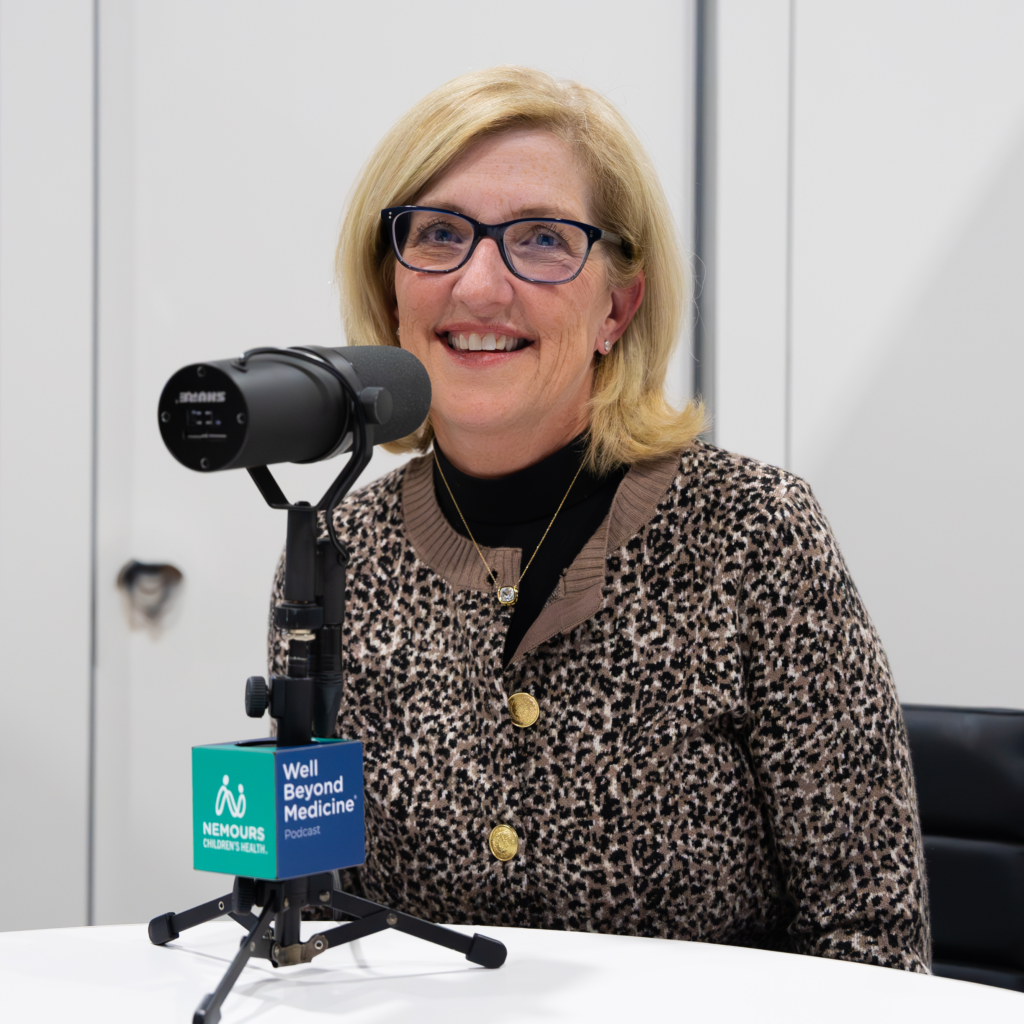
Hospitals can be intimidating for children, especially when they don’t understand what’s happening. Nancy Tinsley, RN, MBA, FACHE, Chairman, Xploro Inc., joins us to discuss Xploro’s gamified platform that uses interactive stories, avatars and games to help kids and families understand medical care. The goal: reduce fear and anxiety while empowering children to take an active role in their healthcare journey.
Featuring:
Nancy Tinsley, RN, MBA, FACHE, Chairman, Xploro Inc.
Host/Producer: Carol Vassar
TRANSCRIPT
Announcer (00:00):
Welcome to Well Beyond Medicine, the world’s top-ranked children’s health podcast, produced by Nemours Children’s Health. Subscribe on any platform at nemourswellbeyond.org or find us on YouTube.
Carol Vassar, podcast host/producer (00:12):
Each week, we’ll be joined by innovators and experts from around the world, exploring anything and everything related to the 85% of child health impacts that occur outside the doctor’s office. I’m your host, Carol Vassar. And now that you’re here, let’s go.
Music (00:30):
Let’s go. Well Beyond Medicine.
Carol Vassar, podcast host/producer (00:35):
Welcome to the Nemours Well Beyond Medicine podcast. We’re at HLTH, and this is a tech conference. We’re going to talk about a very interesting tech way of providing health education for kids. Joining me right now is Nancy Tinsley. She is an RN. She is the executive chair, or the executive chair, I should say, of Xploro. Welcome to the podcast, Nancy.
Nancy Tinsley, RN, Chairman, Xploro, Inc. (00:59):
Thank you, Carol. It’s wonderful to be here and share our story.
Carol Vassar, podcast host/producer (01:02):
You have an administrative background, but this is a startup, if you will.
Nancy Tinsley, RN, Chairman, Xploro, Inc. (01:06):
Yes.
Carol Vassar, podcast host/producer(01:07):
So tell me what Xploro is.
Nancy Tinsley, RN, Chairman, Xploro, Inc. (01:09):
So Xploro is a gamified interactive education platform solution for children who are experiencing healthcare. It’s also for their families, so they share it with their siblings. Obviously, the parents support them with it. But it gives them a way to engage with the experience, understand what’s going to happen in a way that they interact with the platform.
Carol Vassar, podcast host/producer (01:37):
What was the problem to which you were trying to provide a solution and have provided a solution?
Nancy Tinsley, RN, Chairman, Xploro, Inc. (01:45):
Let me tell you a story behind the problem. So here’s the problem from that perspective. A 13-year-old girl was going through cancer treatment for Ewing sarcoma and didn’t fully understand the purpose and standards of her stem cell transplant. And her family struggled with it as well, and she failed her stem cell transplant. As she went along that journey, the healthcare providers were talking with her parents about what was going to go on, and not including her in the conversation and in the decision-making, which led her to not trust the health system and what was going to happen. That’s the story of Izzy. Izzy is the daughter of our founder, Dom Raban.
(02:33):
The problem that we’re solving is to empower and educate children in partnership with their family to truly understand and trust healthcare in a way that they engage with it. And we always say that we are turning fear into engagement. Other ways I say that the problem we’re solving is that kids are scared, parents are uninformed, clinicians are burned out and don’t have adequate resources, and the payers are funding this problem that we’re solving.
Carol Vassar, podcast host/producer (03:07):
It’s a gamification model. Talk about the games. Talk about the avatars. Talk about what I-
Nancy Tinsley, RN, Chairman, Xploro, Inc. (03:14):
Oh, it’s so cool.
Carol Vassar, podcast host/producer (03:14):
… would experience if I were a kid going to Xploro.
Nancy Tinsley, RN, Chairman, Xploro, Inc. (03:19):
Imagine this. You log into the system, you create an avatar that looks like you, or however you want it to look. You can go in, and you can create an avatar for your oncologist or for your nurse or for your dentist or for whatever clinicians that you’re engaging with, with your healthcare experience. You then go in, and I’ll use the example of a child going through cancer. You can go in and download the storybooks to learn about what chemotherapy is about. Why do they do it? What does it involve? You can then go into the games and play a game where you kill the cancer cells just like the chemo.
(04:03):
And you can go into an environment where it’ll take you through what does the chemo unit look like? Or if you’re having an MRI, what does an MRI look like? What does it sound like? How do I hold still during an MRI? So when you look at all that, it’s gamified, it’s interactive, and the child is in charge of it. And it’s them, they can jump up in the dentist chair. They can lay on the MRI machine, and they are in charge of the activity of their avatar. So there’s many, many different collections, whether it’s oncology, surgery, radiology. We’re embarking on a dental collection for… Obviously, we all know dental care is scary. Whether you’re an adult or a child, there’s a certain level of fear. So it’s absolutely gamified.
Carol Vassar, podcast host/producer (04:54):
How do you strike that balance? You’re getting the information out. The kids have a fear of hospitals or maybe a fear of what’s happening to them medically, and making sure that that is medically accurate information, evidence-based information, and that they’re retaining it.
Nancy Tinsley, RN, Chairman, Xploro, Inc. (05:16):
Obviously, we work with all the clinicians on the evidence-based protocols. All the clinical professions have published their protocols, and we look to neutralize the delivery in a way that they understand the medical purpose, yet they also understand what it means to them and how they can interpret it.
(05:36):
And with that, so we have something really cool. We have many things really cool, but this is the one I’ll tell you. We have an expert advisory board made up of children, seven to 17 years old. And they’ve engaged with the health system either as they have chronic care conditions, they’ve gone through acute care like cancer or other surgical procedures, or they’re significantly neurodiverse. They actually go through our content, give us feedback. And of course, we work with all of our clinical teams and partners to make sure that we’re not changing the intent of the purpose of the education. So that’s really cool from that perspective.
Carol Vassar, podcast host/producer (06:15):
Is seven to 17 the range, or does it go a little bit lower than that?
Nancy Tinsley, RN, Chairman, Xploro, Inc. (06:19):
It does go lower, and honestly, it goes higher.
Carol Vassar, podcast host/producer (06:21):
Okay.
Nancy Tinsley, RN, Chairman, Xploro, Inc. (06:22):
Think of it like Nintendo or the Wii. Any age can play those games. So that’s how we like to think, it’s designed really for any age. We will have parents of toddlers, and the parents themselves aren’t that old. They may have never gone through a CAT scan or an MRI. So when they look at this, and they understand how their child learns, once they take a look at it, they can go through it with their child and explain it to their child in a way they know they’ll understand. So not too complicated, whether it’s verbal, whether it’s the pictures, whether it’s the video. That’s how we use it, even on the toddler side of things.
Carol Vassar, podcast host/producer (07:01):
How do you make sure that it’s developmentally appropriate and also culturally appropriate?
Nancy Tinsley, RN, Chairman, Xploro, Inc. (07:08):
We are very diverse from the perspective of language, age, and culture. A couple of things, it is a read-aloud, so it will read to the child in many different languages. That’s how we address a lot of the cultural aspects of it. Because when we work with the teams to put it in the various languages, we don’t just translate it, we understand the culture behind how they deliver the education. So there’s that piece of it. So it’s read aloud and it’s in multiple, many languages.
Carol Vassar, podcast host/producer (07:43):
Did I read that Chickawa is one of the languages?
Nancy Tinsley, RN, Chairman, Xploro, Inc. (07:46):
Yes, you did. You did. Some of them become out of need. We have a client that looks at that. So obviously we have English, and Spanish, and Arabic. We recently did an Arabic version, and we can really put it in any language that the client really needs.
Carol Vassar, podcast host/producer (08:06):
This is all evidence-based. You’ve done some research on Xploro and how it affects kids. Talk about how it lowers anxiety and helps to give kids greater confidence as they go into these procedures. And what parts of the platform do you think are driving that change?
Nancy Tinsley, RN, Chairman, Xploro, Inc. (08:28):
The anxiety side, yes, we have published research that demonstrates this gamified education decreases procedural anxiety and increases knowledge and understanding of the healthcare experience. But if we think about what creates anxiety, it is gaps in knowledge and information that create anxiety. It’s human nature to fill those gaps with unfavorable information. That’s what we do in all situations. So obviously we have the evidence, but we know that the sooner we get education and knowledge in patients and families hands, the better they do at managing the fear and anxiety. We can understand how many times they have gone through the platform and how long they have spent on the platform. That also helps clinical teams understand, “I have 20 kids coming in today for radiology. Of those 20 kids, how well do they interact with the platform, and which children should I be most worried about as I deploy my very scarce resources, such as my child life team?” That’s one way that they approach it.
Carol Vassar, podcast host/producer (09:37):
And part of this is pushing it out through the EHR. Is that how it’s done?
Nancy Tinsley, RN, Chairman, Xploro, Inc. (09:42):
It can be pushed out in many ways. One of the things that’s really important to us, is we integrate the platform into the workflow of our clients. We don’t lay this on top of five other ways they’ve been educating their kids and families. We integrate this into the way their workflow works. So, for example, if they adopt the surgical platform and they have a process where, when they schedule the surgical procedure, we can send out the surgical collection. Then, when they do their pre-op phone call or their pre-op visit three to five days before surgery, they can evaluate how well the child and family have used the platform or that they can remind them to use it.
(10:26):
The best part of this is then, when the child comes in, our clinicians are reporting that kids are showing up much more informed, much less anxious. They’re curious and questionable as opposed to fearful. And the clinicians aren’t doing that five-minute rush education, “Here’s what’s going to happen before you go into the OR.” So it’s a whole different… It’s a game-changer in how we’re educating kids and families.
Carol Vassar, podcast host/producer (10:53):
Let’s talk about that workflow for clinicians. This alleviates some stress on them, especially when they have to do the education piece, whether it’s child life or the provider, doesn’t it?
Nancy Tinsley, RN, Chairman, Xploro, Inc. (11:05):
When you think about… We’ve been educating patients for decades. I call it a legacy problem in our industries. We haven’t really given it the kind of attention that it needs to be successful. We’ve had leaflets and pamphlets that are either outdated or might not be as accurate as we would like them, and we don’t have a consistent distribution, and we don’t often evaluate how effective they work. In fact, we know that adult health literacy is 12%. So we know that there’s a big problem. So the health education we have been doing over the past decades, if it was as effective as we would want it to be, our health literacy would be more than 12%.
Carol Vassar, podcast host/producer (11:45):
Okay.
Nancy Tinsley, RN, Chairman, Xploro, Inc. (11:46):
So when you look at that, that’s a key problem that we’re solving for, is improving health literacy of the entire family.
Carol Vassar, podcast host/producer (11:55):
It really works nicely, as you talked about in the overlay, but not in the… It’s not a barrier to what the clinicians are doing. It’s an enhancement to what they’re doing when educating the families.
Nancy Tinsley, RN, Chairman, Xploro, Inc. (12:07):
It’s very helpful for the clinicians. When you think about it, when the kids show up, if they’re knowledgeable and curious and having a conversation with the clinician, versus the clinician has to figure out how to hurry up and educate them. That hurry up and educate them often turns into more anxiety. So it gives tools to the clinicians to say, “We have this workflow where the education collection goes out at one point in the workflow when they get scheduled for surgery. We reinforce it when we do the pre-op teaching. We reinforce it when we do the phone call the night before surgery, and then we do what we call teach back.” So they teach us what they learned when they come in so that we can fill the gaps.
Carol Vassar, podcast host/producer (12:54):
Okay.
Nancy Tinsley, RN, Chairman, Xploro, Inc. (12:55):
The other good thing about this, oh, there’s so many good things, but one good thing is that we have quizzes. So the kids can earn stars and incentives by taking the quiz, and they can take it multiple times. But what the quiz does is, is it informs the clinical team on how much they know. So the clinical team, once again, like I use the radiology example, if there’s 20 children coming in for radiology, not only can I see how well they interacted with the platform, but how well did they do on the quizzes, and who may have taken the quiz multiple times and still struggles with the content. That’s more of a priority for me as someone who took the quiz a couple of times and eventually understood it better. And like I said, when we deploy scarce resources, how do we prioritize? That’s a way to prioritize.
Carol Vassar, podcast host/producer (13:47):
Let’s talk about parents and caregivers. They must have a role here in making certain that not only are they informed, maybe using Xploro, but the kids are definitely informed about what’s coming next. What is their role?
Nancy Tinsley, RN, Chairman, Xploro, Inc. (14:02):
The parents’ role?
Carol Vassar, podcast host/producer (14:03):
Yes. Or caregiver.
Nancy Tinsley, RN, Chairman, Xploro, Inc. (14:06):
We look at this from both perspectives. Parents can use the platform. Some parents like to learn it first to understand what the kids are going to be experiencing. I like the opposite of that, where the child will engage with the platform and then teach the parents what they learned. If you do it both ways, they can kind of learn together. Because oftentimes a parent has never gone through a similar healthcare situation, and they’re learning themselves. So the other thing for the family, you have siblings, “Oh, my sibling is starting chemotherapy. My only experience is knowing my aunt went through chemotherapy and had a lot of concerns because I heard them talking. I hear my mom and my aunt talking. So now I’m worried about my siblings.” Now you can have the siblings also go through the platform and reinforce it, and support the child who’s going through the chemotherapy.
Carol Vassar, podcast host/producer (15:02):
Is the content specific to siblings at times?
Nancy Tinsley, RN, Chairman, Xploro, Inc. (15:05):
No, the content is specific-
Carol Vassar, podcast host/producer (15:06):
It’s the same across the board.
Nancy Tinsley, RN, Chairman, Xploro, Inc. (15:07):
It’s the same across the board, like the Nintendo or the Wii.
Carol Vassar, podcast host/producer (15:10):
Okay. I know that lowering anxiety is a big metric for you. What other metrics do you track to discern success?
Nancy Tinsley, RN, Chairman, Xploro, Inc. (15:23):
This is one of my favorite parts, in that when we work with clients, we spend a lot of time discovering what their quality goals are and how Xploro can help our clinical teams achieve their quality goals. So, of course, one of their quality goals is always patient-centric. How do we reduce patient anxiety? How do we improve the experience for the patient? How do we make sure that the patient is involved in discussion around their care? But as important, they have operational goals. How do I decrease the use of pre-op sedation? How do I improve the recovery experience for the kids after surgery? How do I decrease canceled procedures because either they don’t show up or they show up and they aren’t prepared? Either they ate something before the procedure, and they weren’t supposed to, or their anxiety’s too high for the procedure.
(16:19):
So, for example, we have one client who is really working to eliminate the need for sedation before radiology. That is absolutely going to improve their radiology workflow and the amount of time it takes to do radiology procedures. We love to learn all the quality goals that our clients are working to accomplish because Xploro is an enabler for that, to help them achieve those goals.
Carol Vassar, podcast host/producer (16:43):
When you implement this, for years and years and years, it was paper, it was pamphlets.
Nancy Tinsley, RN, Chairman, Xploro, Inc. (16:50):
Right.
Carol Vassar, podcast host/producer (16:51):
Do you find there are barriers? Do you find there is resistance? Do you have to have high-speed internet? What are some of the things you’ve brought up against and been able to resolve?
Nancy Tinsley, RN, Chairman, Xploro, Inc. (17:01):
Yeah. What we love about this is there’s been no resistance at all because everyone knows we’re not really using the leaflets and the pamphlets like we should. In fact, we have photos of empty pamphlet racks and outdated pamphlets in a lot of healthcare waiting rooms, and those things that we want patients to learn while they wait. So the resistance has been minimal. Here’s what we hear about: “We need this really bad. We understand the impact that it has.” And the beauty of implementation is that it’s very easy to be implemented from an IT perspective. It doesn’t involve PHI.
Carol Vassar, podcast host/producer (17:43):
Okay.
Nancy Tinsley, RN, Chairman, Xploro, Inc. (17:44):
So we intentionally built it so that we’re not transferring any PHI within the solution, within the SaaS solution, which could not make it easier. And we work with them from a change management perspective to understand what we’re not going to do for patient education anymore and how we’re going to implement Xploro. Because a really important element of change management is that we remove the old way when we implement the new way, because otherwise we have multiple ways in which we do it. So, usually it’s how quickly and how fast can we get this implemented?
Carol Vassar, podcast host/producer (18:22):
We’re here at Health. We’re hearing all about AI. We talk about augmented reality. We talk about virtual reality. It’s all out there. Do you see tools such as those enhancing children’s health education and maybe even Xploro moving forward?
Nancy Tinsley, RN, Chairman, Xploro, Inc. (18:41):
If you were to say, “What’s that going to look like in future years?” Is we actually have one pilot health system using Xploro as their digital front door. So our future vision is just that, that the Xploro platform is the digital front door. It incorporates the AI and the AR in virtual reality, some of our clients use it in the hospital. It’s a little bit challenging right now simply because it’s so equipment intensive and it’s high cost, but right now from a digital front door perspective, that’s how we see our future, where everyone enters through what is going on in their treatment, what is their plan of care, how are we going to deliver it and Xploro is here to take you through it.
Carol Vassar, podcast host/producer (19:31):
What are the next five years looking like for the Xploro tool?
Nancy Tinsley, RN, Chairman, Xploro, Inc. (19:36):
Right now, we have collections in oncology, surgery, radiology, sleep studies. We’re building dental out, and we’re looking at future collections within high-priority service lines, such as Heart Institute, neuro orthopedics. Those are all kind of on our roadmap.
Carol Vassar, podcast host/producer (19:59):
When you look at a generation, this generation of kids who are getting this kind of education, which is online, which could involve virtual reality in the future, interactive learning, interactive learning about health. What do you hope changes in terms of how they view hospitals, how they view their own bodies, and the idea of being a patient in a hospital or in a clinic?
Nancy Tinsley, RN, Chairman, Xploro, Inc. (20:27):
I would use one word: empowerment. How do we empower the kids to take charge of their healthcare, take charge of their health experience by using Xploro to engage them in it, and make sure that they understand that? Really, so that they trust the health system and they see it as a partnership in which they’re going to get better. How are they going to learn how to get better? How are they going to learn to manage whatever chronic disease that they have? How are they learning to build their health behavior? So that maybe when they’re adults, health literacy is more than 12. Wouldn’t that be a great goal?
Carol Vassar, podcast host/producer (21:11):
That would be a great goal. Have you thought about tracking that over time longitudinally when they enter adulthood, maybe looking back at their Xploro experience?
Nancy Tinsley, RN, Chairman, Xploro, Inc. (21:20):
Yeah. There is… Obviously, health literacy is a national number, but some of the things that we are tracking, and this is what we love for our clients, is that we are tracking usage and engagement. So we will be comparing and doing more use studies of, how do the kids that use it do compared to those that don’t use it. So those are just a basic research platform. We have a lot of clients that are either doing use studies with us through quality, and there’s a couple right now where we’re signing onto some pretty significant research on the impact of the Xploro platform and education overall.
Carol Vassar, podcast host/producer (21:56):
Some great things happening in the health education world with interactive tools such as Xploro. It sounds like there’s a lot of growth happening and going to happen in this area. Nancy Tinsley, who is the executive chair of Xploro. Thank you so much for being here.
Nancy Tinsley, RN, Chairman, Xploro, Inc. (22:13):
Well, thank you for hearing our story. We have a lot of good things to share.
Music (22:17):
Well Beyond Medicine!
Carol Vassar, podcast host/producer
The gamification of medical education – yet another important aspect of children’s health that we’re honored to share with you from our visit to HLTH in Las Vegas. Our Xploro episode is part of a series recorded at HLTH in Oct. 2025 featuring healthcare leaders from across various sectors speaking to the work they’re doing that positively impacts children’s health.
We have a few more of the episodes recorded at HLTH to get to you in the coming weeks and months, so please check out this series and all of our podcast episodes on your favorite podcast app and smart speaker, the Nemours YouTube Channel, and on our website: nemourswellbeyond.org. Visit there to leave a podcast episode idea, a review, or subscribe to the podcast and our monthly e-newsletter. That address again is nemourswellbeyond.org.
Our production team this week includes Susan Masucci, Lauren Teta, Cheryl Munn, and Alex Wall. Video production by Sebastian Reilla and Britt Moore. Audio production by yours truly. On-site production assistance provided by Robbie Dorius and his team from HLTH. Thank you to them.
I’m Carol Vassar. Thank you for listening. Join us next time as we hear how to keep the human aspect of healthcare alive in an ever increasingly digital world. Until then, remember, we can change children’s health for good, well beyond medicine.