The road to an autism diagnosis can sometimes take years between a family’s first concerns and a formal evaluation. In this episode, we explore the science behind a new hair-based biomarker screening tool in the early stages of development, and seek to understand what researchers hope it could one day offer as part of a larger clinical picture. Our guest, David Elkin, PhD, a pediatric clinical psychologist and VP, Clinical Liaison & Advocacy at LinusBio, talks about how the tool works, what the current research suggests, and, importantly, what the tool cannot do. The test is designed to help clinicians rule out autism risk, not confirm a diagnosis, and it remains one of many steps in a comprehensive evaluation process. This is a conversation about emerging science, the complexity of autism diagnosis, and the ongoing search for tools that can support, not replace, the clinicians who serve these families.
Featuring:
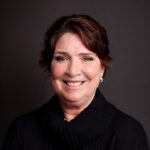
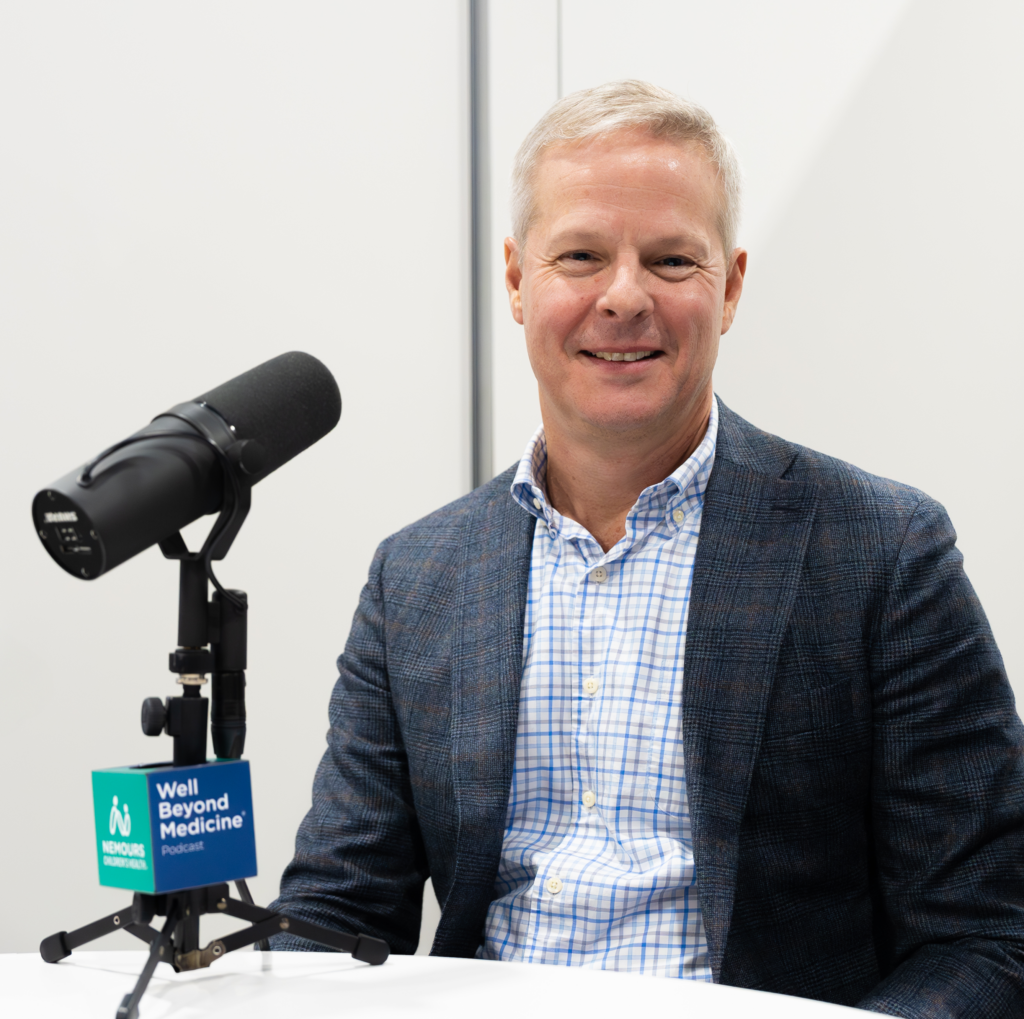
David Elkin, PhD, VP, Clinical Liaison and Advocacy, LinusBio
Host/Producer: Carol Vassar
TRANSCRIPT
Announcer (00:00):
Welcome to Well Beyond Medicine, the world’s top-ranked children’s health podcast, produced by Nemours Children’s Health. Subscribe on any platform at nemourswellbeyond.org or find us on YouTube.
Carol Vassar, podcast host/producer (00:12):
Each week, we’ll be joined by innovators and experts from around the world, exploring anything and everything related to the 85% of child health impacts that occur outside the doctor’s office. I’m your host, Carol Vassar. And now that you’re here, let’s go.
MUSIC (00:29):
Let’s go-o-o Well Beyond Medicine.
Carol Vassar, podcast host/producer (00:35):
We’re at HLTH in Vegas, and I’m joined right now by Dr. David Elkin. He’s asked me to call him David. He is a child clinical psychologist and the vice president of clinical education and autism programs at LinusBio. I love the name. Welcome, David.
David Elkin, Vice President, Clinical Education and Autism Programs, LinusBio (00:54):
Thanks for having me. It’s a joy.
Carol Vassar, podcast host/producer (00:56):
I want you to start with the really exciting portion of our conversation, and that is describing the vision behind LinusBio’s hair strand biomarker test.
David Elkin, Vice President, Clinical Education and Autism Programs, LinusBio (01:09):
The goal here is early detection, which can lead to early intervention. The problem with autism diagnosis and intervention, of course, is that it takes so long. There’s such a gap between when autism signals appear and autism diagnosis is made in the United States. The average age of diagnosis in the United States is age four, but symptoms appear much earlier. And so you’ve lost two or two and a half years of intervention time to help these kids so they can get better and live their lives as they want to. Our goal is to push that back to detect it earlier, so you can start interventions earlier, so they improve.
Carol Vassar, podcast host/producer (01:46):
Talk about the science behind this. This is absolutely amazing. You take a single strand of hair, and you analyze it. Talk about the science behind that.
David Elkin, Vice President, Clinical Education and Autism Programs, LinusBio (01:53):
Yeah. So you take a strand of hair, and you put it in a custom-made machine for us, cut it in half, and you open it up. And now you’re looking at like tree rings, or you’re reading a book. And it’s about an inch and a half long. You don’t have to pull it out by the root ball, and so it’s just got hair. And you hit that with a laser, and that kicks off all the organic materials that are in the hair. And mass spectrometry picks that up and reads about 150,000 biochemical signatures per hair, over a thousand time points in one strand of hair.
(02:27):
Machine learning then puts all those together and detects the biomarker. So that machine learning analysis of all those organic materials is the biomarker. Again, it’s very precise with a negative predictive value of 95% and a 90% sensitivity. It’s very good at what it does.
Carol Vassar, podcast host/producer (02:46):
As you’re looking at this, how are you figuring out, or how is the machine learning figuring out that there’s an autism risk?
David Elkin, Vice President, Clinical Education and Autism Programs, LinusBio (02:54):
Yeah. So it’s putting together … It’s a good question you asked. It’s putting together, not DNA. It’s not measuring DNA. It’s not measuring the absolute values of chemicals in the hair. It’s measuring how those two things come together. And where those two things come together, really, is who you are and who I am. You’re not just a bunch of DNA. Who you are has been affected by the environment, and you’re not just the environment. You bring DNA to the table.
(03:20):
Where those two things come together … You’re the genes you have from birth and the environment around you. Where those two things come together is called the exposome. It’s a really fancy word, but it really is a holistic way of looking at who you are. And that’s what’s being measured in a variety of ways, baby teeth, but more efficiently in hair.
Carol Vassar, podcast host/producer (03:42):
How did you narrow it down to autism? There must be other things that you could have been looking for, but how did you go to the autism risk test?
David Elkin, Vice President, Clinical Education and Autism Programs, LinusBio (03:53):
Well, I have to give credit to our founder and CEO, Manish Arora, because this was his vision. He talks about it all the time. He has triplet girls. And one of them was misdiagnosed as having autism, and it took years to get the correct diagnosis. He’s on faculty at Mount Sinai, and it’s one of the largest NIH-funded exposomic labs in the world. And that got his attention. He said, “This time delay, the grueling aspect of an autism diagnosis or misdiagnosis, we need to fix that.” And he turned his attention to this issue, this problem.
(04:30):
Also, as you know, autism is increasing, and not only here in the United States, but worldwide. And so we’re facing a surging number of diagnoses. We’ve got to do something. And if the science is there to help, why not deploy it?
Carol Vassar, podcast host/producer (04:45):
As you look at the results here, we’re talking about an autism risk. Are there other factors that need to be considered before the actual autism diagnosis is made?
David Elkin, Vice President, Clinical Education and Autism Programs, LinusBio (04:54):
Oh, absolutely. It’s a great question. So this is not taking the place of a diagnosis. This is merely a tool. This is a screener. What we’re trying to give to the clinicians is the power to do this in a more precise way.
(05:09):
Right now, clinicians diagnose autism based on subjectivity, observing the children, observing the interaction with caregivers, parents, getting reports perhaps from daycare workers, watching all this. So it’s subjective. What if you were to add in an objective measure as well that the clinician could then use? He or she could diagnose quicker, could make the move sooner for that child, so the child benefits. This is in no way taking the place of a clinician. In fact, we want to add to the clinician what he or she can use to help the child.
Carol Vassar, podcast host/producer (05:42):
You mentioned that the average age of diagnosis here in the US today is four. If the child is diagnosed, has the test, the risk is there, is later diagnosed, but before four with autism, what interventions can be brought to bear at that early age?
David Elkin, Vice President, Clinical Education and Autism Programs, LinusBio (06:02):
Oh, there are lots of really good evidence-based interventions. The main one that people probably think of is ABA, applied behavior analysis. But even with younger children, you can have … There’s great research being done on things you can do with them on the floor, getting them to interact with you, turning off screens. But again, this is a screener, and it’s really good at ruling out autism, and that’s how we’re talking about it.
(06:27):
When we go to hospitals, we talk about managing your workflow. So if you’ve got a lot of kids trying to get into your clinic for an autism evaluation, what if you could pull some of those out? Because I can’t tell you how many times my partner and I were doing autism evaluations, and we’re sitting there going, “Why are we seeing this kid? This child doesn’t have autism.” That child just took up a space that could be used on somebody else. If you pull out some of those children from the workflow, the ones that are already in go through faster.
(06:54):
Now, there’s something going on with that child you want to follow up on, so maybe that child is in a different evaluation pathway. So we’re trying to reimagine or help clinics reimagine how they manage this care, this flow of patients as well. But again, we want to be in assistance to them. We don’t want to tell them which way to go, left or right.
Carol Vassar, podcast host/producer (07:13):
It sounds like it’s a great tool, again, to help with that workflow and that flow of getting into a diagnosis or somebody who could do a diagnosis. Isn’t there a jam-up at that point as well, when the doctor recommends you need to see a specialist with the possibility of autism, and then there’s a delay even at that point, isn’t there?
David Elkin, Vice President, Clinical Education and Autism Programs, LinusBio (07:33):
Oh, yes, exactly. And that’s actually the primary delay. So let’s say that you have concerns about your child. And by the way, I’ve learned to trust mama instincts. When a mom says-
Carol Vassar, podcast host/producer (07:44):
Thank you.
David Elkin, Vice President, Clinical Education and Autism Programs, LinusBio (07:44):
… “There’s something going on,” you’d better pay attention.
Carol Vassar, podcast host/producer (07:46):
Thank you.
David Elkin, Vice President, Clinical Education and Autism Programs, LinusBio (07:46):
You’d better pay attention because she knows. So they’ll go to, say, the pediatrician and say, “I don’t know. What do you think? Maybe he or she has autism.” And the pediatrician may say, “You’re right. Go get the evaluation.” That’s when the wait really starts because that’s where the delay is, at least a year. Some places, two years. We were talking to some clinics in Florida that said they have a three-year wait list. Even if it’s a year, that’s 12 months of missed opportunity. That’s 12 months of brain growth that you could have been working with. That’s sad to me.
Carol Vassar, podcast host/producer (08:21):
Let’s talk about the test itself. Sensitivity. How sensitive is it? Do you get false negatives? Do you get false positives? What’s your data showing you on this?
David Elkin, Vice President, Clinical Education and Autism Programs, LinusBio (08:31):
So again, it’s attuned. It’s been aligned to do better with rule-out. So the negative predictive value is 95%. That means if you get the hair sample done and it comes back as not having the biomarker, there’s a 95% chance that your child does not have autism. Now, I know what you’re thinking.
Carol Vassar, podcast host/producer (08:53):
The 5%?
David Elkin, Vice President, Clinical Education and Autism Programs, LinusBio (08:53):
“But what about that 5%?” Exactly. I used to work at St. Jude Children’s Research Hospital, and they had, “There’s a 95% chance your child’s going to survive this.” And everybody said, “But 5%.”
(09:05):
I say jokingly, 95% is probably better than I am. I mean, that’s probably better than a human. I mean, I’m wrong when I do my diagnosis in a clinic, so it’s very good at ruling out autism. We’re looking in the future at maybe improving the rule-in aspect, but it’s not there yet. The science isn’t there yet.
Carol Vassar, podcast host/producer (09:23):
All right. Talk about the balance between the hope for early detection and the risk of overdiagnosis or perhaps unintended consequences.
David Elkin, Vice President, Clinical Education and Autism Programs, LinusBio (09:35):
Yeah. So I think that one of the reasons why the diagnosis of autism is surging here in the United States and worldwide, probably two good reasons. One, we’re getting better at noticing it, but two, the diagnostic criteria for autism has expanded so much, so there’s an awful lot of kids now that fall under that rubric.
Carol Vassar, podcast host/producer (09:53):
Okay.
David Elkin, Vice President, Clinical Education and Autism Programs, LinusBio (09:56):
Okay? But to your point about overdiagnosis, I think most clinics, specialty clinics that have a developmental behavioral pediatrician, a child psychologist, like myself, doing these diagnoses, they go about it in a very precise, very calm way. And I don’t know that we’re overdiagnosing or calling kids autism when they probably don’t have it. It happens, of course. But I think what you’re seeing in terms of rise is concern from parents and also an expanded diagnostic criteria.
Carol Vassar, podcast host/producer (10:29):
What about kids, or parents, or families who are in rural areas? How are you making this available, as available as it can be, to the nation and the world, even?
David Elkin, Vice President, Clinical Education and Autism Programs, LinusBio (10:44):
I mean, I’m from Mississippi, so I’m very much attuned to health equity-
Carol Vassar, podcast host/producer (10:48):
Absolutely.
David Elkin, Vice President, Clinical Education and Autism Programs, LinusBio (10:48):
… making it available to people who really need it. Right now, it’s a pay-as-you-go model. We’re working with payors across the country to set it up, and that’s going to take a little time. It’s going to take more research, but that’s the goal of LinusBio is to make this available to whoever needs it.
Carol Vassar, podcast host/producer (11:06):
I’m going a little off-topic here. I’m curious about autism. Is it genetic? Is it behavioral? Is it learned? Is it something that happens between birth and, say, one infection, or how does it come about?
David Elkin, Vice President, Clinical Education and Autism Programs, LinusBio (11:24):
It’s a very complex disorder, and that’s why diagnosis is a complex thing. You’re asking a very good question. So genetics explains between 40 and 80% of autism. There’s no one autism gene. In fact, there are really elegant twin studies, identical twins, and one will develop autism and one won’t. And it makes you go, “How did that happen?” And it goes back to the exposome.
(11:51):
So if you have the same DNA, identical twins, there must have been something different in the environment that affected that individual differently. And that’s why you can’t just look at DNA, and you can’t just look at environmental exposure. You have to look at where they go together to look at the whole person. That’s the exposome. And that’s the, for me at least, the exciting part about the science.
Carol Vassar, podcast host/producer (12:16):
Do you have an example of a family who has undergone, their child’s undergone the test, ruled out, but perhaps moved into the system and actually was diagnosed with autism?
David Elkin, Vice President, Clinical Education and Autism Programs, LinusBio (12:30):
Again, great question. The test itself is so new. We went to market in February, so we haven’t got longitudinal data of that sort, but we do have stories. I’ve talked to caregivers who got the negative result, and they were happy. We’ve also talked to parents who got the non-negative who said, “Basically, that means the biomarker’s been detected, proceed on. Go get your diagnosis from the specialists. So go to the pediatrician, developmental pediatrician, and psychologist.”
(13:04):
You would think that some of those parents would be very nervous, worried that you’re creating anxiety in them. Actually, the ones we’ve talked to express almost a relief. Now they know. Because, as we’ve said before, a biomarker doesn’t point back to causation. It points forward to intervention. So, “Okay, now I know. Let’s get this treatment started.” Again, going back to early detection leads to early intervention. We can help them. So it doesn’t condemn your child to a life of suffering. It actually opens up doors for you and your child to work with them.
Carol Vassar, podcast host/producer (13:40):
It sounds like families are reacting well, knowing, knowing, and then proceeding and getting the treatment that’s necessary for their child.
David Elkin, Vice President, Clinical Education and Autism Programs, LinusBio (13:48):
Correct.
Carol Vassar, podcast host/producer r (13:49):
Because that can be a relief from that anxiety, as you mentioned.
David Elkin, Vice President, Clinical Education and Autism Programs, LinusBio (13:52):
It can be, yes.
Carol Vassar, podcast host/producer (13:53):
I’m curious about the regulatory considerations that you had to look at as you were creating this test, and also the privacy considerations that you maybe had to consider.
David Elkin, Vice President, Clinical Education and Autism Programs, LinusBio (14:08):
Yeah. So in terms of regulatory, this company was given FDA Breakthrough status. So, FDA gave us that. All the lab work is done in New Jersey at a CLIA-approved lab.
Carol Vassar, podcast host/producer (14:22):
All right.
David Elkin, Vice President, Clinical Education and Autism Programs, LinusBio (14:23):
So those two things are-
Carol Vassar, podcast host/producer (14:24):
That’s all good.
David Elkin, Vice President, Clinical Education and Autism Programs, LinusBio (14:24):
That’s all good. That’s right. In terms of privacy, are you talking about HIPAA or keeping the information within a family?
Carol Vassar, podcast host/producer (14:30):
Keeping the information within a family. Is it like any other standard test? I mean, blood tests? Hair tests seem to be relatively new, at least for this usage. So yeah, I’m wondering about privacy in terms of HIPAA.
David Elkin, Vice President, Clinical Education and Autism Programs, LinusBio (14:45):
Yeah, and that’s why we work with the medical providers. This is an RX test. So someone, actually, to be very specific, a psychologist can’t order this. I can’t order this.
Carol Vassar, podcast host/producer (14:55):
It has to be an MD?
David Elkin, Vice President, Clinical Education and Autism Programs, LinusBio (14:56):
It has to be an MD, a physician. And so once you do that, now you’re within a protected confidential space, and you’re within that medical home-
Carol Vassar, podcast host/producer (15:04):
Got it.
David Elkin, Vice President, Clinical Education and Autism Programs, LinusBio (15:05):
… where the physician and the family are working together, but they’re surrounded by privacy.
Carol Vassar, podcast host/producer (15:10):
I understand that you are also working on a similar test for ADHD. Is that correct?
David Elkin, Vice President, Clinical Education and Autism Programs, LinusBio (15:16):
Coming down the pike.
Carol Vassar, podcast host/producer (15:17):
Tell us about that.
David Elkin, Vice President, Clinical Education and Autism Programs, LinusBio (15:20):
The thing to think about with the hair strand is that it’s a very powerful platform. Right now, it’s being deployed towards autism, but there are indications that we could go towards other disorders as well. ALS in the future, Lou Gehrig’s disease.
Carol Vassar, podcast host/producer (15:36):
Oh, wow.
David Elkin, Vice President, Clinical Education and Autism Programs, LinusBio (15:36):
A dear friend of mine … Speaking personally now, sorry.
Carol Vassar, podcast host/producer (15:38):
That’s fine.
David Elkin, Vice President, Clinical Education and Autism Programs, LinusBio (15:39):
A dear friend of mine named Scott Coffey passed away from ALS, and it was a horrible thing to watch him go.
Carol Vassar, podcast host/producer (15:45):
I’m so sorry.
David Elkin, Vice President, Clinical Education and Autism Programs, LinusBio (15:46):
I did the eulogy at his funeral, so I watched it. So this disorder has tremendous personal, I guess, credit with me, so I’m excited about that.
(15:57):
But you’ve got this platform now that we could then tune to other diagnoses. It’s curious because in my world, mental health, there are very few biomarkers. There are no biomarkers for, say, anxiety, depression, whatever. You can’t draw blood and say, “You have depression,” like you can-
Carol Vassar, podcast host/producer (16:17):
You can just look at me and …
David Elkin, Vice President, Clinical Education and Autism Programs, LinusBio (16:18):
No. You can look at me and tell I’m anxious. But you draw blood, and you can say, “Well, you have diabetes,” or “you have sickle cell or leukemia.” But you can’t do that in psychology and psychiatry. That’s where the company’s heading is, giving that kind of information to clinicians to empower them to help families earlier.
Carol Vassar, podcast host/producer (16:39):
I want to go back to the ALS, the potential for a hair strand ALS diagnosis. A lot of people might be concerned that they don’t want to hear that diagnosis. We’re looking at adults mostly here. Who would get that test, and at what point? Because I don’t know, could a doctor order it for me when I’m 30, and I don’t get ALS till I’m 60?
David Elkin, Vice President, Clinical Education and Autism Programs, LinusBio (17:08):
See, I think we’re, at this stage, we’re way too early to even talk about how we deploy that or whatever. But I will say this, you start picking up on ALS early, speaking from my experience with my colleague, Dr. Coffey, you change how you live your life. You know?
(17:25):
So I don’t know yet. To answer your question, I don’t know what that would look like, but what if you did like he did, and he had me film him as he gave instructions to his sons because he knew he wasn’t going to be there?
Carol Vassar, podcast host/producer (17:39):
Aw.
David Elkin, Vice President, Clinical Education and Autism Programs, LinusBio (17:39):
I mean, it’s an emotional time. I don’t know what that’s going to look like, and that’s going to be something for the company to decide, not me, obviously. But I think that the goal here, of course, is early detection, early intervention.
Carol Vassar, podcast host/producer (17:53):
Early intervention.
David Elkin, Vice President, Clinical Education and Autism Programs, LinusBio (17:53):
It can help people earlier. That’s the goal.
Carol Vassar, podcast host/producer (17:56):
Let’s talk about that. What do you see with this biomarker test, going back to autism, what do you see that will allow this to change the landscape of autism diagnosis, and how will interventions change?
David Elkin, Vice President, Clinical Education and Autism Programs, LinusBio (18:14):
Ah, now we’re talking. This makes me excited.
Carol Vassar, podcast host/producer (18:16):
The secret sauce.
David Elkin, Vice President, Clinical Education and Autism Programs, LinusBio (18:17):
Yeah, exactly. So the standard go-to treatment is applied behavior analysis, but behavior analysis is like a suit off the rack. You have to tailor it to fit each child. Each child’s different, especially on a wide spectrum like autism. So Child A, she may need certain types of intervention, but Child B, he may need different types of interventions. I think that’s where we’re headed in terms of interventions for autism, tailoring them, much like we tailor interventions in other areas of medicine, to the individual’s needs. So if you think of ABA like a blunt instrument, let’s go laser-focused on that child. I think that’s where the research is heading in our field.
Carol Vassar, podcast host/producer (18:58):
It’s almost like personalized medicines for autism.
David Elkin, Vice President, Clinical Education and Autism Programs, LinusBio (19:02):
Exactly. Exactly. You don’t treat everybody in medicine exactly the same. You tailor it to fit her, to fit him. And I think that’s where the researchers are taking it with autism treatment.
Carol Vassar, podcast host/producer (19:11):
And again, as you talk about the spectrum, there are some who are high-functioning. My son is one. And then there are some kids who might need more interventions as life moves forward. It sounds like this is just going to be a wonderful tool to get them started on that right path.
David Elkin, Vice President, Clinical Education and Autism Programs, LinusBio (19:28):
That’s how we’re framing it. Exactly. I see kids who need a greater degree of intervention. I see that as an opportunity. I see it as potential. Rather than, “Oh, this is going to take more,” “Oh, this is going to take more. Great.” We can give this child more earlier, which leads to better results. You see better improvements in intelligence, social skills, verbal skills, all those things that allow us to live our lives. That’s what we’re after with these interventions.
Carol Vassar, podcast host/producer (19:56):
For parents who are listening now, especially parents of a young child, they’re hearing about this kind of screening. What’s one message you would like them to take away from our conversation today?
David Elkin, Vice President, Clinical Education and Autism Programs, LinusBio (20:09):
We’re here to empower your clinicians, to empower your pediatricians, to help you help your kid. We want to come alongside, a Navy term. We want to come alongside clinicians and families and be there to support them so that early detection can lead to early intervention.
Carol Vassar, podcast host/producer (20:26):
Dr. David Elkin, this has been a fabulous conversation. Of course, I have a personal interest in this and making sure that kids are getting off on the right foot with an autism diagnosis. So this is just fabulous stuff that’s happening in the world. You are a child clinical psychologist and the vice president of clinical education and autism programs for LinusBio. Thank you so much for joining us.
David Elkin, Vice President, Clinical Education and Autism Programs, LinusBio (20:49):
Thank you for having me. It’s been a joy.
MUSIC (20:51):
Let’s go-o-o Well Beyond Medicine.
Carol Vassar, podcast host/producer:
That is some phenomenal technology available now to help families identify a child’s need and apply needed interventions early. Thanks, David, for making time to fill us in on it while at HLTH in Las Vegas.
Two more episodes are coming in the next two weeks to help us close out our HLTH series. Check out all of our episodes on your favorite podcast app and smart speaker, the Nemours YouTube Channel, and on our website: nemourswellbeyond.org. Visit there to leave a podcast episode idea, a review, or subscribe to the podcast and our monthly e-newsletter. That address again is nemourswellbeyond.org.
Our production team this week includes Susan Masucci, Lauren Teta, Cheryl Munn, and Alex Wall. Video production by Sebastian Reilly and Britt Moore. Audio production by yours truly. On-site production assistance provided by Robbie Dorius and his team from HLTH. Thank you to them.
I’m Carol Vassar. Thank you for listening. Next time around, we learn ways in which physicians and researchers can make scientific language more consumable and user-friendly. Until then, remember, we can change children’s health for good, well beyond medicine.