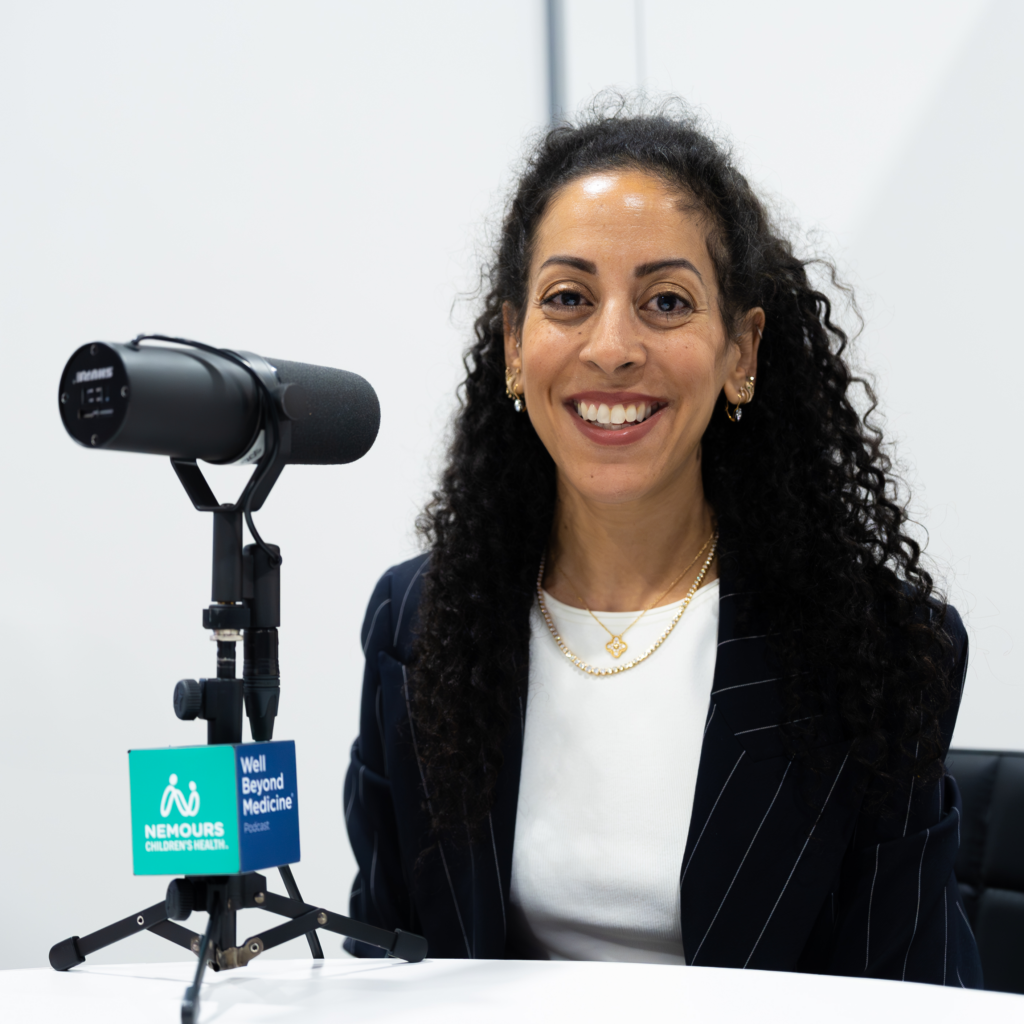
Jessica Malaty Rivera, MS, Executive Director, Infodemiology Initiative, and infectious disease epidemiologist, joins us to unpack the “infodemic,” the overwhelming flood of health information shaping how we think, decide and act. From misinformation to trust, she explains why science isn’t finished until it’s communicated — and what each of us can do to navigate today’s complex information landscape more responsibly.
Watch the episode on YouTube.
Featuring:
Jessica Malaty Rivera, MS, Executive Director, Infodemiology Initiative
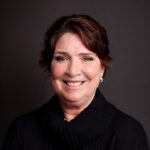
Host/Producer: Carol Vassar
TRANSCRIPT
Announcer (00:00):
Welcome to Well Beyond Medicine, the world’s top-ranked children’s health podcast, produced by Nemours Children’s Health. Subscribe on any platform at nemourswellbeyond.org or find us on YouTube.
Carol Vassar, podcast host/producer (00:12):
Each week, we’ll be joined by innovators and experts from around the world, exploring anything and everything related to the 85% of child health impacts that occur outside the doctor’s office. I’m your host, Carol Vassar. And now that you’re here, let’s go.
MUSIC (00:30):
Let’s go, oh, oh, Well Beyond Medicine.
Carol Vassar, podcast host/producer (00:36):
Hi everyone. I was joined not that long ago at Health in Las Vegas by Jessica Malaty Rivera. She’s an experienced infectious disease epidemiologist. Now, at the time of our conversation, Jessica was a senior science communication advisor for the de Beaumont Foundation. Recently, she was named Executive Director of the Infodemiology Initiative under the nonprofit Public Good Projects. Jessica studies trust in the area of health communications, and we talked extensively about trust, about the infodemic. We now find ourselves in as a nation, what an infodemic is. The idea that science is truly unfinished until it’s communicated, and how all of that, that entire philosophy, has shaped the way she approaches her work. Here’s my conversation with Jessica Malaty Rivera.
Jessica Malaty Rivera, MS, Executive Director, Infodemiology Initiative (01:25):
I feel so strongly about that sentiment, which unfortunately I did not come up with myself. So, Mark Welford came up with the statement that science isn’t finished until it’s communicated, and essentially is saying that the job of scientists doesn’t end behind closed doors in laboratories or even in fancy papers that are intended for high-impact journals. For science to be a tool in people’s toolkits and information to make informed choices, it needs to be translated. It needs to make sense to people, especially now in a very, very fraught information ecosystem with digital media and social media kind of creating a lot of noise, making it very difficult for people to understand what science is. There seems to be almost like a battle for science and who gets to claim it. And I’ve got the great job of sense-making and translating it so that people understand it and make informed choices from it.
Carol Vassar, podcast host/producer (02:16):
That’s a skill. Not everyone has that skill, especially in the scientific world.
Jessica Malaty Rivera, MS, Executive Director, Infodemiology Initiative (02:20):
That’s right.
Carol Vassar, podcast host/producer (02:21):
You’ve helped to popularize a term infodemic, which refers to the spread of too much or some misleading information during a health crisis. How does studying information and the way we study disease help us understand today’s public health challenges?
Jessica Malaty Rivera, MS, Executive Director, Infodemiology Initiative (02:39):
Yeah. And again, and not necessarily a new word. It’s been a word that’s been around for a couple of decades, but not as common as I would like it to be. And so I’m trying to, like you said, make it more popular so people understand that there are non-disease-related trends that can actually harm people’s health. And one of those things is an infodemic, which oftentimes happens in tandem with an epidemic or in the most recent history, a pandemic. Those driving factors can make health-based decision-making much more scary, much more dangerous, and have very, very long-lasting impacts. Mis and disinformation spread much faster than evidence-based science, but infodemics is not necessarily just about mis and disinformation. It’s a fire hose of information, which makes even a trained person feel a little bit overwhelmed by how to navigate all that information, to know what is true and trustworthy from what is false and untrustworthy. And we’re doing a lot on understanding those intersections of biological threats and information threats that both kind of coincide and make public health experiences, emergencies, events that much more dangerous for the public.
Carol Vassar, podcast host/producer (03:47):
We’re in an infodemic, I would assume, right now.
Jessica Malaty Rivera, MS, Executive Director, Infodemiology Initiative (03:50):
100%.
Carol Vassar, podcast host/producer r (03:51):
What do we need to know?
Jessica Malaty Rivera, MS, Executive Director, Infodemiology Initiative (03:53):
Yeah. That information’s not neutral, and you need to really check sources. I mean, I ask people to do very basic things. It’s really not inventing the wheel again. It’s asking who, what, when, where, and why about any information that you’re accessing. Sometimes it’s just literally checking, “When was this published?” Sometimes it’s old news. Sometimes it’s checking who published it. Do they have conflicts of interest? It’s helping people do their own kind of investigation. The investigation that I do as an epidemiologist all the time. Epidemiologists ask who, what, when, or why about a disease and how it affects people. Infodemiology kind of asks those same questions, but about the information. And I’m helping people do that so that they can be better consumers of information.
Carol Vassar, podcast host/producer (04:37):
Journalism does the same thing, but we don’t necessarily trust journalists these days. Are people trusting public health? Are they trusting epidemiologists such as yourself who are evidence-based believers?
Jessica Malaty Rivera, MS, Executive Director, Infodemiology Initiative (04:51):
That’s such a good question. And I wish I had a simple answer to it. I think it depends is the answer, which is a very epidemiology answer. It depends because we are in a battle right now to regain trust. I just was the other day was looking at the CDC website, and noticed that the about page had been updated. And on the about page were 12 mentions of the word trust. And then the only reason why I counted is because I study trust, and I want to understand how trust is a determinant of health. It is a driving force in people’s health decision-making. And I think that there is a tug of war that’s happening, the evidence-based side on one side, the non-evidence-based wellness, kind of alternative science views on the other.
(05:34):
And people are stuck in the middle, and people are trying to understand, well, why is it bad to want to make America healthy again? And that’s the wrong question. I do want to make America healthy again, but we have to do it in the right way. And so I think we’re right now seeing this tug of war happening with who’s trustworthy, who’s evidence-based, what even is evidence? And unfortunately, that’s what I mean about information not being neutral. People don’t understand what’s behind the information a lot of times.
Carol Vassar, podcast host/producer (06:03):
Do people understand that they need to take those extra steps to look at how old an article is, who wrote the article? What kind of information was used to write the article? Or do we need to start from scratch and say, “All right, here’s how you know you can trust this information?”
Jessica Malaty Rivera, MS, Executive Director, Infodemiology Initiative (06:22):
Yeah. I mean, shame never changed anybody’s mind, and screaming at somebody rarely does, too. And so there’s a lot of repetition, a lot of going back to the basics in the work that I do. You have to do this work with empathy and patience. Otherwise, you’re just going to be creating more extremists and more people who are actually fleeing from science or even fleeing from wellness, the alternative science, because they don’t feel safe. They don’t feel like they can ask questions. They don’t feel like they can come to the table with uncertainty. And I am saying uncertainty is the most welcome thing in science.
(06:54):
It is the driving factor of the scientific method. We don’t know something, and then we do experiments to find the answer to it. So I want people to feel welcome with the uncertainty and the freedom to ask for navigational supports, the freedom to say, “I don’t know how to find a trusted message. I don’t have very good scientific or even media literacy. How can I get those skills?” I try to do that the best I can so that I’m not creating more people who are afraid of this information.
Carol Vassar, podcast host/producer (07:21):
You have said you can do more harm than good when you focus only on debunking myths. And debunking a myth is a big thing that I try to do. How can we create more harm when we’re actually trying to create good?
Jessica Malaty Rivera, MS, Executive Director, Infodemiology Initiative (07:37):
Yeah. The reason why I said that is because I think a lot of times science communication can be trivialized to just myth-busting and debunking. When really, if we did that, if you spend all your time doing that, I wouldn’t sleep because there’s just always something to debunk. There’s always mis and disinformation. There’s always going to be false claims and circulating narratives that are not true, but they’re not all equally harmful. And I think that that’s where the discernment comes in of understanding what has a potential to be viral or what has the potential to actually influence people’s behavior? Is it showing up in phone calls to the ER? Is it showing up in visits to the pediatrician’s office?
(08:16):
Those are kind of the indicators, and that’s my epi hat coming in, of when information needs that. Otherwise, we would just be, honestly, sometimes inadvertently, amplifying mis and disinformation. I mean, one of the tactics of science communication is called a truth sandwich, where you lead with the truth, you debunk in the middle, and you finish with the truth, because the focus should be the truth. If we focus too much on the problem, it sometimes puts a little bit more oxygen into the flame.
Carol Vassar, podcast host/producer (08:42):
You talked about things going viral. You went viral, didn’t you?
Jessica Malaty Rivera, MS, Executive Director, Infodemiology Initiative (08:45):
Yeah.
Carol Vassar (08:46):
Starting in 2020, the pandemic, I presume, you started posting to Instagram, and your friends are like, “Hey, this is great stuff. People should know this.” They were sharing it. And you became sort of a very well-known, trusted voice for evidence-based information in the middle of a pandemic. Talk about what that experience taught you, what being in the eye of the storm really indicated to you about people and trust, which you study, and what people really need from science communication.
Jessica Malaty Rivera, MS, Executive Director, Infodemiology Initiative (09:21):
Yeah. It taught me a lot. I think one of the biggest lessons it taught me is that people are hungry for this information. I mean, when I would do weekend Q&As, for instance, I would get thousands of questions, very earnest questions from people who were like, “I don’t feel like I can come to my doctor with this laundry list of questions and concerns, but I feel like you’re my phone a friend, but you’re like my phone a epi, and you can talk to me like a normal person without making me feel bad.” And I realized, my gosh, people just need somebody to speak to them like a human or like a fellow mom or like a fellow person who was also bummed that we were having to stay at home all the time. All those things made me more relatable to folks, and I loved that human connection.
(10:01):
I felt connected to my audience in that way. It also taught me that I’m very sensitive because it came at a huge cost. I mean, I’d be lying if I said it was all good. I definitely think the good outweighs the bad, but the bad was really bad. I mean, to be a public face, pro-science, pro-vaccine, pro-public health mitigation efforts, I got a lot of hate. I got a lot of threats. I got a lot of vitriol. And I think it taught me that being a public figure requires some tough skin, which I had to grow in the last five years. And it’s changed my relationship with being in front of the camera a little bit. But I also know that I’ve seen transformation that I could have never even anticipated.
(10:49):
A lot of people would say, “Don’t focus on the extremes or the anti-vaxxers. Focus on that movable middle, the people who are right in the neutral spot.” And I have mostly, but I’ve seen people from the extreme change their mind because it finally clicked. I made it made sense to them. I dispelled the things that were causing them to be fear-based and caught in cycles of conspiracy. And that’s the greatest pride I could ever have of being part of those types of transformations. I didn’t do it for myself. I did it because that one person changing their mind is changing the community one person at a time.
Carol Vassar, podcast host/producer (11:26):
You persisted.
Jessica Malaty Rivera, MS, Executive Director, Infodemiology Initiative (11:27):
I did. Yeah.
Carol Vassar, podcast host/producer (11:28):
Good for you.
Jessica Malaty Rivera, MS, Executive Director, Infodemiology Initiative (11:29):
Thanks. Thanks.
Carol Vassar, podcast host/producer (11:30):
In your recent writing, you talk about infodemic resilience as society’s ability to withstand false or misleading health information. You came through that storm in 2020, 2021, it sounds like. What does building that resilience look like when we’re talking about schools or we’re talking about communities, we’re talking about clinical settings or just the community at large?
Jessica Malaty Rivera, MS, Executive Director, Infodemiology Initiative (11:55):
Yeah. We talk a lot about resilience for a lot of things, climate change, another pandemic, preparedness, but I don’t think people talk enough about resilience for infodemics. And I really think that, especially right now, where information is not neutral and without sounding like a Luddite, I think AI is changing a lot of things for people when it comes to how they can exist in digital landscapes. Resilience to fake news, resilience to deep fakes, resilience to mis and disinformation, or even just too much information, is a skill that I think should be taught from the very earliest stage. And I say this as a mom of three kids who are already experiencing hearing things at school or reading things in a headline or in passing.
(12:48):
And I want them to have those types of skills, of saying, “Is that trustworthy? Is that a reliable source? Is the thing that I just heard even true?” So that they don’t grow up misled. I think that kind of indoctrination of skills needs to happen really, really young. Otherwise, we’re going to be setting ourselves up for many more infodemics that are going to cause a lot of harm.
Carol Vassar, podcast host/producer (13:08):
Is creating that resistance, building that resistance, either for yourself or within your family, within your kids, is part of that, actually putting down the phone, maybe taking some cues from the Luddites in your life, putting down that phone, closing that computer, and leaving the world of social media and online?
Jessica Malaty Rivera, MS, Executive Director, Infodemiology Initiative (13:28):
100%. I mean, I don’t want to throw the baby out with the bathwater here and say it’s all bad. I definitely think there is a lot of good that can happen. I’ve seen that good happen, but I do think that we need to have a much healthier relationship with the volume of content that we’re all consuming and the speed at which we’re consuming it. A lot of people don’t get past the lead in an article because the lead and the title is just as much information as you need for a very viral social media post. And I am speaking even to newsrooms here. Any of the major newspapers can basically tell a whole story in a square, right? Headline, lead, maybe a fact or two written in small text or a caption, but it’s…
Carol Vassar, podcast host/producer (14:12):
Is it really the whole story, though?
Jessica Malaty Rivera, MS, Executive Director, Infodemiology Initiative (14:14):
Right. Exactly. And so I do think that that is… I want my kids to have better reading comprehension skills than reading two sentences and thinking they have the whole thing. Yes, there’s a time and place for a TLDR, but the TLDR is not how you become an informed person on this planet.
Carol Vassar, podcast host/producer (14:29):
Let’s take that a step further. Let’s talk about the algorithms. The algorithms are designed to reward seemingly outrage.
Jessica Malaty Rivera, MS, Executive Director, Infodemiology Initiative (14:38):
Oh, yeah.
Carol Vassar, podcast host/producer (14:39):
When you’re putting out information that really isn’t by design, generally speaking, designed to create outrage. How can we fight back against those algorithms? Can we?
Jessica Malaty Rivera, MS, Executive Director, Infodemiology Initiative (14:52):
I struggle with this a lot because I know that the content that does well, that gets the clicks and the eyeballs, is the one that elicits strong emotions. It’s the one that gets people to either feel indignant, outraged, wanting to then scream on the internet themselves and post with an all-caps mention of what’s happening. I’ve been a victim of that, too. And I don’t like what it does to my nervous system. I also don’t like what it does to just my experience as a person and a person on the internet. And so I do think that fighting back will probably look like not just being reactive, but being proactive. A lot of times we talk about things like pre-bunking or information inoculation that’s almost anticipating what you might see that may be the rage bait.
(15:40):
How can we get ahead of that message and say, “You know what? You’re probably going to be hearing…” And we did that a lot, actually, most recently with the MAHA report and with the Tylenol news. We knew it was coming. And so we did a lot of front-loading on the internet and saying, “Hey, you’re probably going to be hearing headlines that make these types of correlations and causal claims. Here’s how you can anticipate those articles sounding. Here’s how you can brace for impact. Here’s how you can interpret them better.” And I think it’s going to require a lot more of that instead of being reactive.
Carol Vassar, podcast host/producer (16:10):
Related, you’ve talked about equipping leaders. It sounds like that pre-information information was very helpful in the instance you cited. How can we equip and train local health workers, clinicians, even influencers to be those credible messengers? Do you have a success story in that area?
Jessica Malaty Rivera, MS, Executive Director, Infodemiology Initiative (16:31):
Yeah. I mean, I think there’s a lot of creators online who are doing this work very successfully, and I love to see it. This cannot be just my responsibility or the responsibility of a handful of people. It requires all hands on deck. And I think having an all-hands-on-deck approach to saying, “Look, you may not have been trained in science communication. You may have never taken a class in science communication. You may not have felt comfortable even doing public-facing communications, but if you’re able to make science make sense, translate it into easy, accessible, emotionally intelligent, culturally competent information, consider doing that on the internet. Consider doing that in your communities. Consider doing that on a Substack, on Instagram, on a podcast.”
(17:15):
I think that we have to be flooding the zone with people who speak the language of science in a way that makes sense to wide audiences. Otherwise, we’re going to lose the battle for information. I mean, I sometimes feel overwhelmed that we are swimming upstream a bit, but I’m trying to invite more people in to be like, “Hey, you don’t have to be 20 years in the game and in science communication to do this job. Learn a few skills, take practice, and perhaps collaborate with other creators who are doing it so that you can get better and better, but it has to be a group project, a group effort.”
Carol Vassar, podcast host/producer (17:50):
I love your communication style. It’s empathetic. It’s honest. As you try to address this infodemic, and it sounds like this is a longer haul than just, okay, we have this negative post or this negative podcast that’s out there, and it’s going to hit immediately. You’re in for the long haul. How do you maintain that compassion when you’re facing misinformation and what you alluded to earlier with your experience in 2020 during the pandemic, outright hostility?
Jessica Malaty Rivera, MS, Executive Director, Infodemiology Initiative (18:22):
Yeah. It takes knowing when to take a break, and focusing on mental health, and making sure that you’re okay. I mean, I’ve had to scale back a bit just because of the toll it takes. I also think knowing… Thinking back on the benefits and the good that outweighs the bad, that’s what keeps me going. Meeting people in real life who’ve said that they’ve been influenced and impacted by the work that I do, that keeps me going. See, the moments like this, talking about it, that keeps me going. Knowing that I have three young kids who are going to be growing up in a world in which… I mean, I feel like I’m the last generation that was pretty analog and have seen so many advancement in technology, which I’m very much beholden to lots of things now and also technology. But if my kid’s whole life in the future is going to be even more digital, I don’t want them to not have these tools and toolkits.
(19:18):
So I want to be a better mom in that sense of training them to have those skills. And the friends that I have and their kids, too, we’re raising a whole generation of people who are going to have to grow up in this system. So I can’t stop, and so I’m going to keep going because of my kids.
Carol Vassar, podcast host/producer (19:34):
The proliferation of AI. We’re at a health conference. AI is the talk of the town, has been, at least for the past couple of years, since I’ve been coming to health. Does that worry you in the communication world, especially at the speed at which it is proliferating?
Jessica Malaty Rivera, MS, Executive Director, Infodemiology Initiative (19:50):
Yeah. I mean, I think it’s helpful to not consider AI as a monolith because it can be used for good, too. And we’re seeing it at a conference like HLTH. We’re seeing AI be used for so many transformative things in diagnostics, therapeutics, and even information processing, but we also have to approach very cautiously. I think that not just the bots are the concern here. I told a colleague the other day: I’m fully anticipating reports of malpractice from a provider who cited a fictitious or hallucinated clinical trial. I mean, it’s not outside the realm of possibility that measurable harms can happen because of an overreliance on AI. And so I am approaching it cautiously, but with cautious optimism too. I think that there’s a lot of reform that needs to happen, especially from an environmental standpoint.
(20:43):
And as a public health practitioner, that intersection is very, very clear, knowing that environmental harms are a driving factor in public health emergencies. And so I struggle a bit knowing that it is not a sustainable or even close to green system yet. Perhaps it can get that way soon, I hope. But I do think that we are going to be existing with AI from now on. I don’t think it’s going anywhere. And so, how can we use it for good? I think through innovations like places like here, I think even thinking about it as a tool for creating really evidence-based content, so long as you’re fact-checking it, making sure that you’re citing actual evidence behind it and not saying, “Oh, well, ChatGPT made this post for me based on things that sound sciencey.”
(21:25):
I mean, there’s a book that I often refer to called How Charts Lie, and it’s a book that has taught me a lot. I do a lot of work in data and data visualization and just knowing that a chart in and of itself is a reliable thing because it looks like a smart person made it, right? A chart is, it seems very sophisticated. If you have the skills on Tableau or even ChatGPT, you can make something look like science, and the sophistication that is happening from the bad actors will be harder to distinguish between good science, evidence-based science, AI hallucinated science, and stuff that is actually reliable. And I think because of that, this type of work of training people on how to discern who made it, how it was made, is more timely than ever.
Carol Vassar, podcast host/producer (22:12):
Having that human element seems like it has to be right in there. 10 years from now, will we still be in an infodemic, do you think?
Jessica Malaty Rivera, MS, Executive Director, Infodemiology Initiative (22:21):
I do, unfortunately. I do think that what’s happening right now with Public Health, capital P, capital H, as a whole, between budget cuts, between major shakeups in the US government, and how that affects global health too, because of policies and budgets that have disappeared from those policies, I think course correcting is going to take many, many years. I think that what we’re seeing is setting the foundation for some pretty rough years in public health. And I think when we have rough years in public health, infodemics increase.
Carol Vassar, podcast host/producer (22:53):
What do you think will be the signs that we’re finally turning it around and coming out of an infodemic? And we’re talking years down the line. So just want your educated estimation on that.
Jessica Malaty Rivera, MS, Executive Director, Infodemiology Initiative (23:05):
Yeah, it’s a fair question. And if I were to guess, I would assume that we’re not re-litigating established science on the public forum and on stages that used to historically be evidence-based, right? I think that science is iterative; science needs to evolve, but there are some things that we have settled. And I think when we stop seeing the re-litigation of things that have out far, far proven that benefits outweigh harms or risks, hopefully will be out of an infodemic in that sense. But I don’t necessarily think that infodemics are fully eradicatable, if that’s a word.
Carol Vassar, podcast host/producer (23:45):
It is now.
Jessica Malaty Rivera, MS, Executive Director, Infodemiology Initiative (23:46):
Right. And I say that because they’ve existed since the beginning of time. There’s always going to be an alternative take. There’s always going to be a different interpretation of something. I mean, going back to the history of vaccines, when the first vaccines were being introduced to prevent smallpox, people thought, “Well, if you take that vaccine, you’ll turn into a cow.”
Carol Vassar, podcast host/producer (24:06):
Yes, I remember this.
Jessica Malaty Rivera, MS, Executive Director, Infodemiology Initiative (24:06):
Because it was derived from cowpox. I don’t think fringe alternative, snake oil is going anywhere, but I hope, like what we talked about earlier, resilience to those types of trends and awareness of that type of… Expecting those things to happen in tandem should be more ubiquitous. And I say that because I remember early in the pandemic, even folks who were high up and some of these government institutions being like, “Well, I wish we had been more aware that we would have so much resistance.” And many of us who’ve been studying trust and mis and disinformation have been like, “Are you kidding? We knew this would happen from the moment SARS-CoV-2 was first identified. We anticipated the false claims, the racist claims, the conspiracies, and then the mis and disinformation.”
(24:51):
And I think it even reflected itself in how we prioritize the funding. We spent billions of dollars, rightly so, to develop vaccines in Operation Warp Speed. We didn’t spend any money on a comms plan to turn those vaccines into vaccinations, because at the end of the day, that’s what saves lives is a vaccination, meaning somebody got it. And that happens when trust and messages that are trustworthy are communicated to the person receiving the vaccination. And so we have to be thinking bigger about future public health emergencies, which will happen. Unfortunately, we will have more pandemics. How do we get people to anticipate and prepare for the infodemic that will absolutely happen at the same time?
Carol Vassar, podcast host/producer (25:30):
We definitely have to think big, but in my final question, I want to ask you, think small, what can I do? What can one person do to chip away if it’s only in a small way at that infodemic?
Jessica Malaty Rivera, MS, Executive Director, Infodemiology Initiative (25:42):
Yeah. I mean, I do think that each person is responsible for the information that they share. And I think being more judicious about what you share and why you’re sharing it and asking yourself all those questions before you share it, take a pause, take a beat before you click post, is going to be slowly measurable change that can happen. I mean, so many times, misinformation is not disinformation, right? Disinformation intends to harm.
Carol Vassar, podcast host/producer (26:08):
Right.
Jessica Malaty Rivera, MS, Executive Director, Infodemiology Initiative (26:09):
Misinformation is sometimes benign, or the person who’s sharing it doesn’t intend to harm.
Carol Vassar, podcast host/producer (26:12):
Exactly.
Jessica Malaty Rivera, MS, Executive Director, Infodemiology Initiative (26:13):
But if everybody just took five extra seconds to pause before they post it, I think we would probably see safer information ecosystems.
Carol Vassar, podcast host/producer (26:20):
There you go, folks. Think before you post.
Jessica Malaty Rivera, MS, Executive Director, Infodemiology Initiative (26:22):
Yeah.
Carol Vassar, podcast host/producer (26:23):
Jessica Malaty Rivera, thank you so much for being here on the Nemours Well Beyond Medicine Podcast.
Jessica Malaty Rivera, MS, Executive Director, Infodemiology Initiative (26:28):
Thanks for having me. This is great.
MUSIC (26:30):
Well Beyond Medicine.
Carol Vassar, podcast host/producer
The word infodemic is definitely a word on the rise. It was coined in 2003 by journalist David Rothkopf as a blend of the words information and pandemic in reference to the SARS outbreak happening back then. It really came into prominence during the COVID-19 pandemic and has been used extensively by the World Health Organization ever since. It’s even found in the Oxford English dictionary, but has yet to be recognized by Merriam-Webster.
Thanks to Jessica Malaty Rivera for joining us at HLTH in Las Vegas for our Word of the Day and for all the great info she shared about combating the infodemic by accurately translating scientific language and evidence-based information for general consumption. Our HLTH Series comes to a conclusion with our next episode, where we look at the Food as Medicine roadmap of the Academy of Nutrition and Dietetics with Dr. Allison Steiber.
Don’t forget, you can listen to any episode of the podcast on your favorite podcast app and smart speaker, the Nemours YouTube channel, and on our website: nemourswellbeyond.org. Visit there to leave a podcast episode idea, a review, or subscribe to the podcast along with our monthly e-newsletter. Again, that address is nemourswellbeyond.org. Our production team for this episode includes Susan Masucci, Lauren Teta, Cheryl Munn, and Alex Wall. Video production by Sebastian Reilla and Britt Moore. Audio production by Steve Savino and yours truly. On-site production assistance was provided by Robbie Dorris and his team from HLTH, and we are thankful for it. I’m Carol Vassar. Thank you for listening. Until next time, remember, we can change children’s health for good, well beyond medicine.