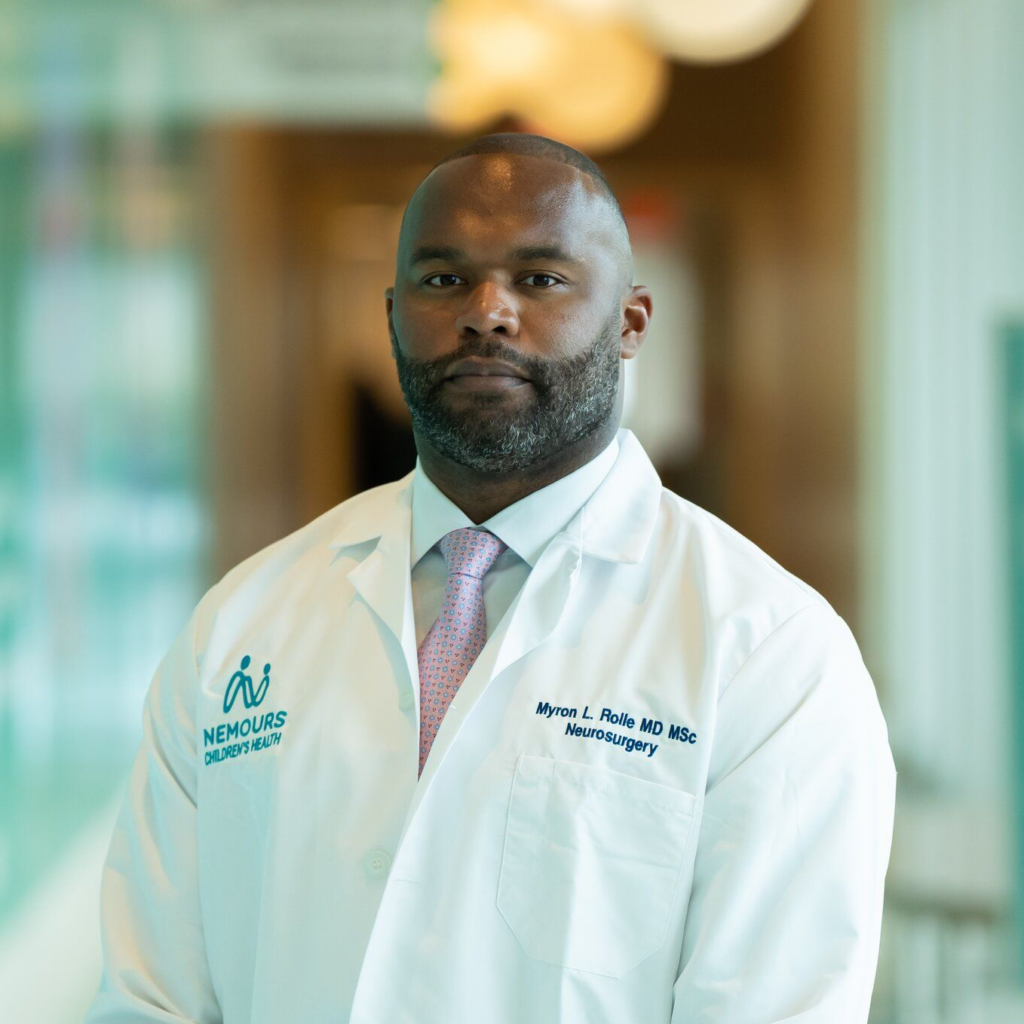
Caribbean American Heritage Month sets the stage for Dr. Myron Rolle’s extraordinary journey from his Bahamian roots to Rhodes Scholar, professional football player, and pediatric neurosurgeon. He reflects on the experiences and values that shaped his path, and how family, discipline, education, and service continue to guide his work in the operating room and beyond. He also shares why teamwork, mentorship, and giving back remain central to his mission in medicine and in the community.
Watch the episode on YouTube.
Featuring:
Myron Rolle, MD, MS, former NFL player, pediatric neurosurgeon, Nemours Children’s Health, and President/Founder, The Myron L. Rolle Foundation
Host/Producer: Carol Vassar
Learn more about Caribbean American Heritage Month
TRANSCRIPT
Announcer (00:00):
Welcome to Well Beyond Medicine, the world’s top-ranked children’s health podcast, produced by Nemours Children’s Health. Subscribe on any platform at nemourswellbeyond.org or find us on YouTube.
Carol Vassar, podcast host/producer (00:12):
Each week, we’ll be joined by innovators and experts from around the world, exploring anything and everything related to the 85% of child health impacts that occur outside the doctor’s office. I’m your host, Carol Vassar. And now that you’re here, let’s go.
MUSIC (00:30):
Let’s go, oh oh.
(00:32):
Well Beyond Medicine.
Carol Vassar, podcast host/producer (00:37):
Hi everyone. I am so pleased to welcome back to the podcast Dr. Myron Rolle.
(00:41):
Dr. Rolle is a pediatric neurosurgeon at Nemours Children’s Health. He’s also a retired NFL player. He played his college football at Florida State University and is a Rhodes Scholar. And his path from the football field to the operating room is as remarkable as it is inspiring. He was raised in a family deeply rooted in Bahamian heritage with a strong emphasis on education, discipline, and service. And he has consistently operated at the highest levels academically, athletically, and now in medicine.
(01:18):
This episode will be released (is being released) in June during National Caribbean American Heritage Month. So we wanted to share his story in depth because it does offer a really powerful reflection on how culture and family shape purpose and how that purpose evolves into a lifelong commitment to care, prevention, and advocacy.
(01:41):
With that, Dr. Rolle, welcome to the podcast.
Myron Rolle, MD, Pediatric Neurosurgeon, Nemours Children’s Health (01:45):
Thank you. Thanks for having me back on.
Carol Vassar, podcast host/producer (01:45):
You were born in Houston. If I did my research correctly, you were raised in New Jersey, and your parents were from The Bahamas. I’m curious, how did your family and your cultural foundation shape the way that you look at the world today?
Myron Rolle, MD, Pediatric Neurosurgeon, Nemours Children’s Health (02:00):
Well, I was born in Houston to be an American and a Bahamian citizen, to be very honest with you. My mommy was seven months pregnant with me in Nassau, Bahamas. Had all my older brothers in the Bahamas, wanted me there as well, but also wanted me to be an American because daddy was wrestling with a job offer from Citibank, where he worked, to either go to Luxembourg in Europe or to go to New York City. And so she says, “In preparation for that trip, let me have my last child be also a U.S. citizen, make it a little easier for us.”
(02:31):
So she had some friends in Houston who she went to high school with who were living there. That’s why she chose that city. That’s the only reason. I got permission from her OB-GYN in Nassau, Bahamas, to fly, flew me to Houston, and had me there. As soon as I was able to fly back, I flew from Houston back to Nassau. I spent the first three years of my life in The Bahamas. And then when daddy’s job transfer became finalized, we ended up moving up to New Jersey. He worked in New York.
(03:00):
So that’s kind of the story of how we got to Jersey. And even when we got to America and weren’t physically in The Bahamas, we continued with our Bahamian roots, had to do book reports on Sir Lynden Pindling, our first prime minister, and his story. We had to do book reports on Sir Milo Butler, our first governor general. I had to learn about our holidays, Junkanoo, what that meant, when Independence Day was in the Bahamas. We obviously were culturally immersed in the food. My friends were eating pasta and lasagna in New Jersey. I’m eating peas and rice and crack conch, boiled conch, stew conch, Johnny cake, all the different Caribbean cuisine that mommy knew how to make and would teach us how to make as well.
(03:51):
And then every summer I’d spend the school year in America and then take the summer. As soon as school ended, the next day we’re on a flight to The Bahamas and spending that time between Nassau and Exuma with our grandparents, with our cousins, with our godbrothers, with our aunts, uncles. And then we would come back to America the day before school. So it was sort of like one foot in America, one foot in the Bahamas. And that existed for the majority of my childhood until I started playing football in the summer, and I needed to be in America to do camps and those sorts of things. But for the first seven, eight years of my life, it was back and forth, back and forth.
(04:29):
And I enjoyed that. Even though we were physically displaced from The Bahamas, we still felt connected to the island, still felt connected to the culture, still felt driven by the morals in the Moral Constitution, that our Bahamian heritage and the strength of our Bahamian heritage to abolish slavery in 1830 and the slave owner, Lord John Rolle, left his slave name to all the slaves and then all the roles sort of congregated in Exuma, Bahamas and were part of the abolitionist.
(05:03):
I mean, just thinking about the power of that story, the power of our surname, the power of where we come from, just always felt strong about our position, not only just in the Bahamas, but in America and the world. And my parents never let us not know that and feel that and walk out of the house with that same confidence every day.
Carol Vassar, podcast host/producer (05:24):
I’m hearing a lot about family, and family is clearly central for you, not just the family you came from, but the family you are raising. Two sets of twins, I understand. What did your parents teach you early on about things like discipline and community, and education?
Myron Rolle, MD, Pediatric Neurosurgeon, Nemours Children’s Health (05:41):
It’s a great question. And my parents are both 75 years old. And I often joke that they met when they were eight years old in Nassau. They started dating at 15 and married at 21. Been married for 54 years now, going on five. And they are exceptional. And I joke with them that the Bahamas are so small, y’all really had no other option. Y’all hide to date each other. Like two handsome and beautiful people, it’s just designed… It worked that way. You didn’t have a lot of other options. But they are phenomenal parents, phenomenal grandparents now.
(06:15):
And as you mentioned, starting my own family, the same level of faith being the center of our home, our household, the Christianity, that strong upbringing is a part of my home. And we go to church every Sunday with my kids, to Sunday school. We read books on the Bible. We sing songs in the Bible. We pray before every meal. The same prayer that I prayed as a young Bahamian in The Bahamas, I taught my kids that prayer. And when my aunties and uncles came from The Bahamas and heard my kids say that, they were so proud that things were staying consistent and we weren’t getting too far disconnected from our roots of how we were living.
(06:53):
So faith is certainly the centerpiece of it. Discipline, focus, hard work, being selfless. Service is incredibly important. Giving to others and making sure that you’re respecting and responding to others’ needs, especially those who are disenfranchised and vulnerable, that’s incredibly important. It’s a huge, huge thing for us to walk out into the community and be a part of it. And we’ve been teaching our kids the importance of no matter what somebody looks like, no matter where they come from, what their name is, what their last name is, what street they grow up on, they are humans too, and they deserve an opportunity. And if you have a chance to help them in a system, then do that. And that was something that was instilled in me as a young person. That’s why I started my own foundation. That’s why I came to Nemours, because I can do pediatric brain surgery in the operating room, but then I can also help the community too.
(07:41):
And so this sort of ethos of service and philanthropy and giving of yourself to others, not only is it Christian in nature, but it’s also a role in nature too. My parents really put that into us. And now with the help of my outstanding life, we’re able to implement that into our own home.
Carol Vassar, podcast host/producer (07:59):
Family and education. Education has to have been huge. You ended up being a Rhodes Scholar. Not everybody gets to be a Rhodes Scholar, so kudos to you for that. How has that been throughout your life? What has been the consistent thread for you? And what did you come to understand about education and what it really gives you as a kid and as an adult?
Myron Rolle, MD, Pediatric Neurosurgeon, Nemours Children’s Health (08:23):
I think education is the great equalizer. The more you know, the more you can develop your intellect, the more you can express your thoughts well, the more you can do those things. You can be a player in the world’s game and not be on the sideline, not pontificate about what the world should be doing or how things should be run. As a boundary observer, you can actually be in it and help solve these problems.
(08:46):
And so education is that catalyst to holding that posture and that position. So applying for the Rhodes Scholarship was something that I thought about when I was in high school. I saw Bill Bradley was a Rhodes Scholar. He’s somebody I looked up to as a student athlete growing up. I saw Bill Clinton and Susan Rice and Rachel Maddow and Kris Kristofferson. All these people. George Stephanopoulos. I watch him every morning, reminded me on TV, and I was like, “Oh, he’s also a Rhodes Scholar.” So I thought about it as a young person and said, “Okay, if I can be a Rhodes Scholar, then I can truly take this educational momentum that you all have started in me to another level.” And that’s why we applied. And thankfully, by the grace of God, we won. And now I look at it as an opportunity to meet people, to network.
(09:36):
When I was in Oxford as a Rhodes Scholar, I was away from the football. I was away from America. I was away from the hustle and bustle of the college, the U.S. college system. And so I was honestly like a Black Harry Potter over there. I was just sort of with a cape and a wand punting on the 10th River and doing all the cool stuff that you would do as an English student. And I was truly able to meet some phenomenal people.
(10:04):
And now I have friends in Lusaka, Zambia, Cairo, Egypt, Perth, Australia, who are also Rhodes Scholars. And we developed a community of friends that when there’s ideas or thoughts that come along, we all get on the call together and we start talking about what we can do, what we can do in our individual past, but what can we do together as Rhodes Scholars?
(10:24):
And so education is about building community. It’s about bridging that gap between knowing and not knowing or being involved and not being involved. And it’s something that I hold dear. And that’s why the pursuit of it and the consistent pursuit of it is so valuable in my life. And it’s helped me even today as a neurosurgeon, where I can think through problems, think through complex problems that arise in the brain and the spinal cord, and help these vulnerable kids who we’re operating on.
Carol Vassar, podcast host/producer (10:51):
One thing I’m hearing from you is not just community, but teamwork. You are part of a team, whatever community you’re part of. Talk about that because some people are islands unto themselves, but it sounds like you are very much a team player.
Myron Rolle, MD, Pediatric Neurosurgeon, Nemours Children’s Health (11:05):
You have to be. I think team is so crucial. The Bible talks about iron sharpening iron. You need to have people next to you with you who are going to inspire you, motivate you. You can be admired by it. They can admire you, but at the same time, you need to glean support from them. A rising tide lifts all boats. Everyone has got to be moving in the same direction. And if you have a great team around you that you trust, then it makes the job so much easier.
(11:29):
When you work in silos in your own echo chamber, you can often become not humble. You can become overconfident and have that hubris that I’m doing all the things right. It’s all me. It’s everything is me, me, me. But then you realize it’s not all you. You’re given this power and disgrace by someone else. And the fact that you’re even here right now is a testament to other people who have fought for you, women and men, names you know and don’t know who have come before you that have provided you opportunity to stay at this hotel, to eat at this restaurant, to be educated at this school, to work at this particular place, to fly on this airline, to do all the things you’re doing now. So you didn’t get here alone. And if you don’t want to acknowledge a team, that’s on you. But trust me, there is a team, an invisible team behind you that got you to where you are now.
(12:13):
And so I recognized it, I acknowledged that. And then I put into place the team that I have today, between family, between friends, between work colleagues, between fraternity brothers, between my own teammates, my physical teammates that I had in college and in the National Football League. All of these men and women serve a purpose as I serve for them to help inspire, to help edify, and help buttress our journeys forward. Why try to go at it alone when you can go at it with a team, and you can feel that support, you can feel that sense of community, and you can accomplish a goal together?
(12:51):
To me, whenever I played on a football team that was about individual accomplishments, we never were successful. No matter how fast we were, how big we were or strong we were, we never won. And people would always ask, “Well, how come this team was so much talent, so much individual skill, cannot get across the finish line?” But the teams that were less talented from a metric standpoint, but we worked together, we trusted each other, we communicated, we supported each other, in long games we weren’t supposed to win. And that to me was all I needed to see, to know that having a team by your side that does all those productive and healthy things like communication, like support, like help, like looking out for each other, all those sorts of things, that’s the winning, successful formula for sure.
Carol Vassar, podcast host/producer (13:38):
Do you see that in play at Nemours?
Myron Rolle, MD, Pediatric Neurosurgeon, Nemours Children’s Health (13:42):
Definitely do. I came into a winning team already, and I just wanted to add value to it. We have an outstanding neuroscience department led by Satya Gedela, who is from day one, our vision aligned and I appreciated everything that he’s done to grow our neuroscience division. And he’s done it exponentially faster than anyone has done it ever at Nemours or in Central Florida.
(14:04):
And then my actual neurosurgical colleagues, from Greg Olivieri, who’s our chief, to Chris Gegg, both of these gentlemen are remarkable, not only seasoned neurosurgeons, but great people, and willing to support. When you first start off as a pediatric neurosurgeon in your first job at a fellowship, you’ve been training forever, you’ve been fellowshipping forever, and now you’re like, “Okay, now it’s my time to really take care of these kids,” you want to make sure you have people next to you who you’re able to call on for support, help, advice, knowledge, information.
(14:36):
Even if something doesn’t go that well, you’re able to call them and say, “Hey, did I do the right thing. Am I okay?” And they’ll encourage you and say, “Yeah, keep going.” And that’s what it’s about. And those are some of the conversations that people don’t see, but that’s what a team does, and that’s what teammates do. And I found that at Nemours, not only within neuroscience, but the whole hospital, the leadership. Even Nemours Delaware. Honestly, I’ve been able to work with some folks in Delaware around some policy and advocacy, around pediatric gun safety and folic acid fortification to prevent spina bifida. And the reception and the welcoming and the willingness to use their platform, their bully pulpit to get us all to the finish line has been remarkable.
(15:20):
So yes, I think Nemours has embodied that team spirit. And out of all the places that I could have been, Orlando, I was looking to be in Florida, I was looking to be in Orlando in the job market. I won’t call it the other hospitals I was looking at, but I was looking at other pediatric hospitals in Central Florida, and Nemours stood out, and I’m glad I chose here. I’m glad they chose me.
Carol Vassar, podcast host/producer (15:39):
It sounds like you have wrapped yourself around a team, and they’ve wrapped around you. How many of the people that you’re working with now or that you’ve worked with in the past would you consider mentors? Obviously, your family, as you noted, when we started our conversation, but who else has guided you both early on, and who’s guiding you today?
Myron Rolle, MD, Pediatric Neurosurgeon, Nemours Children’s Health (16:01):
Yeah. So I love mentors, and I love mentorship. I’m a mentor on my own of about 13 young Black men who are interested in medicine.
Carol Vassar, podcast host/producer (16:09):
Oh, wow.
Myron Rolle, MD, Pediatric Neurosurgeon, Nemours Children’s Health (16:09):
We call it the Honor Rolle, like my last name, little play on it.
Carol Vassar, podcast host/producer (16:12):
Oh, I love that.
Myron Rolle, MD, Pediatric Neurosurgeon, Nemours Children’s Health (16:14):
Yeah, no, we love it too, for sure. And the kids, they’re awesome. And they all came to us different ways. I had a teammate, Derek Mason, who played with me in the NFL. I’ll talk to my cousin in the NFL and then reached out to my cousin. And I ended up helping his son. He wanted to shadow me in the hospital at Harvard. And we did that during my residency and we continued our relationship. I had a book, and I signed a couple books in Atlanta, did a book tour, met a young man there, and met a young man in Jacksonville. My wife and I were in St. Kitts at the airport. Randomly, a young Black brother comes up to me and asked me to be his mentor. He’s in medicine, and he knows my story. He’s part of my fraternity. And I just felt the genuineness in his approach and his presentation to us. We took him on.
(16:55):
So we were sort of collecting these young men like Thanos and the Infinity Stone, like The Avengers. We were just collecting all these young men and assembling them together, and we created this group called Honor Rolle where we meet every month, and we talk about how life is challenging at times, but if you have a group that you can be unfiltered and vulnerable with, especially as Black men in medicine, that’s huge. That’s critical. Because often we don’t get to express microaggressions and frustrations to our non-Black colleagues because they may either not understand it or it may be perceived a different kind of way, but now you’re in a safe spot where you can say these things that we can talk about some of the tricks and tips that I see.
(17:35):
I don’t want to go too deep into this, but I remember when I was in residency, and we would have sub-Rs, these medical students come in and do rotations with us at the hospital. And a lot of the residents, or sorry, medical students who were coming from the Harvards, the Hopkins, Cleveland Clinics, these really fancy, prestigious medical schools, and they were non-Black, they would hear from other folks how to succeed on these rotations. They would know everything. It was almost like robotic. They studied a manual, and I was like, “Huh.” And then I would see some of the Black brothers and Black sisters who were struggling because they didn’t have anyone to tell them what to do, how to do it. And they’re capable of it, but they didn’t have the manual. And so I was like, “Okay, that’s different. Now I’m inside. Let me give them the cheat sheet.”
(18:23):
So I wanted to give them the opportunity. Now, if you fail or you don’t do as well, that happens. We understand performance level is going to shift people up and down, but I at least want to give you a fair shot because if they’re getting this blueprint on how to get it done and you’re not, I mean, you’re already working against the grain. And so this is a part of that mentorship.
(18:44):
But to answer your question on myself, coaches, pastors. Dr. Ben Carson is somebody who I consider a mentor. I read his book, Gifted Hands, when I was in the fifth grade, which inspired me to want to be a pediatric neurosurgeon. I had a chance to meet him through some family connections. Went to church with him, Sunday school, golfed with him, ate at Denny’s with him, and had fellowships with him and his wife. And he wrote me a letter of recommendation for pediatric neurosurgery. He’s an awesome person.
(19:12):
Another guy named Jay Storm, he is a pediatric neurosurgeon at CHOP. He’s the chair at Children’s Hospital of Philadelphia. Remarkable person, somebody who I look up to tremendously. So those are a couple of my mentors in medicine, but I had mentors, like I said, in life spaces from older fraternity brothers to older teammates of mine. A guy named David Thornton played with me when I was in Tennessee. I was a rookie. He was an 11-year vet. And when I tell you David did all the things right, he was kind. He was humble. He talked to everybody from the president of the Tennessee Titans, the head coach, the general manager, all the way to the guy who’s washing our jockstrap. Everybody he treated with respect and honor and integrity, and I loved that about him.
(19:58):
And the crazy thing about David, which I loved, is that he wasn’t a huge guy. He was muscular. And obviously well-built as a football player, but he wasn’t the biggest player on our team. We had guys who were bigger than him, but when he walked in the locker room, guys stood up a little bit, and they straightened their backs up. And they turned down the rap music that had a lot of curse words on it because David was super Christian and David was super honorable, and they were like, “Oh, okay, David’s here. Okay. Okay.” And I was like, oh my goodness, you got these grown men, 360-pound defensive linemen who are rough, tough from Memphis, Tennessee, kind of aggressive, kind of guys who recognized when this guy walked in the presence, the leadership, “Oh yeah, let me turn this music down because I don’t want to disrespect our leader.” It was remarkable.
(20:40):
So David is somebody who I hold in high esteem. He’s somebody who’s looked at my children, and he’s been a part of that kid’s life and it’s such a blessing. So those are a couple of the mentors and people who have helped lead me this way. And I’ve tried to turn that around to do it with my own mentor group with the Honor Rolle for sure.
Carol Vassar, podcast host/producer (20:56):
When he entered the locker room, it was a sign of respect to turn down that rap music.
Myron Rolle, MD, Pediatric Neurosurgeon, Nemours Children’s Health (21:03):
Oh yeah. Definitely.
Carol Vassar, podcast host/producer (21:03):
That’s amazing.
Myron Rolle, MD, Pediatric Neurosurgeon, Nemours Children’s Health (21:04):
Yes.
Carol Vassar, podcast host/producer (21:04):
Let’s talk. You studied at Oxford. We talked a little bit about that. That was your Rhodes Scholarship. Went on to play in the NFL, either of which could be considered a career pinnacle. Some people just want to be a surgeon. Some people just want to play in the NFL. You did both and then pivoted to medicine. And not just into medicine, but one of the most demanding specialties in medicine, which is pediatric neurosurgery. What drew you into medicine, and why do you stay committed to medicine today?
Myron Rolle, MD, Pediatric Neurosurgeon, Nemours Children’s Health (21:35):
Yeah. I think medicine has always had an interesting place in my life. I’ve always wanted to do it after reading about Ben Carson and seeing a Black man who had a temper when he was younger, like I did. I had parents who focused on education like I did, and just kind of went through some of the same things I did in childhood. And I saw that, and I said, “Okay. He can be a hero of mine. He can be somebody who can be the standard for me.” So that was always locked in my head that medicine could be a future. And let me use football, what football’s doing for me right now. Let me use it to get there.
(22:12):
And so that’s to be frank with you, economically. If I play football, play it well, I can get to the NFL and make a lot of money, which can pay for medical school. If I play this football game well and continue to achieve success, I really like the success. I like the competition, but maybe it can help me open doors in the future and give me a platform that maybe another discipline wouldn’t.
(22:34):
So I come into a room, and I talk to a patient who’s nervous about neurosurgery or nervous about their brain and spine surgery, but then I tell them, “Hey, I played football like you. I see you got a New England Patriots shirt on. The New England Patriots beat me 50 to nothing when I was a rookie or something like that.”
(22:49):
“Oh, Dr. Rolle, you’re so funny. Ha-ha.” I said, “Okay, cool. We broke that ice. Now let’s talk about the treatment that I like to offer you.” And so it kind of loosens people up. It was a benefit.
(22:58):
And then football taught me a lot of things that I’m using today as a physician, from communication, hard work, overcoming adversity, teamwork that we talked about earlier, being adjustable and adaptable, and how are you flexible in the moment when there’s real pressure happening. When something bad happens, do you pivot? How can you get to options B, C, and D when option A doesn’t work? And that’s critical. You have to maintain your calm, maintain your cool, take a heartbeat or two, breathe, and then go about your business.
(23:29):
Some people get paralyzed and stuck when pressure hits. I think football has taught me how to breathe and work through those very tense moments and perform at that level. If you want to be elite, if you want to be successful in football, especially at the high level, you’ve got to be able to work through your anxiety and quell those emotions. 80,000 fans screaming, but that’s got to be quieted down. You’ve got to lock in and focus. And in surgery, not 80,000 people, but this is a life at risk right in front of you. You’ve got to be able to quiet all those nerves and anxious feelings down to focus on this patient, focus on his or her life, and try to save it. So football was the perfect chapter one to my life, and medicine has been a seamless transition to chapter two.
Carol Vassar, podcast host/producer (24:13):
And part of chapter two or chapter three is the Myron L. Rolle Foundation, which expands your impact beyond football, beyond medicine, beyond the operating rooms. I want to know what the foundation is, what drove you to begin it, and how you are using it to create opportunities for others and work toward public policy that emphasizes prevention.
Myron Rolle, MD, Pediatric Neurosurgeon, Nemours Children’s Health (24:38):
Definitely. No, thank you for bringing it up. We’re very proud of the Myron Rolle Foundation. Started in 2009 when I was at Florida State University, wanted to help children and families underserved and marginalized in areas of health, wellness, and education. And since then, we’ve grown to a point where we have a larger staff, we have a larger impact. And we’re mainly in Central Florida, but we work all around the state on a few different eras. One is pediatric gun safety, working with legislative lawmakers and other community members to advocate for policy education awareness around safe storage, how we protect our children, and keep their futures alive by not being riddled with bullets because kids get their hands on unsecured firearms. So that’s exciting.
(25:21):
And then working with partnering organizations, whether it be pro Second Amendment folks or whether it be really, really safety focus groups, getting everybody to the table to come together as a meeting point, a middle ground of our kids are our most prized possession and we need them to be safe and their life not to be cut short or impaired by discharging a firearm that’s unsecure they find in their home or in the car. So, pediatric gun safety is one of the main principles.
(25:48):
Another one is mental health. We talk a lot about mental health in regards to young people, middle school age, not just high school. I think people start really focusing on high school because that’s when stress happens a lot with prom and identity and all these sorts of things. But middle school and even elementary school, and you have kids that are struggling with these issues, who do end up getting their hands on guns or do something deleterious to their life or someone else’s, because they’re struggling with this trauma, because they’re struggling with these issues, that’s important.
(26:17):
So I partner with Aspire Health Partners, who work in Orlando, do mobile clinics, mobile van visits to underserved areas of Orlando to try to provide these mental health support resources, counseling, and medications for some of these underserved children. So that’s exciting for me as well.
(26:36):
And then food security, the other big one that we do. And so we have mothers who are very at risk for a disease called spina bifida, one because they’re Latino or Black, and two, because sometimes in their food, they’re dyed, they’re not consuming as much folic acid as others. The FDA in the ’90s said that you need to enrich wheat products with folic acid, which can prevent spina bifida by almost 80 to 90%. And now we’re seeing that Black and brown folks are having higher rates of spina bifida. The incidences are much higher than whites, mainly because the diets are consumed largely in corn masa and white rice and they don’t have folic acid in them all the time.
(27:16):
And so seeing these patients, these kids who are born with wide open spines, wide open backs where it’s visible to me and to the rest of the world and bacteria can get in and life-threatening meningitis can happen, we want to get on the preventative side of things and use the foundation and use our platform, our bully pulpit as leaders and thinkers in this space to write bills, write policy that mandates that manufacturers enrich corn masa white rice with folic acid at the standard level to help prevent spina bifida and these catastrophic diseases.
(27:47):
So far in Florida, we got a resolution passed. We’ve created the first-ever Spina Bifida Awareness Week, October 18th and 24th. We’re very excited about that. And in Delaware, Pennsylvania, New Jersey, we have bills currently circulating the House and the Senate up there in those state legislatures. And we’re hopeful that that can get passed, too.
(28:05):
So the foundation does a lot of work, but those are the three main areas from pediatric gun safety, mental health, and then food security. We’re fired up about it. And we’re glad that we’ve found our niche, found our groove, thankful for Ginsburg Institute, who has been supportive of us and Nemours. And then all of our other central Florida departments from Alianza for Progress. That’s a grassroots Hispanic organization that helps us with food security. Aspire, as I told you, it’s a mental health organization, really, really important in Orlando. And then for pediatric gun safety, from the Osceola County Sheriff’s Office to the Orlando Police Department to Monique Worrell, the state attorney, the district attorney for this area, to Melissa Vickers, the Ninth Circuit Judicial Public Defender. I’ve gone into the Orange County Juvenile Detention Center and talked to a lot of those young men about pediatric gun violence and gun safety. So we’re not working alone in silo. Again, back to the theme, teamwork, teamwork, teamwork, working with other people who are doing similar things to keep moving forward and advancing the progress.
Carol Vassar, podcast host/producer (29:06):
Dr. Myron Rolle is the chairman and founder of the Myron L. Rolle Foundation, a retired National Football League player, a Rhodes Scholar, and a pediatric neurosurgeon with Nemours Children’s Health.
MUSIC:
Well beyond medicine.
Carol Vassar, podcast host/producer
Dr. Rolle is one of the thirteen million people of Caribbean heritage in the US, celebrated during Caribbean American Heritage Month each June. Others you may have heard of include Rihanna, Nicki Minaj, Sheryl Lee Ralph, Alfonso Ribeiro, Tia and Tamera Mowry, and Lenny and Zoë Kravitz through Lenny’s mom, Roxie Roker, the stage actress best known for her appearances on The Jeffersons in the 1970s, who’s also the cousin of Al Roker, who, yes, is also of Caribbean American heritage.
Some historic figures of note with Caribbean American heritage include Sidney Poitier and US founding father Alexander Hamilton. Thanks to the amazingly accomplished, kind, family-focused, and community-minded Dr. Myron Rolle for helping us with our celebration, and be sure to check out our show notes for more information on Caribbean American Heritage Month.
Thanks to our production team for this episode, including Cheryl Munn, Susan Masucci, Lauren Teta, and Alex Wall. Video production by Brit Moore. Audio production by yours truly.
Join us next time as we get the state of children’s health today from the perspective of Mark Del Monte, chief executive officer and executive vice president of the American Academy of Pediatrics. I’m Carol Vassar. Until then, remember, together we can change children’s health for good, well beyond medicine.
MUSIC
Let’s go. Well beyond medicine