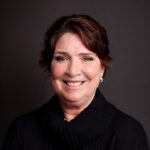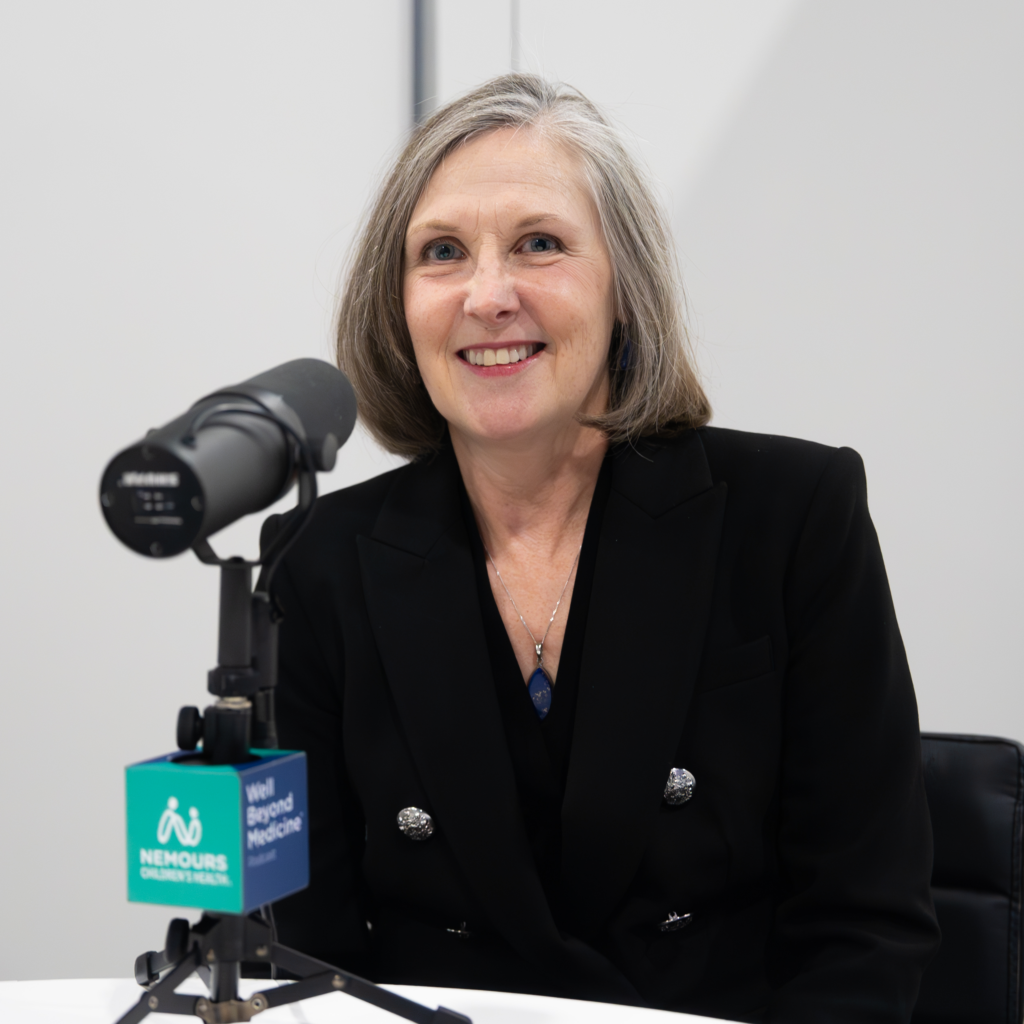
“Food as medicine” is transforming the future of pediatric care. From programs like WIC to the essential role of registered dietitians, nutrition is emerging as a powerful driver of better outcomes for children. Allison Steiber, RD, PhD, Chief Mission, Impact and Strategy Officer, Academy of Nutrition and Dietetics, shares her organization’s Food as Medicine roadmap and unpacks the critical gaps in access, funding, and awareness that stand in the way of impact. She also discusses what it will take to ensure every child has the nutrition they need not just to grow, but to truly thrive.
Watch the episode on YouTube.
Featuring:
Allison Steiber, RD, PhD, Chief Mission, Impact and Strategy Officer, Academy of Nutrition and Dietetics
Host/Producer: Carol Vassar
TRANSCRIPT:
Announcer (00:00):
Welcome to Well Beyond Medicine, the world’s top-ranked children’s health podcast, produced by Nemours Children’s Health. Subscribe on any platform at nemourswellbeyond.org or find us on YouTube.
Carol Vassar, podcast host/producer (00:12):
Each week, we’ll be joined by innovators and experts from around the world, exploring anything and everything related to the 85% of child health impacts that occur outside the doctor’s office. I’m your host, Carol Vassar. And now that you’re here, let’s go.
MUSIC (00:30):
Let’s go oh, oh, well beyond medicine.
Carol Vassar, podcast host/producer (00:36):
Hi everyone. We are at Health in Las Vegas, and I am so pleased today to have with me Dr. Allison Steiber. Dr. Steiber is chief mission impact and strategy officer for the Academy of Nutrition and Dietetics. And we’re going to talk about all things food-as-medicine, AKA FAM. Welcome to the podcast.
Allison Steiber, RD, PhD, Academy of Nutrition and Dietetics (00:57):
Thank you. It’s wonderful to be here, Carol.
Carol Vassar, podcast host/producer r (00:59):
So you in your organization, in the food-as-medicine strategic roadmap that you have produced, you have described FAM interventions as food-based programs paired with medical nutrition therapy. How do you see that playing out concretely in pediatric care, especially for children with, say, chronic conditions or nutrition-sensitive conditions?
Allison Steiber, RD, PhD, Academy of Nutrition and Dietetics (01:29):
Absolutely. So Carol, food-as-medicine is an interesting space. It is a giant umbrella of different types of provision. So it might be food access through a produce prescription or medically tailored groceries. It might be culinary medicine where they’re training physicians and other allied health professionals to be able to cook while thinking about how to prevent and treat chronic disease.
(01:54):
But I think our best example, particularly in the pediatric space, is the WIC program. So we have both access to healthy foods within the WIC program. And we also have access to registered dieticians who provide medical nutrition therapy for children, but also for pregnant women. And I think that has shown over and over that when you pair those two things, access to healthy food with nutrition care provided by a credentialed practitioner, you get the best outcomes. And they have shown this in a bipartisan manner.
Carol Vassar, podcast host/producer (02:26):
I have to be honest, I had never thought of WIC as food-as-medicine, but it really does fit into that umbrella, doesn’t it? And it’s not new.
Allison Steiber, RD, PhD, Academy of Nutrition and Dietetics (02:34):
Absolutely. Absolutely not. We’ve been doing it for decades, and we’ve been showing for every dollar spent, many, many dollars saved. We’ve shown really positive health outcomes in these kids. So it’s a great example in the pediatric space of the power of food-as-medicine.
Carol Vassar, podcast host/producer (02:51):
Is there another example that’s as powerful or close to being as powerful?
Allison Steiber, RD, PhD, Academy of Nutrition and Dietetics (02:55):
I mean, certainly, but maybe not within the pediatric population.
Carol Vassar, podcast host/producer (02:58):
Okay.
Allison Steiber, RD, PhD, Academy of Nutrition and Dietetics (02:59):
So we have Meals on Wheels for older Americans with the Older Americans Act, which has been very successful. The challenge there is that it often doesn’t connect. It doesn’t have the funding resources to connect a registered dietician with the meal provision. Some of the newer Food is Medicine coalition sites do that really, really well, but they’re not funded often through the avenue of the Older Americans Act.
(03:23):
But in the pediatric space, I think honestly, WIC is our best example. There are other places where you have wraparound programs for children living with obesity or adolescents living with obesity, where they have nutrition, therapy, physical activity, and mental health, but they may or may not have the food access piece. So it’s when you pair the two that I think you see the biggest impact on health outcomes.
Carol Vassar, podcast host/producer (03:50):
You mentioned registered dieticians and actually the actual name, I have it right here as registered dietitian nutritionists. Your roadmap really emphasizes them. They seem to be front and center in the work that you’re doing. What gaps are limiting what RDNs, as they’re known, being involved in children’s care in particular, and how can we close those gaps?
Allison Steiber, RD, PhD, Academy of Nutrition and Dietetics (04:18):
Right. So I’m going to address this in a few ways. When you think about access to care, particularly for children, I think that’s an even larger gap than it is for adults. We have to think about it in four ways. And we laid this out in our strategic roadmap in our four pillars. But the very first is they have to have access to care.
(04:38):
And so if you think about states that have Medicaid, our most vulnerable children, it’s not consistent. We have a huge inequity in terms of access to care. So, Nevada, where we’re at right now, provides, through Medicare, access to registered dieticians and nutritionists through the Medicaid program for children living with obesity, diabetes, or cardiovascular disease. But if you go to Alabama, Medicare does not. And if you go to Florida-
Carol Vassar, podcast host/producer (05:07):
Medicare or Medicaid?
Allison Steiber, RD, PhD, Academy of Nutrition and Dietetics (05:08):
Medicaid. Apologies. Thank you for catching that. Medicaid does not, and particularly for children, they do not. In Florida, it depends on your Medicaid package. So it may, it may not. These challenges, because they’re at the state level, mean that access to care is inequitable. And then it depends on where you live geographically. So certainly, access to care is one major thing. And our roadmap is really focused on improving that at the federal and state levels.
(05:37):
And we’re working both with Medicaid, but we’re also working federally with Medicare, and we’re working with an act, the MNT Act, which would provide reimbursement for people living with different chronic conditions to have access to a dietician. The second thing, though, is referrals. And our Medical Nutrition Therapy Act addresses that as well. So right now, only physicians can refer. And interestingly, there was a study that was published a number of years ago, 2017, in the American Journal of Lifestyle Medicine.
(06:09):
And in that journal, they wanted to really investigate pediatricians’ or primary care providers ‘ referrals to children living with obesity. And what they found in the primary care setting, which, if you imagine that’s where the majority of care happens for all families, less than 20% of physicians were referring to a dietician for children living with obesity. And of that 20%, less than 50% of the families were actually utilizing that referral and following through. So that is a problem. That is a huge barrier. Physician awareness, understanding the importance, and ensuring that families understand the importance of nutrition for their children, right?
Carol Vassar, podcast host/producer (06:50):
Absolutely. Now you mentioned those are two of the pillars. What are the other two?
Allison Steiber, RD, PhD, Academy of Nutrition and Dietetics (06:54):
So, sustainable payment models is that second one, and we really feel strongly about improving sustainable payment models. But the third one is demonstrating effectiveness. Our payers need to know the ROI. They need to know what populations benefit, what pediatric populations benefit the most. Is it children living with obesity? Is it adolescents that have obesity, hypertension, type 2 diabetes? What is the dose? How many times do they have to be seen by a dietician to really see that health impact? And they also need to know the duration. For how long do they need to be seen? So demonstrating effectiveness is number three.
(07:32):
And number four then is interprofessional awareness of what dieticians bring to that table. There was a recent blueprint that was published looking at comprehensive care for obesity, and the four pillars really were nutrition therapy, exercise, behavioral health, and, of course, medicine and medical care. And we need to be walking in line, lock and step to make sure that everyone who’s living with obesity gets that care.
Carol Vassar, podcast host/producer (08:00):
Well, when we’re talking about kids with obesity, maybe they’ve had the privilege of seeing, because it’s inconsistent whether or not they’re seeing a registered dietician. What about adherence? When they get the instruction, “This is a better food than that, you need to get X amount of exercise,” how much adherence are we having issues with adherence to that?
Allison Steiber, RD, PhD, Academy of Nutrition and Dietetics (08:24):
So this is such a complex issue. This is not about whether the child wants to adhere or not necessarily. This is about inclusion in the family, into that care. It’s about having a multi-component, multidisciplinary intervention that is designed to meet the family where they’re at and making sure that we use language that reduces bias, making sure that we think about their resources and what they can afford and what they can’t afford.
(08:52):
And so it’s not as simple as having perhaps a community ally or peer. It’s really very complex, and we want to avoid any potential side impacts or side effects from the care. We want to ensure that what we’re doing is best for the child, and that takes a village, really.
Carol Vassar, podcast host/producer (09:12):
Community is key.
Allison Steiber, RD, PhD, Academy of Nutrition and Dietetics (09:13):
Community is key. One of the things that we’ve talked about is, right now, there’s a nurse in most schools.
Carol Vassar, podcast host/producer (09:19):
Right.
Allison Steiber, RD, PhD, Academy of Nutrition and Dietetics (09:20):
What if we put a dietician in all those schools, particularly schools that are in low-income areas, living with high rates of poverty? Could that improve the access both for families, but also for children, and for the school health systems, right? Would having a dietician embedded in that school district be a community asset that would change the game?
Carol Vassar, podcast host/producer (09:42):
And I think you have said or mentioned in some of your writings that when we form our food habits young, and they’re good habits when we’re young, we’re going to have those for a lifetime. It sounds like having an RDN in the school is one way of ensuring that kids start on the right foot in terms of their food intake and their ideas about nutrition. Are there others? Is there curricula that could be brought to bear? Is there something we can do in the preschool or even with new moms and dads?
Allison Steiber, RD, PhD, Academy of Nutrition and Dietetics (10:16):
Absolutely. So when you think about it from a systems approach, you think about how we can ensure that people that are feeding and caring for our children have the information they need, but that also children are exposed at a young age to what healthy foods look like. Otherwise, they grow up as adults with kind of an unknown that they don’t know what fresh fruits and vegetables look like, particularly if they don’t have access to it.
(10:40):
But it doesn’t always have to be fresh. It could be frozen vegetables. It could be frozen fruit. It could be canned without salt. There’s many ways to get fresh fruits and vegetables, beans, lagoons, nuts, all low-cost, affordable way, but take time to prepare. And if you don’t have those skillsets and that’s not part of your culture, you may not know how to incorporate that into your diet.
(11:02):
So it really takes not just one class or one flyer being sent home. It takes shifting a culture toward how do we give moms and dads the time and the resources to provide those kinds of foods and to be able to prepare those kinds of foods for their children. And I think there are many different interventions that have been tried, but when we don’t do it as a multi-stakeholder intervention where we’re bringing together schools, industry, food producers, government, and healthcare providers all on the same page of what healthy looks like and what we’re trying to achieve, you don’t get the results that you need to eat. You get one-offs.
Carol Vassar, podcast host/producer (11:48):
Is that something that your organization is working towards? All of those partnerships, bringing in the right people to make sure that every child starts off on the right foot?
Allison Steiber, RD, PhD, Academy of Nutrition and Dietetics (11:56):
Absolutely. We have a number of interest groups within our organization that we bring together to talk about advocacy, that we bring together to think about research, and that we advocate for universal meals in school systems. That’s a major thing that we advocate for on our policy team. We have a school nutrition group within our organization that just focuses on how to ensure we’re providing better school nutrition that children will eat and reduce food waste.
(12:26):
You hear that all the time, “Oh, if you make the food healthy, there’ll be more food waste.” But in order to do that, we have to bring all the stakeholders together. And so we’ve done convenings where we bring multiple stakeholders together to have conversations about how to get that done.
Carol Vassar, podcast host/producer (12:41):
Does that include kids?
Allison Steiber, RD, PhD, Academy of Nutrition and Dietetics (12:43):
That’s a great question. I can’t think at the moment of a time when we’ve brought children to our stakeholders, but it doesn’t mean we couldn’t do it in the future.
Carol Vassar, podcast host/producer (12:51):
Something to think about.
Allison Steiber, RD, PhD, Academy of Nutrition and Dietetics (12:52):
Something to think about.
Carol Vassar, podcast host/producer (12:53):
I want to talk about that first pillar of access. Let’s talk about families that are food insecure.
Allison Steiber, RD, PhD, Academy of Nutrition and Dietetics (12:59):
Right.
Carol Vassar, podcast host/producer (12:59):
The kids aren’t not necessarily getting food on a regular basis, and if they’re getting food, it might not be the most nutritious and it might not come on a regular basis. How do you make sure that food-insecure homes can move past that access issue and really secure what they need in terms of food early in life, and that early learning toward those footsteps towards good health overall?
Allison Steiber, RD, PhD, Academy of Nutrition and Dietetics (13:31):
Well, this is a huge problem. And of course, at the root of that is poverty. And so poverty drives so much of this. It drives access to be able to go to a grocery store where they sell fresh fruits and vegetables. It drives a family’s ability to have shopping or be able to have healthcare, be able to have a variety of mechanisms beyond just food and nutrition. But when we think about food nutrition, historically, we’ve had robust safety net mechanisms that provide families living in poverty with access to healthy food.
(14:09):
And of course, that’s the Supplemental Nutrition Assistance Program or SNAP that provides families. And then SNAP-Ed, which provides families not just with access to food, but also the education to make wise decisions within their food buying arena. And this is so challenging now because we know SNAP-Ed has been removed as an opportunity for our families and the funding to SNAP has been greatly declined.
(14:39):
And SNAP is for a whole family, whereas WIC, as we discussed before, is really aimed at pregnant women, infants, and children. But together, those safety net programs provided people living in poverty with a mechanism for getting access to healthy foods. Without those mechanisms, we are going to see poverty and food insecurity and nutrition insecurity, which is not just providing calories, but providing micronutrients and healthy foods that kids need to thrive and grow. We’re going to see that reduced dramatically. They’re going to have less nutrition security, less food security.
(15:17):
Unfortunately, we’re also taking away our monitoring mechanisms. And so there’s a couple different surveys that the CDC did that helped us understand food insecurity and malnutrition, frank malnutrition within our pediatric population. Haines is at risk. The use the Youth Behavioral Surveillance System survey is at risk. So how are we going to know, as the situation changes, when we’ve taken away our safety mechanisms at the federal and state level?
Carol Vassar, podcast host/producer (15:48):
And that could affect generations to come?
Allison Steiber, RD, PhD, Academy of Nutrition and Dietetics (15:50):
Generations.
Carol Vassar, podcast host/producer (15:51):
Let’s talk about the sustainable funding. That’s another of your pillars. What’s it going to take to get pediatric food-as-medicine programs reimbursed through Medicaid or through … I mean, I’m thinking pediatrics, so it’s not really going to go under the Medicare umbrella, but also through private insurance.
Allison Steiber, RD, PhD, Academy of Nutrition and Dietetics (16:14):
Well, I wish I had that magic wand that could say, “This will do it.” What I like to think is that if we can demonstrate the return on investment, if we can demonstrate not only is it enough to show health impact, we’ve done that. We have two physician statements that leveraged what we call an umbrella review, which is a way of taking all the literature that was done in a systematic fashion, pulling it together, and saying, “What are the consistent themes and outcomes?”
(16:46):
We know in the pediatric arena, particularly in overweight and obesity, that when dieticians intervene, we get improved health outcomes, but I don’t think that’s enough. I think we also need to show the health systems how that benefits them in a cost-saving way, so that we don’t get just insurance companies, but also the health systems, the larger health systems, seeing the benefit, so they will invest in programs that are in the community.
(17:15):
Right now, I think health systems are beginning to eyeball the community, but they’ve been historically very vested in the acute care setting. So how do we get them to see by investing in food-as-medicine programs in the community, they will have healthier children that will grow up to be healthier adults, and that will be a more vibrant and productive society. And I think that is tough to demonstrate because it’s so far down the road.
Carol Vassar, podcast host/producer (17:43):
It’s tough to demonstrate, but is anyone doing it? Do you know any examples?
Allison Steiber, RD, PhD, Academy of Nutrition and Dietetics (17:48):
I mean, I think WIC is my best example, and I don’t know of food-as-medicine programs at the moment that have been very targeted to pediatrics, adolescents, and children. I think we have some of the diabetes work, the prevention of diabetes work, and CDC was doing some great work and programming for children and adolescents to prevent overweight and obesity. But again, those programs are at risk now due to some of the administration changes.
Carol Vassar, podcast host/producer (18:20):
We talked a little bit about families affected by not having enough good access to food. Let’s talk about communities and food deserts.
Allison Steiber, RD, PhD, Academy of Nutrition and Dietetics (18:30):
Yes.
Carol Vassar, podcast host/producer (18:30):
Can some of the food is medicine ideas, programs be brought to bear within communities and tailored for children and families who maybe are in an under-resourced neighborhood?
Allison Steiber, RD, PhD, Academy of Nutrition and Dietetics(18:42):
Right. So that is a great question. There are already programs that are beginning to happen in food banks through Feeding America, which is working on food-as-medicine programming through retailers, Kroger, Hy-Vee, just to name a few. There are multiple different ones. Giant Eagle has been doing it for many, many years, where they are embedding dieticians within the retail space so that parents and individuals can come and have conversations about, “Someone just told me my child is living with obesity or is becoming overweight. What are foods I can prepare for my child that will be healthy and yet allow them to be active and have the energy to play soccer, or basketball, or do any of the activities that they would like to do?”
(19:31):
So I think that in the community, we’re beginning to see some of that move. The question is, how do you pay for it? It goes back to that first question of how do you pay for it in a sustainable way? So I think education models, certainly when we think about government agencies like USDA, the United States Department of Agriculture, doing things like MyPlate, that is a great tool. It’s free to the public, where parents can get pediatric-focused, adolescent-focused guidance on healthy foods that are affordable to feed their families, but it’s often hard to implement that without help.
(20:08):
And so that’s where the provider comes in. Having a registered dietician that can support that family to guide them through, whether it’s buying groceries or getting access to a food bank or meal provision at home if you can’t travel outside the home.
Carol Vassar, podcast host/producer (20:25):
Do you have any personal examples of people who have maybe used the food-as-medicine programs or even WIC, it seems to be really front and center here, to improve their lives and the lives of their children?
Allison Steiber, RD, PhD, Academy of Nutrition and Dietetics (20:41):
Absolutely. I mean, I’m a registered dietician myself, and I remember very early on when I was doing my internship in Kansas City through KU Med Center, I remember that we went to a WIC facility and they did such a wonderful job of helping moms understand the importance of breastfeeding, the importance of as their child weaned off breastfeeding, when was the appropriate time to wean off breastfeeding? Lots of moms got misinformation, lots of parents had misinformation from perhaps relatives or other caregivers.
(21:20):
So they didn’t know how long to do breastfeeding. They didn’t know what foods to introduce when, and WIC stepped in and provided easy-to-use resources that paired that kind of WIC basket, the plethora of foods that could be purchased as an example of what healthy foods look like, 100% fruit juice, cereals that were whole grain without sugar, all those things. And those moms took that back and were able to implement that into their households.
(21:52):
And you could see because all of a sudden the children came back with subsequent visits with improved health, less anemic perhaps, or having a better growth trajectory on the growth chart. So it was very stark for me to see, as a very young practitioner, the impact that WIC made in those communities.
Carol Vassar, podcast host/producer (22:13):
And it stayed with you to this day.
Allison Steiber, RD, PhD, Academy of Nutrition and Dietetics (22:16):
Absolutely. Absolutely.
Carol Vassar, podcast host/producer (22:17):
If we were to sit down again in 2030, what would you like to see in terms of the role of food-as-medicine in children’s health? And what’s, say, one practical step you’d like clinicians and parents to take to move us closer to that vision?
Allison Steiber, RD, PhD, Academy of Nutrition and Dietetics (22:35):
Well, if I were to wave a magic wand, I would love to have kids grow up in an environment where they could safely walk down sidewalks, they could exercise and play at playgrounds without fear, that they could have access to foods and understand the power of the culturally relevant foods for them and how to do that in a healthy way, that they lived in an environment low violence, but at the core of that is really nutrition. You cannot grow and thrive and have cognitive development without good nutrition.
(23:11):
And we’ve seen that globally. We know that. We have a little different situation in the United States, we think, than other countries, but that’s actually not true. If you do not provide children with healthy foods, they will not grow up optimally and be healthy, productive adults. So one way that we can do that, I’m going to leave you with the idea of pediatricians referring to dieticians and dieticians being embedded in the community.
Carol Vassar, podcast host/producer (23:40):
Well, I hope you’ll come back sooner than 2030 because this has been fabulous information. Dr. Allison Steiber, you are the Chief Mission Impact and Strategy Officer for the Academy of Nutrition and Dietetics. Thank you so much for joining us.
Allison Steiber, RD, PhD, Academy of Nutrition and Dietetics (23:54):
Thank you, Carol. This is wonderful.
MUSIC (23:56):
Well beyond medicine.
Carol Vassar, podcast host/producer:
And this episode marks the conclusion of our HLTH series, recorded last fall in Las Vegas. But we’re back on the road again with episodes coming your way from the 2026 Pediatric Academic Societies meeting that concluded just last week in Boston. You’ll hear from such pediatric health luminaries as Mark Del Monte, president of the American Academy of Pediatrics, Dr. David Keller from the University of Colorado School of Medicine, Dr. Susan Whaley from Children’s National Hospital, Dr. Diane Alvarez from Nationwide Children’s Hospital, and Doctors Weijen Chang and Matt Davis from Nemours Children’s Health, each in their own way, speaking to the very core of whole child health, defining it, paying for it, and starting with children.
Check out our HLTH series, the PAS series, and all of our podcast episodes on your favorite podcast app and smart speaker, the Nemours YouTube channel, and on our website, nemourswellbeyond.org. You can visit there to leave a podcast episode idea, a review, or subscribe to the podcast and our monthly e-newsletter. That address again is nemourswellbeyond.org.
Our production team for this episode includes Susan Masucci, Lauren Teta, Cheryl Munn, and Alex Wall. Video production by Sebastian Riella and Britt Moore. Audio production by Steve Savino and yours truly. On-site production assistance provided by Robbie Dorius and his team from HLTH. We thank them and look forward to seeing them this November.
I’m Carol Vassar. Thank you for listening. Join us next time as we learn about what it takes to ensure quality and safety in the pediatric healthcare space. Until then, remember, we can change children’s health for good, well beyond medicine.