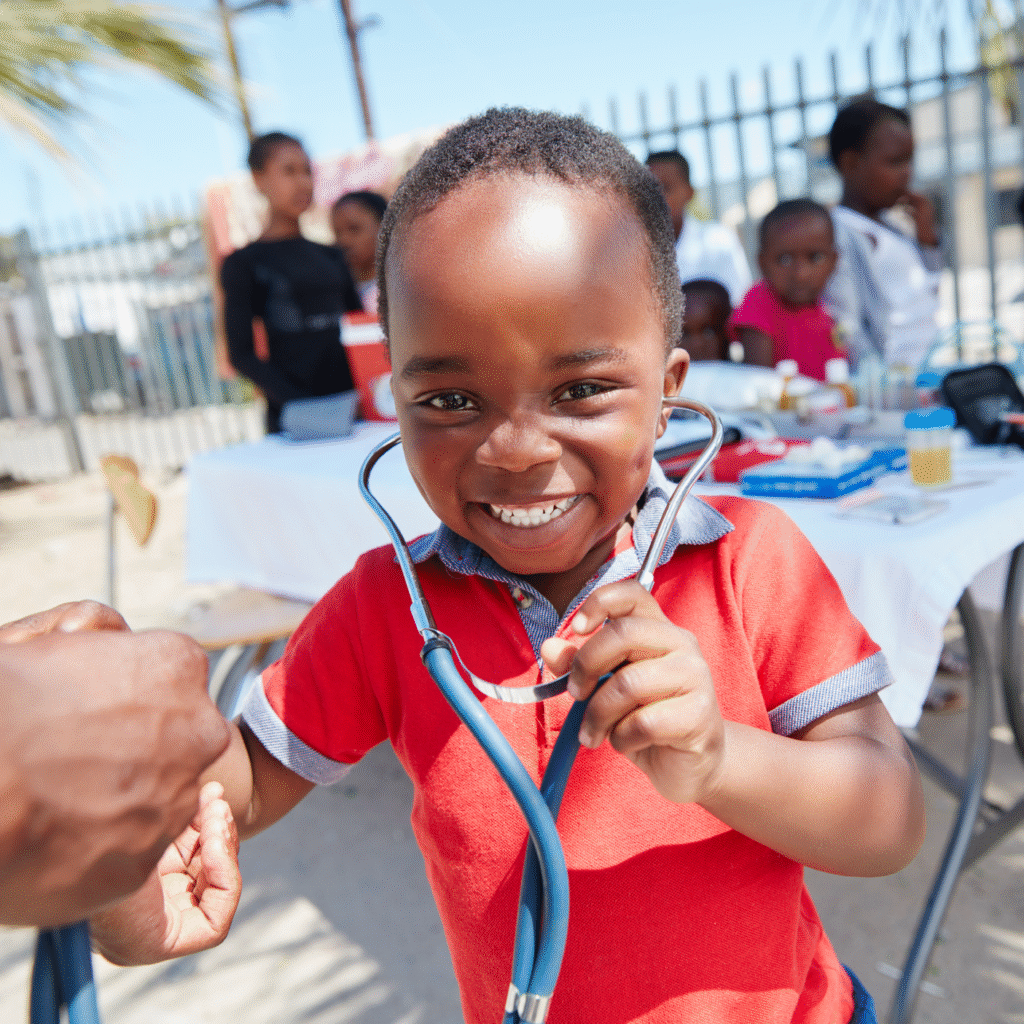
What can global public health teach us about caring for children everywhere?
Recorded at the Ginsburg Symposium in Orlando, we explore the launch and early impact of the Ginsburg Institute’s Global Health Experience Program – an immersive initiative preparing future physicians to practice whole child health in an increasingly interconnected world.
Rooted in the mission of Nemours Children’s Health and the Ginsburg Institute, the conversation examines how most health outcomes are shaped far beyond hospital walls — and why hands-on, experiential learning is essential to developing compassionate, effective physician leaders.
Featuring:
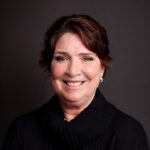
Nancy Molello, MSB, Executive Director, Ginsburg Institute, Nemours Children’s Health
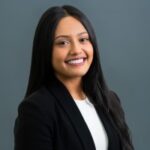
Aribah Ali, Ginsburg Scholar, Nemours Children’s Health
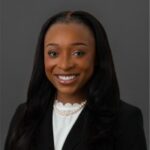
Treasure Ray, Ginsburg Scholar; and Coordinator, upliftED, Heart of Florida United Way
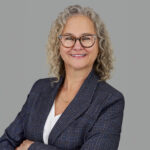
Host/Producer: Carol Vassar
Announcer (00:00):
Welcome to Well Beyond Medicine, the world’s top-ranked children’s health podcast, produced by Nemours Children’s Health. Subscribe on any platform at nemourswellbeyond.org or find us on YouTube.
Carol Vassar, podcast host/producer (00:12):
Each week, we’ll be joined by innovators and experts from around the world, exploring anything and everything related to the 85% of child health impacts that occur outside the doctor’s office. I’m your host, Carol Vassar. And now that you’re here, let’s go.
MUSIC (00:30):
Let’s go, Well Beyond Medicine.
Carol Vassar, podcast host/producer (00:35):
We are in Orlando, Florida. We are at the Ginsburg Symposium. And with me today is the executive director of the Ginsburg Institute, Nancy Molello. We also have Treasure Ray, who’s with us. She’s a Ginsburg scholar. She’s been through the scholar program and coordinator now at upliftED, which is part of the heart of Florida United Way, and also Aribah Ali. She is a community health division worker working on K-readiness here at Nemours Children’s Health.
(01:06):
We’re talking about a new program, and it takes people away from Orlando, away from the US, all the way to Uganda. So, I want to start with you, Nancy. Talk about what inspired what you’re calling the Global Health Experience Program and your goals in launching a partnership with [inaudible 00:01:27] University and Johns Hopkins University to do all of this.
Nancy Molello, Nemours Children’s Health (01:31):
Great. Hi, Carol. Nice to be here again. So, our Ginsburg Scholars Program is a program that we designed two years ago for young folks who are taking a gap year before going off to medical school or school of public health. And during that year, we hire them here at Nemours, and we give them opportunities to work with pediatricians in a clinical setting, doing research, and then working in the community with our community partners.
(02:00):
And as part of that experience, it’s always been my desire to have them have a global experience to really understand what is public health, what is public health globally, and to really have them have an experience of thinking about what other cultures are like and how they can bring that back as they become budding physicians or folks that want to be in the world of public health.
Carol Vassar, podcast host/producer (02:24):
Connect this back to me, if you will, to Nemours’ mission, and that is whole child health. It is making certain that people like Treasure, like Aribah, are well-rounded in their goals to become physicians, and we’ll talk a little bit about that later. How does it connect to Nemours’ focus on pediatric and adolescent health?
Nancy Molello, Nemours Children’s Health (02:45):
Well, as we know, only 85% of a child’s health happens outside of the walls. Only 15% of a child’s health happens inside of the walls of Nemours. And so, if you don’t understand all of the factors that help children be healthy and thrive in the community, you can’t serve them as well. So, you will be a better and more empowered physician.
(03:12):
Both of these young ladies will be physicians one day, is that it will help them in their career as they look at how they treat their patients, how they understand those social factors that drive health. And if you talk to any physician that we work with who have had the experience of traveling globally, it expands their mind around the idea of that we are a global community. And that the experiences that children face in Uganda, in Liberia, in South America are the same experiences and same struggles that the kids in our own backyard have.
(03:54):
And so, it has us understand that we are a global community and we have a shared humanity and that that shared humanity, you can only experience seeing it on the ground, not reading it in a book, not looking at a movie, not reading an article. And so, this opportunity was really for them to serve them for their careers as physicians.
Carol Vassar, podcast host/producer (04:16):
Well, I’m going to turn to Treasure and Aribah. I want to talk about what your interest, A, in the Ginsburg Scholars Program was and what your first impressions were when Nancy proposed the idea, “You’re invited to go to Uganda, you’re going to learn about public health there.” Aribah, I’m going to go to you first.
Aribah Ali, Ginsburg Scholar (04:37):
Yeah. So, applying for the scholars program, it really aligned with what I wanted to learn about and continue being a lifelong learner when it comes to an aspiring physician and someone who was in the pre-health field. When you go through all these experiences of shadowing and clinical experience, you don’t really get the public health aspect of it.
(05:03):
So, I really believed that the scholars program did a great job at showing me that and providing me with that knowledge in the public health world. So, when Nancy brought up the trip to Uganda, we were completely shocked or I was completely shocked because it was not in the scholars’ description at all. So, we were-
Nancy Molello, Nemours Children’s Health (05:28):
As most of the things we do are not in the scholars’ description.
Carol Vassar, podcast host/producer (05:31):
And it’s developing.
Nancy Molello, Nemours Children’s Health (05:32):
It’s developing.
Carol Vassar, podcast host/producer (05:33):
The scholars’ program is developing in and of itself.
Nancy Molello, Nemours Children’s Health (05:35):
Yes.
Carol Vassar, podcast host/producer (05:35):
Go ahead, Aribah.
Aribah Ali, Ginsburg Scholar (05:36):
Yeah. So, it was just like, I was in shock. I literally said, “I can’t believe this is happening so many times ever since she told us.” And yeah, just really grateful for the opportunity and the Ginsburg program for allowing us to be part of it.
Carol Vassar, podcast host/producer (05:52):
And Treasure is nodding our head. So, I want to hear your reaction to hearing that you were going to go to Uganda and what it was like when you first got there.
Treasure Ray, Ginsburg Scholar (06:01):
Yeah, of course. So, I remember distinctly, this was during our Christmas dinner, they love to feed us, so it’s always great to have dinner with them, but they brought us out to dinner, and Nancy was like, “Okay, guys.” She always will tell us things in a way. We’re like, “What’s coming next?” And she was like, “So what do you guys think about going to Uganda?” And I remember initially, when I heard it, I was a little scared at first because I had never been to a developing country before. I never really traveled a lot. I had been on a couple of cruises with my family, but other than that, I hadn’t had that experience.
(06:32):
And so, I was like, “Okay, this is going to be a lot for me to have to adjust to.” And I remember thinking, “Can I really do this? Is it something I’m going to get the most out of?” But knowing that Nancy had already had that experience being there, it made me feel a lot better. And then, I remember a lot more, we had to learn about the process of getting there and how long the flight was going to be and having to get a yellow fever vaccine. And I was like, “Oh my goodness, this is too much.”
(06:57):
But then, I had to remind myself why I’m going there and what I’m going to be able to get out of it. And that made the difference, especially since it took us about a full day, so like 24 hours to get there, and I mainly slept on the flight, so it was fine, but-
Carol Vassar, podcast host/producer (07:12):
The best way to do it.
Treasure Ray, Ginsburg Scholar (07:12):
That’s the best way. But then, initially, arriving there, I remember I was definitely shocked at first. I was like, “Okay.”
Carol Vassar, podcast host/producer (07:18):
What shocked you?
Treasure Ray, Ginsburg Scholar (07:19):
Just more so the environment and the people. I will say, the people were actually very friendly. I was not expecting that. I thought they were going to be a little bit, maybe standoffish towards foreigners, but they were very nice. But I would say mainly just things just operate very different there. It doesn’t look like the US.
(07:38):
I know, okay, but I think mainly just that aspect of it, I had to get adjusted to that. Certain things in terms of resource,s there just is a very different environment that I had to adjust to. And I would say, for the most part, I really did enjoy my experience there, but it was just certain things that I knew that I was maybe uncomfortable about, and then had to adjust and really just be in the moment.
Carol Vassar, podcast host/producer (08:02):
What made you uncomfortable, if I might ask?
Treasure Ray, Ginsburg Scholar (08:04):
Yeah, no, of course. I would say mainly just the, sometimes when we were there, there would always be people around, and then also there would be a lot of animals around. So-
Nancy Molello, Nemours Children’s Health (08:17):
Monkeys, specifically.
Treasure Ray, Ginsburg Scholar (08:18):
Yes. I was going to get into that.
Nancy Molello, Nemours Children’s Health (08:20):
On the street.
Treasure Ray, Ginsburg Scholar (08:20):
Yeah. So, I love animals. We went on Safari and I love that. But one thing that I do not like are monkeys, and the monkeys are very scary. I remember…
Carol Vassar, podcast host/producer (08:31):
I see that.
Treasure Ray, Ginsburg Scholar (08:32):
… when we were-
Carol Vassar, podcast host/producer (08:32):
They’re coming right up to you.
Treasure Ray, Ginsburg Scholar (08:33):
Yes. There was a time where one of the monkeys tried to take things from us, and there was a time when they were out on the balcony, and they completely shocked us, and they were running towards us, almost ran into our room. So, there are certain things, like you are not protected from the wildlife there. They are immersed in your everyday experience as well.
Carol Vassar, podcast host/producer (08:52):
Well, let’s focus in a little bit on Treasure and then I’ll come to Aribah. On the healthcare system, what surprised you about the healthcare system? You were there a month, I believe, and was it different? How different was it?
Treasure Ray, Ginsburg Scholar (09:06):
It’s very different there. I would say one of the most shocking things that I saw there was when we went to the malnutrition unit. That was a really transformative time for me because I had never really seen something like that. So, babies from all across Uganda are coming there. So, in Kampala, it’s like the national referral unit. And so, the most malnourished, most sick babies are coming to get treatment there, and not only it’s the babies, it’s their mothers as well.
(09:34):
So, I would say the biggest thing that shocked me was just the actual structure of the systems. When we think of hospitals here, there’s all this equipment and so many things, but they don’t have a lot of resources there for that. And so, when we walk into this room, we’re in this hospital, but honestly, to me, I could compare it to almost a shelter in the most respectful way.
(09:58):
There is a room with 50 beds, 25 beds on each side, babies laying on the beds, and it’s just very heartbreaking to see because I had never been exposed to anything like that. And then, especially to seeing the mothers and thinking how much time and energy it took for them to get there. And so, that was probably one of the most shocking things about the healthcare system: there was just the way that it’s structured and how different it is from the US.
Carol Vassar, podcast host/producer (10:25):
Aribah, continue on. What surprised you? I mean, that seems shocking to me, but what else do you feel was really different and maybe shocking to you with the healthcare system?
Aribah Ali, Ginsburg Scholar r (10:36):
Yeah. Similar to what Treasure mentioned, just the resources that they had are nothing compared to what we have in the US. When we were shadowing Dr. Sabrina Kitaka, who is a pediatrician there-
Carol Vassar, podcast host/producer (10:50):
We’re going to talk to her next episode.
Aribah Ali, Ginsburg Scholar (10:52):
Yeah. And she took us to her infectious disease ward, and we walked into a room full of tetanus patients, and there were three in this really small, cramped room, bedsheets hung up on the wall because you really need peace and quiet and minimal sunlight when it comes to tetanus patients.
(11:10):
But even then, they were still being disrupted just because of how small the area was and how many people were in the room. So, just thinking about those things and how they have to work with what they have, and they still manage to provide care to their patients in those settings.
Carol Vassar, podcast host/producer(11:29):
And tetanus is not something you normally see here in the US.
Aribah Ali, Ginsburg Scholar (11:32):
Not at all.
Carol Vassar, podcast host/producer (11:32):
It’s not really all that common, is it? Key challenges, you were in these units for a month, in various places. You also went on a safari, but mostly in the healthcare work that you did. What were some of the key challenges you saw?
Aribah Ali, Ginsburg Scholar (11:47):
Yeah, I think a big thing for us, and we talked about it throughout the trip as well, is that when everything moves so fast in the US, you need something from someone, a quick Teams message, a quick Teams meeting, but over there, things take a little longer. An email can take a couple business days and some-
Carol Vassar, podcast host/producer (12:10):
Really?
Aribah Ali, Ginsburg Scholar (12:10):
Yup. And sometimes, you would have to show up at their office to get things done. And we were really trying to make the most that we can of the time that we were there, try to work on as many projects as we could. So, that would be a key challenge for me when I was over there, but we learned how to adapt and understand everyone’s schedule and what everyone prefers so we can be more efficient in the work that we were doing.
Carol Vassar, podcast host/producer (12:37):
Treasure, same question. What were some of the challenges you observed in terms… It sounds like communication was a big barrier. What else did you see?
Treasure Ray, Ginsburg Scholar (12:47):
I think in terms of the challenges for Uganda and in Kampala is access to technology. And so, like Aribah was mentioning, it would be difficult to contact them because they’re not really used to having to use technology as their primary source of communication, and especially, I noticed that when we were working with the students.
(13:08):
So, I would say other than the technology, it was probably, like she said, having to wait and having to be not in control over different situations because you had to really go with the flow, especially with certain times we would arrive and have to wait on things, and we would just have to make use of our time there.
(13:27):
And I think it really made us feel so much more impactful in the work that we were doing because it’s like, okay, we don’t have this set schedule. We have to get this done, but whatever we’re able to do, whatever we’re able to accomplish, we felt that much more happy about how we were impacting the people there.
Carol Vassar, podcast host/producer (13:42):
You were there for a month, and you made some impact in various areas. I know you did some research. What was it like, Treasure, talking with or working alongside with Ugandan physicians, researchers, and other students that you might’ve met along the way?
Treasure Ray, Ginsburg Scholar (13:57):
Yes, the people are wonderful. Like we mentioned, Dr. Sabrina Kitaka was amazing, Dr. Esther. I really loved working with the physicians there. I will say one thing that I did take away from them was just how thorough they are and how patient they are. Compared to the US, we move so fast, and physicians do everything that they can to best serve their patients, but oftentimes, I’ve shadowed physicians here. They’re always on the move.
(14:23):
I mean, you don’t get a lot of time to see your physician, typically when you’re going to the hospital. And I remember we were shadowing in an adolescent clini,c and Dr. Sabrina, I remember she spent, I don’t even think less than 30 minutes with each patient that she was talking to. And you could tell she was not trying to rush through it. She was working with her students very thoroughly.
(14:46):
Anytime something would come up, she would ask a question, dig into it. And there are so many things that I think she was able to find that maybe in the US, if that same patient were to have been here, they might have missed. And that is one thing that all of the physicians are amazing at doing there.
Carol Vassar, podcast host/producer (15:00):
Some things we can learn here in the US from that kind of work and that kind of time taken with patients. Aribah, same question, in terms of working alongside the researchers in particular, I know there were specific projects that were worked on by the scholars who went over, what do you think you learned working alongside the folks over in Uganda?
Aribah Ali, Ginsburg Scholar (15:24):
Yeah. So, I definitely feel like we learned a lot about the patient population as well, and just like how culture plays a role in the healthcare system. For example, they’re not really big on talking about sexual education. So, you see that, especially when we were in the adolescent clinic, who knows, maybe they weren’t honest about some of the things that they answered, or they felt that they couldn’t talk about these things with their parents.
(15:57):
And those are some things that you have to respect and not question why, because culture plays a big role in that. But it was very different compared to here in the US, where we’re trying to be more open about it. And when it comes to family planning as well, they’re really big on having a big family. I think Dr. Sabrina mentioned that the average is like six kids per family.
Carol Vassar, podcast host/producer (16:23):
Wow.
Aribah Ali, Ginsburg Scholar(16:23):
So, it doesn’t matter what health conditions are running in the family; they will continue to have kids because family means a lot to them.
Carol Vassar, podcast host/producer (16:33):
Nancy, as you hear Aribah and Treasure glow about this trip to Uganda and what they learned, how have you seen them grow as people and as future physicians?
Nancy Molello, Nemours Children’s Health (16:47):
It makes me cry actually just to see that you put so much into planning something and to developing a partnership with a hospital and a research unit in a foreign country and to come back and just sit across from them and really see how my desire was to give them the opportunity to grow and the opportunity to bring that into whatever career they end up having.
(17:19):
And if they end up, which I’m sure they’ll both be physicians, is someday 20 years from now, they will for sure, think of this experience and for sure think of the opportunity that they had to actually travel there and to actually see how, can I be a better physician? Can I rush less? Like for Treasure to say, we’re on super speed and 10 years from now, she’s a physician in a clinic that says to the clinic staff, “We’re not going to rush through our patients. I’m going to be the physician that spends more time.”
(17:54):
And that it’s tied back to the experience that she had in Africa, or for Aribah to say, “You know what? The culture of someone impacts how they show up in my office as a physician, and I need to know that. I saw that firsthand.” And it’s just such an honor and a privilege to know that I’ve had a small piece into ensuring that they are going to be the kinds of physicians that you and I, Carol, want to see.
Carol Vassar, podcast host/producer (18:20):
Absolutely.
Nancy Molello, Nemours Children’s Health (18:21):
You and I want to be the patient who sits across from them one day.
Carol Vassar, podcast host/producer (18:25):
I’m going to challenge you. I don’t think it’s a small piece.
Aribah Ali, Ginsburg Scholar (18:27):
No.
Carol Vassar, podcast host/producer (18:28):
I think it’s a big piece.
Aribah Ali, Ginsburg Scholar (18:29):
Carol Vassar, podcast host/producer (18:31):
And I’m going to go to Aribah and Treasure to talk about this. Would you consider this? I don’t want to put words in your mouth, but would you consider this a life-changing experience professionally and personally? Talk about that.
Aribah Ali, Ginsburg Scholar (18:41):
A 100%. Everyone, while we were there, part of the Mujhu team have always said once you come to Uganda, you’re not the same person when you go back, because it truly is a transformative experience. And I’ve always been interested in a global health experience, but of course, finances and logistics are always a big concern, but the fact that Nancy put in the effort to want this for us truly means so much, and that there are people out there who really want us to be the best physicians that we can be. So, thank you.
Carol Vassar, podcast host/producer (19:17):
I’m seeing Treasure nod her head.
Treasure Ray, Ginsburg Scholar (19:20):
Yes. I can say so much, I can go on and on and on about-
Carol Vassar, podcast host/producer (19:24):
Please.
Treasure Ray, Ginsburg Scholar (19:25):
So, personally, this trip challenged me so much. Like I mentioned, I was initially scared, and I didn’t know what to expect, and then getting there. And I was that person who would often complain about little things. I would be frustrated because I couldn’t control certain situations and I really had to let all of that go. And so, it changed me as a person. I remember, so the first half of the trip, the entire group was there. The second half of the trip, it was just us scholars, and we were in a different living situation than the first half. And-
Nancy Molello, Nemours Children’s Health (19:57):
They stayed in where all the medical students stay in Uganda. So, they actually had the opportunity to be in what they call the guest house right next door to other medical students who are from Uganda.
Carol Vassar, podcast host/producer (20:08):
Oh my goodness.
Nancy Molello, Nemours Children’s Health (20:09):
And I did that intentionally. The first half of the first two weeks, we stayed in a hotel, a very nice hotel, very similar to the US, but I wanted them to have a true experience of what it’s like to live in a developing world, a developing country.
Treasure Ray, Ginsburg Scholar (20:27):
Yes.
Nancy Molello, Nemours Children’s Health(20:27):
Sorry, go ahead.
Treasure Ray, Ginsburg Scholar (20:28):
No, that was perfect. Initially, when we moved in, I was like, “Oh my goodness, what have I gotten myself into?” I remember the first couple of days, I did not have hot water. Turns out I didn’t have hot water the entire trip, but I had to use a kettle and a bucket, and I was so upset about it at first. I was like, “This is so awful. I have to do this.” And then, I think back, and I’m like, “I’m complaining about this.” And then, I learned that most of the people or over 60% of the population lives off of less than a dollar a day.
(20:58):
And so, that really challenged me personally just on so many levels. But also, like I said, professionally, working with the physicians there, I know there are certain things that they might have done that I didn’t agree with or that I did want to take back to the US. And so, I really just had to remember to stay in the moment and try to not put my own lens and my own thoughts onto what the physicians and what the patients were doing as well.
Carol Vassar, podcast host/producer (21:22):
In some ways, it was a humbling experience.
Treasure Ray, Ginsburg Scholar (21:25):
Very, very humbling.
Carol Vassar, podcast host/producer (21:26):
As you move into your professional future, what is your professional future, Treasure? You want to be an MD, don’t you?
Treasure Ray, Ginsburg Scholar (21:33):
Yes, I do. That would be my dream. Honestly-
Carol Vassar, podcast host/producer (21:36):
And as you move into that, what leadership skills did you learn here, and what lessons are you going to take forward?
Treasure Ray, Ginsburg Scholar (21:45):
Yes. I think it’s really important. I didn’t understand the importance of it to continue to do global health work. It was something that was in the back of my mind, but when we started to go here and see all the things that they were facing there, I know that eventually, I want to get into global health work and it’s my duty as a physician to not only impact my community, but other communities that don’t have access to those resources.
(22:05):
We met some medical students there from across the country, and we met some other great people. And I think the world of global health work is just an amazing thing that I want to be involved in. And so, I’m so thankful for this experience. And then, I just want to continue to be a compassionate physician.
(22:22):
I think so many times you can… It’s a long journey to get there, and I’m just in the beginning, and I can understand now why sometimes physicians are the way that they are. They have so many things that’s on their plate, but you really have to just, like I have this moment now to look back on to remind me of what I saw and what type of physician I want to be.
Carol Vassar, podcast host/producer (22:40):
Yeah. Aribah, how did all of this influence your leadership skills moving forward as you move into being a physician you’re applying to medical school right now?
Aribah Ali, Ginsburg Scholar (22:51):
Yeah. So, it definitely taught me a lot of teamwork, communication, and just being adaptable. There were a lot of instances in Uganda where we just had to adapt to the teams that we were working in and the projects that we were working on. So, that played a key role in the leadership skills that I hope to carry on, as well as just taking the global health lens and applying it to the future patients that I hope to serve, because they will be coming from these diverse backgrounds and thinking about this trip to Uganda and applying it in those settings.
(23:29):
And yeah, just now it has opened my eyes to hopefully continue global health work as well when I become a physician. And just because our duty, like Treasure mentioned, is not only to serve our communities, but to serve communities all over the world as well.
Carol Vassar, podcast host/producer (23:46):
It really is a global public health world, if you will, which is redundant, but the world is pretty small. It’s well-connected. Nancy, I’m going to have you finish up here. This has been obviously a wonderful experience for these young ladies, these budding physicians. Is this a program you’re looking to continue? And how are you going to move it forward with the next group of scholars, the next cohort, which I think is number three?
Nancy Molello, Nemours Children’s Health (24:14):
So, now we’re on number four.
Carol Vassar, podcast host/producer (24:15):
Oh, okay.
Nancy Molello, Nemours Children’s Health (24:17):
Yes, absolutely. We will continue this. I think we will perhaps bring some medical students next time that we travel. So, we have a scholars’ program, a Ginsburg scholars’ program for medical students at UCF. So, we’ll incorporate some of the medical students as well. And in talking about the trip, there are a number of physicians who said, “I’d like to go too. Is there a way that I can do this trip?”
(24:42):
And so, I’ve already been in conversations with the folks at Mujhu or Mulago Hospital about could we bring physicians? What kind of credentialing do they need to actually practice, and how would we make that happen so that when they land, they could do surgeries, they could see patients. So, I see a lot of opportunity and promise.
(25:02):
And as you can see, the pride that I have in these two young ladies is, it’s the same pride you have in children, your child, is that to see them grow, to see them change as people, to see them really expand who they are in this short one month, it has been an honor for me.
(25:24):
And oftentimes in our careers, we don’t always have an opportunity to do what we love. And I am passionate about making sure that this program continues and that we make sure I’m committed to making sure that we help the next generation of physicians be the best that they can.
Carol Vassar, podcast host/producer (25:43):
Nancy Molello is the Executive Director of the Ginsburg Institute at Nemours Children’s Health, which offers eye-opening opportunities both here and abroad for young healthcare and public health professionals through its Ginsburg Scholars program. We also heard from two Ginsburg Scholars: Treasure Ray; she’s at the Heart of Florida United Way in Orlando, and Aribah Ali. She’s working in K – Readiness with the Nemours Community Health Division. Both scholars are currently applying to medical school.
MUSIC:
Well beyond medicine,
Carol Vassar, podcast host/producer
Giving future physicians a worldwide lens on healthcare and public health: that’s what Nemours and, specifically, the Ginsburg Scholars Program aims to do. Yet, what is the scholar’s impact on the ground? That’s coming up in part two of this series when we talk with their mentors, Dr. Lonna Gordon with Nemours Children’s Health and Dr. Sabrina Kitaka from the Makerere University College of Health Sciences. She joined us from her home base in Kampala, Uganda. Don’t miss it. Thanks to Nancy, Treasure, and Aribah for such a great conversation. And thank you for listening.
Don’t forget, you can make sure you never miss an episode of the Nemours Well Beyond Medicine Podcast by heading to our website, nemourswellbeyond.org, and subscribing to it. Stay in the know by subscribing to our monthly newsletter while you’re there. You can also leave a podcast episode idea and a review. That’s nemourswellbeyond.org. You can also find us on your favorite podcast app, your handy dandy smart speaker, and on the Nemours YouTube channel.
Our production team for this episode includes Lauren Teta, Cheryl Munn, Susan Masucci, and Alex Wall. Video production by Sebastian Riella and Britt Moore. Audio production by Steve Savino and yours truly. I’m Carol Vassar, reminding you that we can change children’s health for good, well beyond medicine.