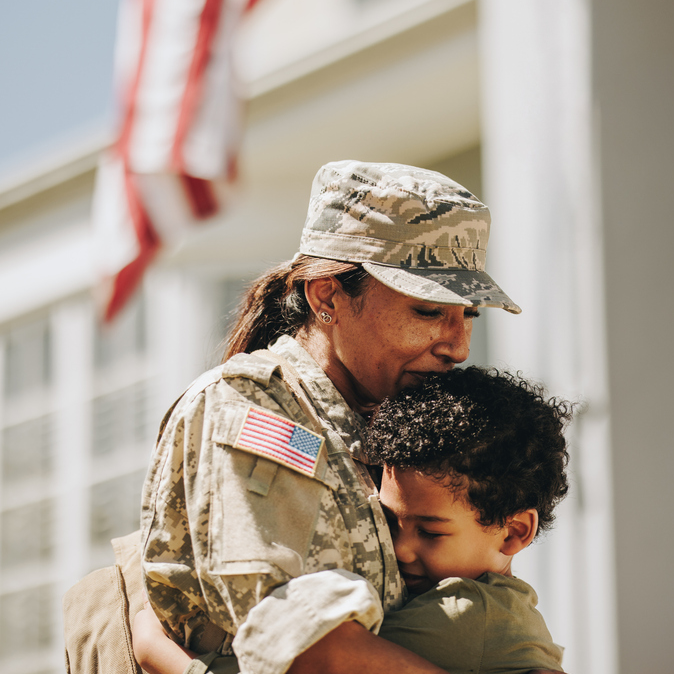
Military-connected families are often praised for their resilience. But behind every deployment, relocation, and homecoming are children navigating constant change — and too often, gaps in the mental healthcare system meant to support them.
In the first episode of this two-part series, we speak with policy leaders from Nemours Children’s Health and the Elizabeth Dole Foundation, along with military-connected parents and advocates, about the unique behavioral health challenges facing military-connected youth. From frequent moves and disrupted continuity of care to the stigma surrounding mental health, they discuss what’s working, where the system falls short and the policy solutions that could help ensure every military-connected child has access to the care they need, wherever military life takes their family.
Featuring:
Daniella Gratale, MA, Associate Vice President, Federal Affairs, Nemours Children’s Health
Meredith Beck, Vice President for Government Affairs and Community Engagement, Elizabeth Dole Foundation
Duane Duke, MD, FACS, FAAP, Colonel, U.S. Army Reserves, Trauma Medical Director, Nemours Children’s Health
Allison Mejia, Child & Family Advocate, Military Spouse
Elizabeth (Liz) Rotenberry, Director, Caregiver Engagement, The Elizabeth Dole Foundation, and Military Spouse
Host/Producer: Carol Vassar
PLEASE NOTE: The comments and opinions of Dr. Duane Duke are his own and do not represent those of the U.S. Army Reserves.
Resources Mentioned in This Series:
- Serving Military-Connected Children: Access to Care (PDF)
- Serving Military-Connected Children: Mental Health and Well-Being (PDF)
- Free, online course: Caring for Children and Teens in Military Caregiving Families
- Initiatives at Nemours Children’s to support military-connected youth
- Military Child and Family Collaboratory
- One Op
- Star Behavioral Health Providers
- Kennedy Krieger Behavioral Health Program for Military Families
Military-focused programs:
- FOCUS UCLA
- Clearinghouse for Military Family Readiness Penn State
- Military REACH Auburn University
- Hidden Helpers Coalition
- To inquire about joining the Hidden Helpers Coalition, email [email protected]
Past Well Beyond Medicine episodes with related topics:
- Ep. 70: Hidden Helpers, Hidden No More (Part 1 of 2)
- Ep. 71: Hidden Helpers Heard (Part 2 of 2)
- Ep. 90: Forum – Supporting Our Military Families and Hidden Helpers (Part 1 of 2)
- Ep. 91: Forum – Supporting Our Military Families and Hidden Helpers (Part 2 of 2)
- Ep. 167: Accessing Pediatric Mental Health Services (PATH) (Part 1 of 2)
- Ep. 168: Accessing Pediatric Mental Health Services (PATH) (Part 2 of 2)
General questions related to the content addressed during the podcast: [email protected]
TRANSCRIPT:
Announcer (00:00):
Welcome to Well Beyond Medicine, the world’s top-ranked children’s health podcast produced by Nemours Children’s Health. Subscribe on any platform at nemourswellbeyond.org or find us on YouTube.
Carol Vassar, podcast host/co-producer (00:12):
Each week we’ll be joined by innovators and experts from around the world, exploring anything and everything related to the 85% of child health impacts that occur outside the doctor’s office. I’m your host, Carol Vassar. And now that you are here, let’s go.
MUSIC (00:30):
Let’s go, oh, oh, well beyond medicine.
Carol Vassar, podcast host/co-producer (00:36):
Welcome everyone. Today is the first of a two-part series during which we are focusing on military-connected youth. These are the kids whose parents are serving in our military or whose parents are retired from it, including those known as Hidden Helpers. These are children who care for a wounded, ill, or injured service member or veteran many times without recognition. Military family life means frequent moves, long separations, and constant transitions. And while those experiences can build resilience, they can also make it harder for kids to access consistent, timely behavioral healthcare.
(01:14):
This episode and the one that follows were developed with members of the Hidden Helpers Coalition and builds on a new two-part policy brief from Nemours Children’s Health and the Elizabeth Dole Foundation. Two briefs that look at both healthcare access and mental healthcare access for these families. To start, we’re stepping back to understand the broader system, what’s working, what’s not, and where the biggest gaps might be.
(01:41):
I’m joined right now by Daniella Gratale, friend of the podcast, associate vice president for Federal Affairs for Nemours Children’s Health, and Meredith Beck. She is Vice President for Government Affairs and Community Engagement at the Elizabeth Dole Foundation. Daniella, I’m going to start with you. Nemours and the Elizabeth Dole Foundation have a longstanding partnership and recently collaborated on that two-part policy brief, which looks at healthcare access and mental health access among these military-connected youth. Why is this brief needed right now?
Daniella Gratale, Nemours Children’s Health (02:16):
First of all, wanted to thank you for having us, Carol, and for this policy discussion. We have had a longstanding partnership on the Hidden Helpers Coalition, but also on a course for providers that looks at how you can care for children and teens in military caregiving families. So lots of really important work, and we use that as a launching-off point for this policy partnership.
(02:37):
A couple of years back, we had co-led a convening with Senator Carper and just uncovered so many great themes and really moving experiences from military- and veteran-connected families, and wanted to think about what is that unique set of issues where Nemours as a health system and EDF with all of their expertise could come together? So we met with Meredith’s team a number of times.
(02:59):
And at the same time in the background, we’ve seen some legislation introduced in Congress. Also, there was a hearing last December on the CHAMPVA program. So we thought there was a good policy movement and a really strong partnership where we each bring some unique expertise. So decided over the course of the past few months to come together and to really put pen to paper and work on some policy and advocacy recommendations.
Carol Vassar, podcast host/co-producer (03:23):
It’s really great to see this partnership really strengthen and move forward over the years. Meredith, I’m going to turn to you. Let’s, again, at a very high level, talk about some of the biggest barriers that are preventing military-connected children and teens from getting behavioral healthcare. How widespread are those challenges as well, I mean, among military-connected families? It’s got to be hard.
Meredith Beck, Elizabeth Dole Foundation (03:45):
Carol, thank you. And thanks for the question. How widespread is it? It’s very significantly widespread because you’ve got to remember that there are two populations here. There are children who are children of those serving on active duty, and then those are children who are potentially those hidden helpers you mentioned in the home for veterans, caring for a loved one, providing help with those activities of daily living, the sometimes wound care, sometimes helping with dressing, feeding.
(04:13):
But then there’s also those who are helping with avoiding emotional triggers that their family or parent might have. So with those populations, there’s also a significant… like in the civilian space, there’s a significant stigma against seeking mental health care. And in the military, however, that stigma is even more so because there is the training that even the service member, the veteran, and even the family sometimes feel they receive is to be resilient, to do with what they have, and to move on.
(04:45):
And unfortunately, that can also impact their willingness to seek mental healthcare because it actually also, for those military families and veteran children, can impact their future employment because many of them are those who also seek to serve in the military in the future. So it’s a very widespread problem, and it also is impacted by those frequent moves that you mentioned because they are… it disrupts their continuity of care. And then that then potentially becomes the… maybe the last thing that is on the mind of the parent or caregiver as they’re trying to reestablish all of those connections for care.
Carol Vassar, podcast host/co-producer (05:20):
Let’s continue along that line of continuity of care, especially with, as you mentioned, Meredith, frequent relocation. Daniella, why is that a critical issue in behavioral health? And what are some of the policy solutions that can be brought to bear to address it?
Daniella Gratale, Nemours Children’s Health (05:37):
Sure. It’s a great question. I think particularly on the mental health side, that trusting relationship between the child or youth and the caregiver is so critical and does take time to build. So with frequent relocation, having to start over can be a daunting challenge. One of the things that we’ve looked at at Nemours, and I think you’ve had them on the podcast too, is how you can leverage telehealth. So, for example, we have the PACT program. From a policy side, there are some barriers to telehealth across state lines.
(06:07):
There are different restrictions related to licensing, but there are also multi-state licensing compacts like PSYPACT, where if the provider is participating and the state is participating, that is an option for families that are comfortable with that to be able to potentially leverage telehealth and be able to have that continuity of care. I think another kind of related issue is just access to care in general. For military-connected families, coverage can become unaffordable or even unavailable at times. And there is some legislation that we do highlight in the briefs to help address that.
(06:42):
So one of the bills is the Healthcare Fairness for Military Families Act, and that would significantly reduce the premium for TRICARE young adults. So that’s a great way to make coverage more affordable for sure. And then there’s also a CHAMPVA Children’s Care Protection Act, and that one looks at the maximum age of coverage and raises it to 26 regardless of marital or education status. So I think we really want to think about access to care, continuity of care, and how these policy solutions, like looking at this legislation or states thinking through joining the PSYPACT compacts, can really help those military and veteran-connected families.
Carol Vassar, podcast host/co-producer (07:19):
And those compacts, I think we’re going to talk a little bit about that with our providers when we have them on in the next episode, but those would provide more of a range of availability of telehealth as kids and families move from state to state and base to base. Is that what I’m hearing here?
Daniella Gratale, Nemours Children’s Health (07:36):
Yeah, because they’re allowing for… instead of the provider having to get registered to practice care in all the different states separately, it allows them to practice and be able to provide services across those state lines, which is really important.
Carol Vassar, podcast host/co-producer (07:50):
Yeah, it is incredibly important. Meredith, I want to close out with you, at least this particular segment of the episode. What are some actionable, realistic best bets from your policy briefs that you believe can begin to close the gaps that we’ve been discussing, at least at the start here?
Meredith Beck, Elizabeth Dole Foundation (08:09):
Sure. And in addition to what Daniella said, because those pieces of legislation are really critical and important, the first piece of this is always awareness, whether it’s the providers, the parents, and policymakers, making sure that they understand this population and their needs and the obstacles that are facing them. And so part of that is one of the pieces of the policy brief is a GAO study that would actually help to identify and define those barriers more clearly so that legislators and policymakers can then address them in a more succinct way.
(08:43):
And then the other piece is ensuring that access to care. Looking at those provider shortages, as Daniella mentioned, the compacts to ensure that you’re not just looking at a set of providers in that particular state. You’re also looking at them potentially across state lines to help address those shortages overall.
(09:02):
And then lastly, making sure that the enlistment requirements for entering personnel and recruits align with current science and data to ensure that those individuals who do want to serve, who may seek mental health care as a result of their role as a hidden helper, aren’t then precluded from serving because they did seek that mental health care. So we just want to make sure that those pieces are in place to facilitate the process for parents and these hidden helpers to seek care.
Carol Vassar, podcast host/co-producer (09:32):
There is so much that goes into this, so much that is on the plate in the policy realm, in the works right now. It’s great to see this. We’re going to take a look at this from the parents’ perspective shortly. Meredith Beck, thank you for joining us, Vice President for Government Affairs and Community Engagement at the Elizabeth Doyle Foundation, and Daniella Gratale, Associate Vice President for Federal Affairs at Nemours Children’s Health.
(09:56):
Like I said, coming up next, we’re going to hear from the parents of some of these military-connected youth on what exactly they’re experiencing day to day, how the system works, how it doesn’t work, and how it can be improved. Stay with us.
Carol Vassar, podcast host/co-producer
Welcome back to our discussion of the unique concerns of military families as they try to navigate their children’s mental health needs. Joining me right now, we have a panel of parents who have experienced firsthand the moves, the changes, and the barriers to care.
(10:26):
They are Dr. Duane Duke, medical director for the Trauma Center at Nemours Children’s Health and a Colonel in the US Army Reserves. Allison Mejia is with the Uniformed Services University Military Children and Family Collaboratory. She is a child and family advocate and also a military spouse. And Liz Rotenberry, she is director of caregiver engagement for the Elizabeth Dole Foundation and herself a military spouse.
(10:53):
First and foremost, thank you to each of you for your service to our nation. Whether you have served directly or in support of our troops, it is very much appreciated. I would love for each of you to think about this question. As you think about your own family’s experiences or the experiences of military-connected families in your networks, what does military family life look like for children? Dr. Duke, I’m going to start with you.
Duane Duke, MD, Nemours Children’s Health (11:21):
So a lot of military families are younger parents.
Carol Vassar, podcast host/co-producer (11:25):
Mm-hmm.
Duane Duke, MD, Nemours Children’s Health (11:26):
And after the service member finishes their initial training, they’re assigned to their first Garrison station. So that Garrison station may be entirely in a different part of the country than the support network for the family. And this is usually young families, so parents in their 20s and 30s.
(11:49):
When the unit is mobilized for deployment, whether that is a war-fighting deployment or humanitarian assistance mission, the service member deploys, and then the family is left to sort of get by during the deployment without either one of the parents, or even sometimes extreme circumstances, both parents gone. So every military family has to develop a contingency plan if they have two service members as parents, which it does happen.
Carol Vassar, podcast host/co-producer (12:24):
Yeah.
Duane Duke, MD, Nemours Children’s Health (12:25):
So the young family is back at Garrison. Garrison is sort of the term that means you’re stateside base. And the service member may be deployed for deployments that range from three months to even a year and a half. So that’s a long time to certainly upset a family’s dynamic during that mobilization.
(12:51):
So the individual bases all have family support mechanisms and units, but it’s not quite the same as having grandparents that are around the block or aunts and uncles that are around the block or close friends that grew up together.
(13:09):
And many times, that first family move may supersede a deployment by only a month. And so that’s a hard challenge to get established if you’re a parent and have young children, and all of a sudden, one of the parents is going to be gone for as long as a year and a half.
Carol Vassar, podcast host/co-producer (13:31):
So it’s the moving, it’s the separation. Allison, what else do you see as big challenges for these families?
Allison Mejia, Child & Family Advocate (13:39):
Well, Dr. Duke really gave a great response thoroughly. In our family, just asking our own kids, they would answer to this question as it’s a rollercoaster. Some roller coasters are fun to be on, and some are a little scary. And there’s a lot of ups and downs with a lot of comfort in between.
(14:02):
But it’s the dynamic of what was just mentioned, deployments, moves. Those are the ups and downs, the excitement of possibly moving overseas, the contentment in between those ups and downs when the active duty service member parent is stable and at home as opposed to the multiple TDYs and deployments. So it’s definitely a ride.
Carol Vassar, podcast host/co-producer (14:29):
Liz, you’ve probably been on that ride. Describe it for us.
Liz Rotenberry, Elizabeth Dole Foundation (14:32):
Yes, and thank you. As a military family, I will say it was probably one of my proudest moments. I think our families are very proud to serve and to be able to give back to our country and into our nation in such a way, and our children are too. And so one thing I have noticed, there are challenges that absolutely both Dr. Duke and Allison, you’ve both touched on those ups and downs and the difficulties of dealing with deployments, long-term trainings, even non-combat deployments.
(15:06):
My husband was gone a majority of the year each year. Wasn’t always combat, but he was gone quite a bit. And that left me with four children to manage really solely. But one thing I do love about this community is that we do rely on each other. I think my neighbors became some of my closest friends, and even more so now, some of them are military members are… we even call them aunts and uncles because they’ve become like family to us.
(15:34):
They really are. And it’s something I think really awesome to see as these kids growing up with empathy, mature behaviors, the way that they want to be able to give back to others. They recognize others who are in need of help and supports. And those challenges, there’s positives and negatives to some of it. Some of the challenges we face is one thing I kind of share about my own family and my oldest son being the oldest of four, as I’d mentioned, the man-of-the-house mentality.
Carol Vassar, podcast host/co-producer (16:07):
[inaudible 00:16:08].
Liz Rotenberry, Elizabeth Dole Foundation (16:08):
We put this idea and this concept onto our children, and we do it in a loving way. When you’re deploying, my husband would say to my oldest, “Oh, you’re man of the house now for me. I need you to help mom and help your siblings and step up.” That mentality these kids take very seriously.
(16:28):
And that can become a burden and part of the conversation that we’re having now and today, and I look forward to digging in a little bit more about that man-of-the-house mentality and how it can trigger more emotional, mental tolls on our kids. So, but overall, I wouldn’t have changed it for the world. I think living in that little bubble on base and having access to everything was a lifetime of joy for our family.
Carol Vassar, podcast host/co-producer (17:01):
I do want to dig into the mental health aspect of all of this. The families are moving. They’re maybe in need of some mental health services for their children. They’ve been getting them in one place, and then they are uprooting and going someplace else. That has to be really, really difficult. What are the challenges in terms of continuity for kids who are getting behavioral health services here, but now you’re over there? Allison.
Allison Mejia, Child & Family Advocate (17:32):
Phew. That’s a loaded question. I think, personally, in our family experience, we were stationed abroad for 16 years straight and had our children overseas. And towards our end of… the end of our time overseas, an event occurred which caused significant trauma within our daughter. She was at a young age, and it complicated things being that we were overseas. And the fact that, at the time, there was no policy in place at all to even address what had happened.
(18:11):
And so, trying to find the mental health services for her as a young child when we were… we could already see that they were struggling just alone dealing with active duty members who needed those services, it was quite challenging. We were able to find… to get her into a provider that fell under TRICARE. However, within a year, that provider fell off the provider list and… which was another trauma in itself to then have to find someone else.
(18:49):
And I think the greatest barriers that we found was not only finding access to care for our daughter, but access to someone who was specialized for that specific type of trauma. And that was a real challenge, and we weren’t able to fully find that. And then we were told that we were moving to the US, and I thought, “Okay, we’re in good hands. This will be so much easier for us.” And it was a humanitarian reassignment as well. And it wasn’t any easier.
(19:23):
In fact, I almost found it was more difficult because overseas, when we weren’t able to find the right fit for her, it was actually a lot cheaper to pay out of pocket [inaudible 00:19:35] coming over… back to the States. Not only is it horrendously expensive if TRICARE is not covering this provider, but also just trying to find someone. There’s such a lack of care in the area, and it just… it was a lot of stumbles and hurdles throughout the years to try and get her in to get her that care, and a disruption to the continuity of care as well, which was very unhelpful.
Carol Vassar, podcast host/co-producer (20:09):
And the move itself probably destabilizes the family and the child themselves, who’s in therapy. Dr. Duke, I saw you nodding your head as Allison was talking. What are your thoughts? What does frequent relocation and deployment do for that sense of stability for the family, for the child who may be in treatment?
Duane Duke, MD, Nemours Children’s Health (20:31):
Definitely a challenge. So I’ve been in the military a long time.
Carol Vassar, podcast host/co-producer (20:36):
Okay.
Duane Duke, MD, Nemours Children’s Health (20:37):
Long time. So even my service kind of goes back to the time where military families had to get their care at military installations. That evolved that now families have a little bit more choice, depending on where they live, with regards to whether they get care at a military treatment facility, a military medical center, or outsourced to the community, right. So your geography will change with those options, especially if you’re in continental United States, it’s called CONUS. And then, like Allison was describing, which is called OCONUS.
Carol Vassar, podcast host/co-producer (21:17):
Okay.
Duane Duke, MD, Nemours Children’s Health (21:17):
And regardless of military, not military, children in North America have barriers of access to mental healthcare. That’s universal. And we are in the mental healthcare crisis, especially in the post – COVID time period for the youth of America. And the military youth are in the similar situation. With regards to your question about continuity.
Carol Vassar, podcast host/co-producer (21:48):
Yeah.
Duane Duke, MD, Nemours Children’s Health (21:49):
Military families have that challenge for a variety of reasons because if they’re at a military medical center, a military treatment facility, the providers they have will constantly be changing because some of those providers are active duty themselves. So they will have TDY, which means temporary duty station, right, temporary duty change.
(22:17):
That means when you change your Garrison location when they’ll have deployments. So not just in the mental health side, but even just the primary care health side, to see the same pediatrician more than once or twice was a challenge that military families have lived through. And the same thing goes for your primary care for the adult family members, but definitely too for the pediatric care as well.
(22:42):
So, yeah. And so you’re exactly right. It’s a challenge because of deployments, because of family moves, because of the structure of the system, and then that overarching universal problem that we have: barriers to mental healthcare in our country for children, and there’s not enough access.
Liz Rotenberry, Elizabeth Dole Foundation (24:59):
Well, I know I can speak to this very personally because of my family’s experience. Being a proud Marine Corps family, being a military family in general, mental health plays an issue in, I think, the active duty side of things when you consider the fact that my husband, when he comes home with his injuries, that he’s come home with TBI, PTSD, he had shrapnel wounds due to the incident that he was involved in. And even he was hesitant to go get care because he was a promoting gunnery sergeant. He was doing well.
(25:34):
He didn’t want to impact his career, his future, his security. He wanted to make sure that he was on the right path. Well, our families do the same thing. We interpret that as well as a concern that if I say something, this could raise a red flag for my husband. It could raise a red flag for our families. So we put it off. We put it off so much so that when we transitioned out of the military, and we transitioned because of his injuries and because of his mental health, he did not medically retire because of that stigma associated as well, that it later then… it also played an impact on our kids. I kept putting off getting mental health.
(26:15):
My priority was my husband, what was going on. I had no understanding of why our family was going through such crisis. And to see your children going through that, now you keep thinking, “I’ve got this. I can do it. I can handle this. I don’t want anybody to know. I don’t want the judgment or the concerns added.” You’ve already gone through this difficult transition that you were not planning for. You’ve lost family and friends because they don’t understand what’s wrong with the veteran or the loved one who’s now injured.
(26:50):
And you’re faced with, “What do we do?” That stigma kept me from getting care that we should have been getting from the very beginning. And my son, my oldest son, had a suicidal attempt because of his mental health. It got to be so severe. And I had to stop everything from that moment forward and say, “This is ridiculous. Why am I putting off what’s going to potentially impact him for future service to try to save what could be printed on his mental health or on his health records just for his future when we’re clearly going through a crisis?”
(27:33):
And so that stigma still exists to this day. Mental health is seen as not necessarily a proactive treatment plan, but our families, they should be getting mental health from the very beginning. As active duty families, the transitions you’re going through, you should be seeking mental health to help those kids because it didn’t take just the injury. It was the impact of just going through the life as a military kid that added to it, and then the injury compounded that. So stigma in this community really does need to be addressed so that our families can get the proper access to care.
Carol Vassar, podcast host/co-producer (28:15):
Allison’s nodding her head, but before we go to Allison, I want to ask you, Liz, if you don’t mind me asking, how’s your son doing today?
Liz Rotenberry, Elizabeth Dole Foundation (28:21):
He’s doing great. Thank you so much for asking. It’s been a long road. We got him mental health, and all of my children have seen… have gone through mental health. He was 12 years old at that time, and we had three other children younger than him. And I just put them all into care here in Baltimore, Maryland, where they received top-notch care with psychologists who were able to understand the military life. They had an education and a background in it, and that made a big difference. Got care for three years, went on to high school, did great, and now he’s actually serving.
(28:58):
I am fortunate that he is in the Air Force. He just got promoted to Airman First Class. But I will tell you, it took us two and a half years of beating down the military’s door to try to get him in because of his health records, because the Marine Corps denied him any future service because he has that on his records. And what’s unfortunate is, especially when you look at our Wounded Warrior families, these are families that should be offered generational opportunities to serve.
(29:26):
They know best what to expect, what to… how to handle it, how to address it. I mean, my son has been through so much that he will make an excellent service member and for those he serves next to because he’s able to witness and see if there’s impacts, mental health crisis happening, just trauma among himself or his peers, and be able to get the help they need and then go back out and be better soldiers, Marines, airmen because of it.
Carol Vassar, podcast host/co-producer (29:57):
Congratulations. It sounds like he’s a wonderful young man. Allison, comments on the stigma concern.
Allison Mejia, Child & Family Advocate (30:03):
Yeah, I wanted to just stand up and cheer Liz on when she was talking about the prevention aspect of it. And it takes me to when I was a prevention specialist for harmful behaviors for the military. The military does a great job of postvention, but we don’t even begin to start with the prevention part. And that is such a big thing for all of what military children go through. There’s really nothing in place until something actually happens.
(30:40):
In regards to stigma, I just wanted to add briefly, on top of what Liz said is the stigma is there regardless in our everyday life. If we have someone within our military family who needs mental health access, we fall under EFMP, which is the Exceptional Family Member Program. And you can feel punished for being a part of that because that does affect your assignments and where they send you.
(31:12):
And a lot of the times it’s not the assignments that you want that you’re allowed to go to. Also, with special assignments in regards to the service… active duty service member, if special assignments come up, if someone is flagged as having mental health… needing mental health services, that comes up again. So even an underlying factor for stigma, it’s… is a negative thing to have because it affects you greatly. It affects the active duty service member, his career, her career. It’s there constantly.
Liz Rotenberry, Elizabeth Dole Foundation (31:50):
I don’t mean to interrupt, but I actually, Allison, when you mentioned EFMP, I do want to touch on that. I think it’s a wonderful program that they do great work in trying to get families access to those specialty needs, but it is, it is a stigma. And it does prevent families from deploying or traveling, going overseas, or being stationed elsewhere. And it was something that I, too, kept my son at a young age from getting services because we noticed, and I look back now, I’m like, “Oh my goodness.”
(32:21):
I look back, and I see where all the deployments and all the time away, the stress in our house added to my oldest son’s, when he was five years old, started having tics, anxiety, different signs that I couldn’t figure out, but I didn’t want anybody to know about it. And I was encouraged to seek the FMP. And I said no because my family wants the potential to be able to serve overseas and to be able to do embassy duty and other options. And that’s, again, just one of those areas personally where I prevented getting care for my family because of those impacts.
Carol Vassar, podcast host/co-producer (33:00):
Dr. Duke, we haven’t really addressed the telehealth aspect. Is that a tool that can be used for military-connected kids? What are some of the barriers that stop it from being used? I would think moving across state lines, moving internationally might be some barrier to treatment.
Duane Duke, MD, Nemours Children’s Health (33:21):
Well, telehealth as a platform for mental healthcare delivery is a little bit out of my area of expertise, but it certainly has been booming both for civilians and military.
Carol Vassar, podcast host/co-producer (33:36):
That’s fair. Liz, Allison, any comments on telehealth and how it might help to ease the burden for military-connected kids?
Liz Rotenberry, Elizabeth Dole Foundation (33:44):
I can jump in here because it’s-
Carol Vassar, podcast host/co-producer (33:45):
[inaudible 00:33:46].
Liz Rotenberry, Elizabeth Dole Foundation (33:45):
… something that we’ve used personally as a family. I can tell you on the veteran side of things for our military-connected and veteran-connected youth, organizations are coming up with more opportunities for care. Organizations like Cohen Veteran Network through Easterseals, Centerstone, Headstrong. These are all organizations that support our families. And what I love about them too is it doesn’t go on your health record, but you’re getting the care you need.
(34:11):
Now, I will say a lot of the care that they do provide is the, I don’t want to say high-level, but the everyday needs of mental health. If you have children that have complex needs that do need more visibility, more continuity of care, because the telehealth that those organizations do provide might be short-term. They might only be 12 weeks or 16 weeks. You can sometimes get extensions, but I will say that they are very effective, very supportive.
(34:42):
These organizations treat everyone around a military or veteran member. So if it’s a parent, if it’s a friend, if it’s a sibling, if it’s a child, it doesn’t matter. They do family, couples, individual care, child treatments. So I love this aspect of being able to reach out into the community and being able to get that support provided for these families. And I’m hoping that more will continue to pop up as these organizations have.
Carol Vassar, podcast host/co-producer (35:12):
Allison, any thoughts?
Allison Mejia, Child & Family Advocate (35:14):
Yeah. Well, we have experience with telehealth and mental health telehealth with our daughter. And this was going on her third provider while we were overseas, and it was during COVID. So that was our only option to use. And actually, we were quite successful with it because, at that point, being the third provider, it was quite traumatic to take our daughter to the clinic. And we dealt with a lot of barriers and obstacles with that.
(35:44):
So when we had to switch to telehealth at home, we seemed to actually accomplish a lot more, and she was in a comforted state to go through those sessions. And ironically, I just received an email from International SOS, which is the coverage for TRICARE overseas, that they are piloting telehealth in the UK… in the UK and in Spain. So they’re holding a town hall, which I’m really curious about. It seems like it’s the up-and-coming thing now for accessible care and continuity.
Carol Vassar, podcast host/co-producer (36:19):
Excellent. Before we leave here today, I’d love to ask each of you experienced parents, experienced military parents, military spouses, what’s one piece of advice you would give to another military-connected family, another parent trying to navigate the behavioral healthcare system for their children? Dr. Duke.
Duane Duke, MD, Nemours Children’s Health (36:39):
Yeah, I would say don’t feel alone. There’s many people who go through the same thing that you’re going through. Continue to reach out, continue to ask for help, and don’t self-isolate because there are resources and people have navigated these challenges ahead of you. They’ve done it before, and they can help you navigate a path for your family to get you all safe and sound through to the other side.
Carol Vassar, podcast host/co-producer (37:10):
Which is what we want. Allison.
Allison Mejia, Child & Family Advocate (37:12):
There’s power in numbers. And just like Dr. Duke had mentioned, you are your own best advocate for you as well as your family. And there are resources out there. Some of them are not known, so you need to expand in your community and talk about it. And the more we talk about it, the less the stigma there, right? So yeah.
Carol Vassar, podcast host/co-producer(37:34):
The stigma can’t stick. Liz, final word.
Liz Rotenberry, Elizabeth Dole Foundation (37:38):
For parents, I would say don’t wait. We shouldn’t wait for a crisis to happen. For some reason, our community tends to put things off, and we think we can manage it because we can manage everything. We tend to try to manage everything. But what’s best is to get that care right away. It’s the first signs that you see a mental health crisis. One other point I would add real quick, Carol, is for clinicians.
(37:59):
One thing my oldest son always has said to me in recent years is he wished somebody would’ve asked him how he was doing. They ask how the military member is. They ask how the veteran is. They ask how maybe the spouse is. They don’t usually ask how’s the child doing and directly to the child. And he had wished somebody would’ve asked him. So I do think that that’s a great piece of advice that we can all take is to just do those check-ins with our children and for clinicians to also do the same.
Carol Vassar, podcast host/co-producer (38:27):
That’s a great note because we’re going to talk with providers next time around. Liz Rotenberry is director of caregiver engagement for the Elizabeth Dole Foundation. She’s also a military spouse. Allison Mejia is with the Uniformed Services University, a Military Children and Family Collaboratory. She is a child and family advocate, also a military spouse. And Dr. Duane Duke, who is medical director for the Trauma Center at Nemours Children’s Health and a Colonel in the US Army Reserves. Thank you all for being here.
(38:57):
Along with Daniella Gratale earlier in our episode, Associate Vice President for Federal Affairs with Nemours Children’s Health, and Meredith Beck, Vice President for Government Affairs and Community Engagement with the Elizabeth Dole Foundation. And as I mentioned, this is just the first of a two-part series on the mental health needs of our military-involved youth.
(39:16):
Do join us next time when we get that provider perspective. We’ll talk to clinicians. We’ll talk to program leaders who are working every day to meet the needs of these kids in a system that’s sometimes complex, always complex, fragmented, and constantly in motion. I’m Carol Vassar. Thank you so much for watching and listening. And remember, together we can change children’s health for good, well beyond medicine.
MUSIC (39:41):
Let’s go, oh, oh, well beyond medicine.